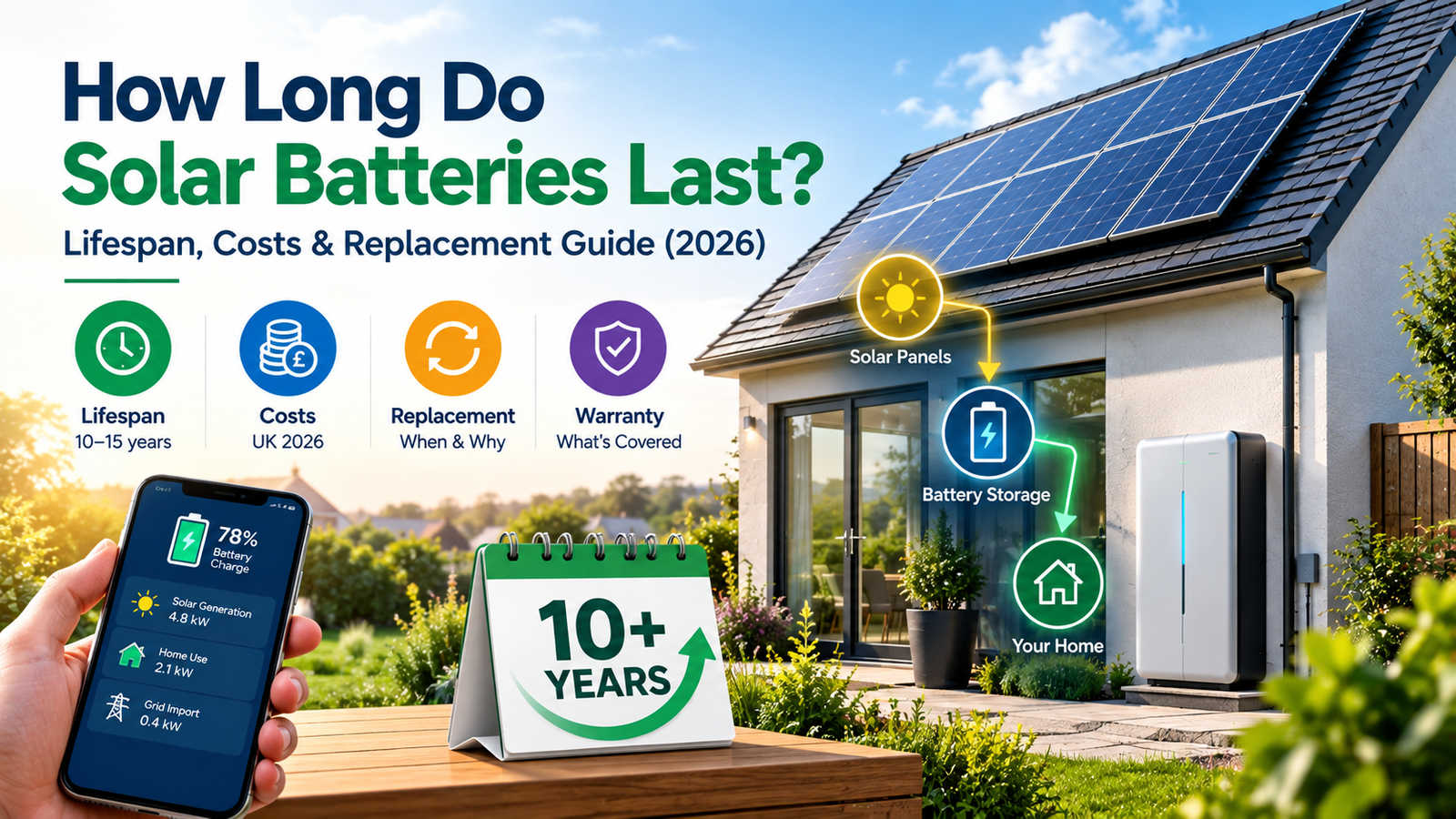
If you are thinking about installing a solar battery in your home, one question probably comes to mind first: how long will the battery actually last?
Solar panels can generate electricity for decades, but batteries have a shorter working life. That does not mean a solar battery suddenly stops working after a fixed number of years. Instead, its storage capacity gradually decreases as it goes through thousands of charging and discharging cycles.
So, how long do solar batteries last?
For most modern lithium-ion home batteries in the UK, a typical lifespan is around 10 to 12 years, although some systems are designed to operate for 10 to 15 years or more, depending on the battery chemistry, usage, temperature, installation quality and warranty terms.
This guide explains everything you need to know about solar battery lifespan, including degradation, cycle life, battery types, replacement costs, warranties and practical ways to make your battery last longer.
How Long Do Solar Batteries Last? Average Solar Battery Lifespan
The average modern solar battery lasts approximately 10 to 12 years under normal household use.
Some manufacturers and installers give a broader expected lifespan of 10 to 15 years, because actual battery life depends heavily on how the system is used and the conditions in which it operates.
A battery does not normally reach its “end of life” and stop working overnight.
Instead, imagine buying a new 10kWh battery. When it is new, it may be able to store close to its usable rated capacity. After years of daily cycling, the battery may hold less energy.
For example:
- New battery: around 10kWh usable capacity
- After degradation: around 8kWh usable capacity
- Later in its life: around 7kWh usable capacity
The exact figures depend on the battery and its warranty.
This gradual reduction is known as battery degradation.
The Energy Saving Trust currently puts the typical lifespan of battery storage at around 10 to 12 years, while other UK industry sources give a wider 10–15-year range for modern lithium-ion systems.
Solar Battery Lifespan at a Glance
| Factor | Typical expectation |
|---|---|
| Modern lithium-ion battery | Around 10–12 years |
| Some modern systems | Around 10–15 years |
| Typical product warranty | Around 10 years |
| Common performance warranty | Around 70% capacity after 10 years |
| High-cycle batteries | Around 6,000 cycles can be possible |
| Lead-acid batteries | Often around 3–7 years |
| Solar panel lifespan | Usually much longer than the battery |
These are general figures rather than guarantees. Always check the specific manufacturer’s warranty before buying a battery.
Solar Battery Lifespan: How Many Years Can You Expect?
A solar battery’s lifespan is influenced by much more than the number printed on its warranty.
Two batteries installed in different homes could have noticeably different real-world lifespans.
For example, a battery used gently in a cool, well-ventilated utility room may experience different ageing from one that is heavily cycled every day in a very hot environment.
The most important factors include:
- Battery chemistry
- Charging and discharging frequency
- Depth of discharge
- Operating temperature
- Battery size
- Installation quality
- Software and battery management
- Overall energy throughput
Modern lithium-ion batteries are popular for home energy storage because they offer good energy density, efficiency and cycle life.
However, “10 years” should not be interpreted as a promise that the battery will have 100% of its original capacity for ten years.
That is where the performance warranty becomes important.
Solar Battery Degradation: Why Do Batteries Lose Capacity?
Solar battery degradation is the gradual loss of the amount of energy a battery can store.
It starts from the beginning of the battery’s life and normally happens gradually rather than all at once. Sunsave explains that lithium-ion batteries gradually lose capacity, discharge performance and round-trip efficiency as they age.
Think about a smartphone battery.
A new phone may easily last all day. Several years later, the same phone might need charging much earlier.
A home battery experiences a similar type of ageing, although it is designed for much more demanding daily energy storage.
What Causes Battery Degradation?
Several processes inside the battery contribute to degradation.
Every time the battery charges and discharges, chemical reactions occur inside its cells. Over thousands of cycles, these reactions gradually reduce the battery’s ability to store and release energy.
Other factors can speed up degradation, including:
- Excessive heat
- Very cold conditions
- Frequent deep discharges
- High charging or discharge rates
- Poor installation
- Incorrect system settings
- Excessive cycling
- Poor thermal management
This is why choosing the right battery is only part of the process. Correct installation and suitable operating conditions also matter.
Solar Battery End of Life: What Happens After 10 Years?
A common misunderstanding is that a solar battery becomes completely useless after ten years.
That is not necessarily the case.
Instead, the battery may still operate while holding less energy than when it was new.
For example, suppose a battery originally provided 10kWh of usable capacity. If degradation reduces its effective capacity to around 70%, it may only provide roughly 7kWh under the relevant conditions.
The exact result depends on the manufacturer’s performance warranty and how capacity is measured.
Many battery warranties use a minimum retained-capacity figure. Sunsave reports that a common performance warranty structure guarantees around 70% of the original capacity after 10 years, although warranty terms differ between products.
At this stage, you have several options:
- Continue using the battery
- Monitor its performance
- Replace the battery
- Add additional compatible storage
- Upgrade the complete battery system
The right choice depends on the battery’s condition, your electricity usage and whether the system is still providing enough financial value.
Lithium-Ion Solar Battery Lifespan: How Long Do Lithium Batteries Last?
Lithium-ion solar batteries are currently among the most common choices for residential energy storage.
They typically offer a lifespan of around 10–12 years, with some systems and installations reaching the wider 10–15-year range.
Lithium-ion technology has several advantages for home energy storage:
- High energy density
- Good charging efficiency
- Relatively compact size
- Good cycle life
- Low routine maintenance
- Suitable for daily charging and discharging
Different lithium-ion chemistries also have different characteristics.
Two important examples are NMC (nickel manganese cobalt) and LFP (lithium iron phosphate).
The choice should not be based on lifespan alone. You should also consider usable capacity, power output, warranty, installation requirements, safety features, compatibility and total cost.
LiFePO4 Solar Battery Lifespan: Are They Longer Lasting?
LiFePO4, also known as LFP or lithium iron phosphate, is a type of lithium-ion battery chemistry increasingly used in home energy storage.
LFP batteries are known for their durability and strong cycle-life characteristics. Sunsave describes LFP as a newer lithium-ion option and notes that it can offer a longer lifespan than some other lithium-ion chemistries.
One reason homeowners consider LFP batteries is their suitability for frequent cycling.
However, don’t assume every LFP battery will automatically last longer than every NMC battery.
The actual lifespan depends on:
- Cell quality
- Battery management system
- Operating temperature
- Charging strategy
- Depth of discharge
- Daily energy throughput
- Manufacturer specifications
When comparing batteries, look at the complete warranty and cycle specification, rather than choosing a battery simply because it uses LFP chemistry.
Lead-Acid Solar Battery Lifespan: How Long Do They Last?
Lead-acid batteries are an older battery technology that has been used for energy storage for many years.
They can still be suitable for certain applications, but their lifespan is generally shorter than modern lithium-ion home batteries.
Sunsave reports that traditional lead-acid batteries typically last around three to seven years, compared with around 10–12 years for modern lithium-ion batteries.
Lead-acid batteries may also require more careful management depending on the specific type.
For a modern UK home solar installation, lithium-based storage is much more commonly considered because of its combination of usable capacity, efficiency, size and cycle life.
Solar Battery Cycle Life: How Many Charging Cycles Do Batteries Last?
Another way to understand battery lifespan is through cycle life.
A battery cycle generally refers to the amount of charging and discharging that represents one complete cycle.
However, one cycle does not necessarily mean charging from 0% to 100% and then immediately going from 100% to 0%.
Partial charging and discharging also contribute to cycle usage.
For example, if a battery is partly discharged and then charged again, that contributes to its overall energy throughput and cycling.
Some modern batteries can achieve around 6,000 cycles, although warranty limits and definitions vary between manufacturers.
How Long Is 6,000 Battery Cycles?
If a battery completed one full cycle every day:
6,000 cycles ÷ 365 days = approximately 16.4 years
But this calculation should not be used as a guaranteed battery lifespan.
Why?
Because battery warranties may have:
- A time limit
- A cycle limit
- An energy-throughput limit
- A minimum capacity requirement
Some warranties state something like 10 years or a certain number of cycles, whichever comes first.
Always read the actual warranty terms.
Solar Battery Depth of Discharge: Does DoD Affect Battery Life?
Depth of discharge (DoD) describes how much of a battery’s stored energy is used before it is charged again.
For example, if a battery has 10kWh of total capacity and you use 8kWh, you have discharged approximately 80% of its capacity.
A battery system may deliberately keep a reserve rather than allowing the battery to reach absolute zero.
This can help protect the battery and maintain its operating limits.
The Energy Saving Trust notes that battery systems may stop discharging when they reach a set minimum level rather than allowing the battery to discharge completely.
Why Does Depth of Discharge Matter?
Repeatedly pushing a battery to its limits can contribute to greater wear.
For this reason, manufacturers establish operating ranges designed to balance usable energy and battery longevity.
When comparing systems, check both:
- Total battery capacity
- Usable battery capacity
A 10kWh battery does not necessarily mean you can use the entire 10kWh every cycle.
Solar Battery Temperature: How Heat and Cold Affect Lifespan
Temperature is another important factor in solar battery life expectancy.
Batteries operate best within the temperature range specified by the manufacturer.
Very high temperatures can accelerate chemical degradation, while very cold conditions can affect charging and battery performance.
This is particularly important when deciding where to install a battery.
Possible installation locations include:
- Garage
- Utility room
- Suitable external wall
- Dedicated battery storage area
The correct location depends on the battery’s specifications and installation requirements.
Sunsave also notes that cold weather can accelerate certain battery degradation processes.
A professional installer should consider the environment before deciding where your battery should be installed.
Solar Battery Size: Does Battery Capacity Affect Lifespan?
Battery size does not automatically determine how many years a battery will last.
However, choosing the correct size can affect how heavily the battery is used.
Imagine two homes.
Home A
A home has a small battery but uses a large amount of electricity every evening. The battery may be cycled heavily.
Home B
A similar home has a larger battery that comfortably covers its normal evening demand.
The second battery may not need to work as hard under the same conditions.
This does not mean “bigger is always better.”
An oversized battery can increase your upfront cost without delivering enough additional value.
The goal is to choose a battery based on:
- Daily electricity consumption
- Solar generation
- Evening energy demand
- Electricity tariff
- Export payments
- Desired backup capacity
- Available installation space
- Future energy needs
For context, Geo Green Power says many UK homes use batteries in the 5kWh–10kWh range, although the appropriate size varies by household.
Solar Battery Installation: Does Installation Quality Affect Battery Life?
Yes. Battery installation quality matters.
A good battery can still deliver disappointing results if the system is poorly designed, incorrectly configured or installed in an unsuitable environment.
A professional installer should assess:
- Existing solar panels
- Inverter compatibility
- Battery capacity
- Maximum charging and discharge power
- Electrical connections
- Installation location
- Ventilation and temperature
- Backup requirements
- Your household electricity use
If you already have solar panels, compatibility is particularly important.
Some batteries can be added to existing solar systems, but the installer needs to check the system architecture and inverter requirements first.
The Energy Saving Trust recommends getting quotes from at least three MCS-certified installers when installing energy storage.
Solar Battery Cost UK 2026: How Much Does Battery Storage Cost?
The cost of a solar battery installation depends on its capacity, chemistry, brand, inverter requirements, installation complexity and whether other equipment needs upgrading.
There is no single price that applies to every UK home.
You should compare the total installed cost, not simply the price of the battery itself.
Your quote may include:
- Battery unit
- Inverter
- Mounting equipment
- Electrical protection
- Installation labour
- Cabling
- Commissioning
- Monitoring equipment
- Additional hardware
- VAT, where applicable
The Energy Saving Trust advises homeowners to compare the installation cost with expected savings and the battery’s lifespan before committing to a system.
What Should You Ask an Installer?
Before accepting a quote, ask:
- What is the battery’s usable capacity?
- What is the expected lifespan?
- What is the product warranty?
- What is the performance warranty?
- What capacity will the battery retain after 10 years?
- How many cycles are covered?
- Is there an energy-throughput limit?
- What happens if the battery fails?
- Is the inverter included?
- Is the installer MCS-certified?
Getting several quotes can make it easier to identify differences in equipment, installation and warranty terms.
Solar Battery Replacement Cost UK: How Much Will a New Battery Cost?
There is no universal solar battery replacement cost in the UK because the price depends on the battery capacity, model and installation requirements at the time you replace it.
The replacement may also involve more than simply removing the old battery and installing a new one.
For example, you might need:
- A new battery
- Compatible inverter
- New cables or protection
- Updated control equipment
- Labour
- System configuration
- Removal of old equipment
The good news is that battery technology may improve between your original installation and the replacement.
For example, a homeowner who installs a battery in 2026 may replace it around the mid-to-late 2030s. The technology, prices and available features at that time could be different.
Therefore, it is sensible to treat battery replacement as a future system cost, rather than assuming the first battery will last as long as the solar panels.
Solar Battery Warranty: What Does a 10-Year Warranty Cover?
A 10-year solar battery warranty is common, but you should read the conditions carefully.
There are usually two important types of warranty:
Product Warranty
This generally relates to defects or problems with the battery hardware.
Performance Warranty
This relates to how much capacity the battery is expected to retain over a specified period.
These warranties are not the same.
A battery could still be working after ten years while having significantly less usable capacity than when it was new.
Sunsave’s 2026 analysis of more than 60 battery models found that a typical product warranty is around 10 years, although individual products can differ.
Solar Battery Performance Warranty: How Much Capacity Should Remain?
The performance warranty is one of the most important parts of a battery purchase.
For example, a manufacturer might guarantee that the battery retains a certain percentage of its original capacity after a specific number of years.
A common benchmark is around 70% retained capacity after 10 years, but this is not universal.
Suppose your battery originally has 10kWh of relevant capacity.
If the warranty specifies 70% capacity retention, that would mean:
10kWh × 70% = 7kWh
That does not mean every battery will reach exactly 7kWh at ten years.
It simply demonstrates how a capacity-retention warranty can work.
Before buying, look at the warranty document rather than relying only on a salesperson’s headline claim.
Solar Battery Replacement: When Should You Replace Your Battery?
You do not necessarily need to replace a solar battery simply because it reaches its tenth birthday.
Instead, look at its actual performance.
Signs that replacement may be worth considering include:
- Noticeably lower usable capacity
- Reduced ability to cover evening demand
- Frequent system faults
- Significant performance decline
- Expired warranty
- Increasing maintenance issues
- Compatibility problems with other equipment
- Poor financial value compared with a newer battery
For example, suppose your battery originally covered most of your evening electricity use.
Years later, it may only cover a small part of your evening demand.
At that point, replacing the battery could make more sense than continuing to use an ageing system.
However, you should compare the replacement cost with the savings you expect to receive.
How to Extend Solar Battery Lifespan: 7 Practical Tips
You cannot stop battery ageing completely, but good operating conditions can help your battery reach its expected lifespan.
1. Avoid Extreme Temperatures
Install the battery in a location that meets the manufacturer’s temperature and environmental requirements.
2. Follow the Manufacturer’s Settings
Do not change battery settings without understanding what they do.
The battery management system is designed to control charging and discharging safely.
3. Avoid Unnecessary Deep Discharges
Use the manufacturer’s recommended operating range and minimum reserve.
4. Choose the Correct Battery Size
A correctly sized battery can help match storage capacity with your household energy needs.
5. Keep Firmware Updated
Some manufacturers provide software or firmware updates that can improve system management and performance.
6. Monitor Battery Performance
Keep an eye on:
- State of charge
- Usable capacity
- Charging behaviour
- Fault messages
- Energy throughput
If performance changes suddenly, contact your installer or manufacturer.
7. Use a Qualified Installer
Correct installation is essential for safe and reliable operation.
The Energy Saving Trust recommends comparing multiple quotes from MCS-certified installers.
Solar Battery vs Solar Panel Lifespan: Which Lasts Longer?
One of the biggest differences between solar panels and batteries is their expected lifespan.
Solar panels can continue generating electricity for several decades, while batteries normally need replacement sooner.
Sunsave estimates that monocrystalline solar panels can last around 30–40 years, compared with around 10–12 years for typical lithium-ion battery storage.
That means a homeowner could potentially replace the battery two or even three times during the lifetime of the solar panels.
This is important when calculating the long-term economics of a solar-plus-battery system.
Don’t only ask:
“How much will my solar battery cost?”
Also ask:
“How much will the system cost over its entire useful life?”
Are Solar Batteries Worth It in the UK in 2026?
Whether a solar battery is worth installing depends on your individual electricity use, solar generation, tariff and installation cost.
A battery can store surplus solar electricity during the day and make it available later when your solar panels are producing less.
It can also work with time-of-use electricity tariffs, allowing some households to charge during cheaper periods and use the stored electricity later.
However, battery storage is not automatically financially beneficial for every household.
The Energy Saving Trust specifically recommends weighing potential savings against the upfront installation cost and expected battery lifespan.
A Solar Battery May Be More Useful If:
- You generate more solar electricity than you use during the day.
- You use a lot of electricity in the evening.
- You have a suitable time-of-use tariff.
- You want to increase solar self-consumption.
- You want some form of backup power and choose a compatible system.
- Your battery installation cost is reasonable.
It May Be Less Attractive If:
- Your solar generation is already used efficiently during the day.
- Your electricity consumption is very low.
- Your battery is significantly oversized.
- The installation cost is high compared with expected savings.
- Your electricity tariff does not provide useful off-peak pricing.
The best decision comes from looking at your own energy data rather than simply following a generic battery-size recommendation.
How to Choose a Solar Battery: A Step-by-Step Buying Guide
If you are considering a battery for your UK home, use this simple process.
Step 1: Check Your Electricity Usage
Look at your annual and daily electricity consumption.
Try to identify how much electricity you normally use in the evening.
Step 2: Check Your Solar Generation
If you already have solar panels, look at how much electricity you export during the day.
A large amount of daytime surplus could indicate that storage may be useful.
Step 3: Choose the Right Capacity
Do not automatically choose the largest battery.
Compare your energy use with the battery’s usable capacity.
Step 4: Compare Battery Chemistry
Look at lithium-ion options and understand the differences between chemistries such as NMC and LFP.
Step 5: Check the Cycle Rating
Look at the manufacturer’s stated cycle life and how it relates to the warranty.
Step 6: Read the Warranty
Check:
- Product warranty
- Performance warranty
- Capacity guarantee
- Cycle limit
- Energy-throughput limit
- Warranty exclusions
Step 7: Check Inverter Compatibility
If you already have solar, make sure the proposed battery works with your existing system or understand whether a new inverter is required.
Step 8: Compare Installation Quotes
Get several quotes and compare the complete installed price, not only the battery price.
The Energy Saving Trust recommends obtaining at least three quotes from MCS-certified installers.
Step 9: Calculate Long-Term Value
Finally, compare:
Installation cost + future replacement costs − expected energy savings
This gives you a more realistic picture of the long-term investment.
Frequently Asked Questions About Solar Battery Lifespan
How Long Do Solar Batteries Last?
Most modern lithium-ion solar batteries last around 10–12 years, although some systems can operate for 10–15 years or more depending on the battery, usage and operating conditions.
Do Solar Batteries Need Replacing After 10 Years?
Not necessarily on the exact tenth anniversary. Around 10 years is a common point at which performance may have declined significantly, but the battery can continue operating if it still provides useful capacity and remains safe and supported.
Can a Solar Battery Last 20 Years?
A 20-year working life is not the typical expectation for a modern residential lithium-ion solar battery. Most guidance places typical lifespan closer to 10–12 years, with some systems reaching the wider 10–15-year range.
How Long Do Lithium Solar Batteries Last?
Modern lithium-ion solar batteries typically last around 10–12 years under normal conditions. Some manufacturers and installers give a broader expected lifespan of 10–15 years.
How Long Do Lead-Acid Solar Batteries Last?
Traditional lead-acid solar batteries generally have a shorter lifespan, often around three to seven years, depending on use and maintenance.
How Many Cycles Does a Solar Battery Last?
Some modern lithium-ion batteries can reach around 6,000 cycles, but the actual figure depends on the model and its warranty conditions. A cycle rating should not be treated as a guaranteed number of years.
How Much Does a Solar Battery Cost in the UK?
There is no single UK price because the total cost depends on battery capacity, brand, inverter requirements, installation complexity and other equipment. Compare complete installed quotes rather than the battery price alone.
How Much Does It Cost to Replace a Solar Battery?
The replacement cost depends on the battery capacity, technology, model, labour and whether other system components need replacing. The future price may also differ significantly from today’s installation prices.
How Can I Extend My Solar Battery Lifespan?
Use the battery according to the manufacturer’s recommended settings, avoid unsuitable temperatures, avoid unnecessary deep discharge, monitor system performance and use a qualified installer.
Final Verdict: How Long Do Solar Batteries Last?
So, how long do solar batteries last?
For most UK homeowners using modern lithium-ion storage, around 10–12 years is a sensible typical expectation, while some batteries may operate effectively for 10–15 years or more depending on their design and conditions.
The most important thing to remember is that a battery does not normally go from “perfect” to “dead” overnight.
Instead, capacity gradually falls over time.
If you are buying a solar battery in 2026, don’t focus only on the advertised capacity or upfront price. Look at the complete picture:
- Expected lifespan
- Usable capacity
- Cycle life
- Depth of discharge
- Battery chemistry
- Temperature range
- Product warranty
- Performance warranty
- Installation quality
- Replacement cost
A good battery should be matched to your home’s actual energy use rather than simply being the biggest model available.
And because solar panels can last considerably longer than batteries, remember to include future battery replacement when thinking about the long-term cost of your solar energy system.
For homeowners who want to make a sensible decision, the best starting point is simple: understand your electricity use, compare several battery systems, read the warranty carefully and get multiple professional installation quotes.