
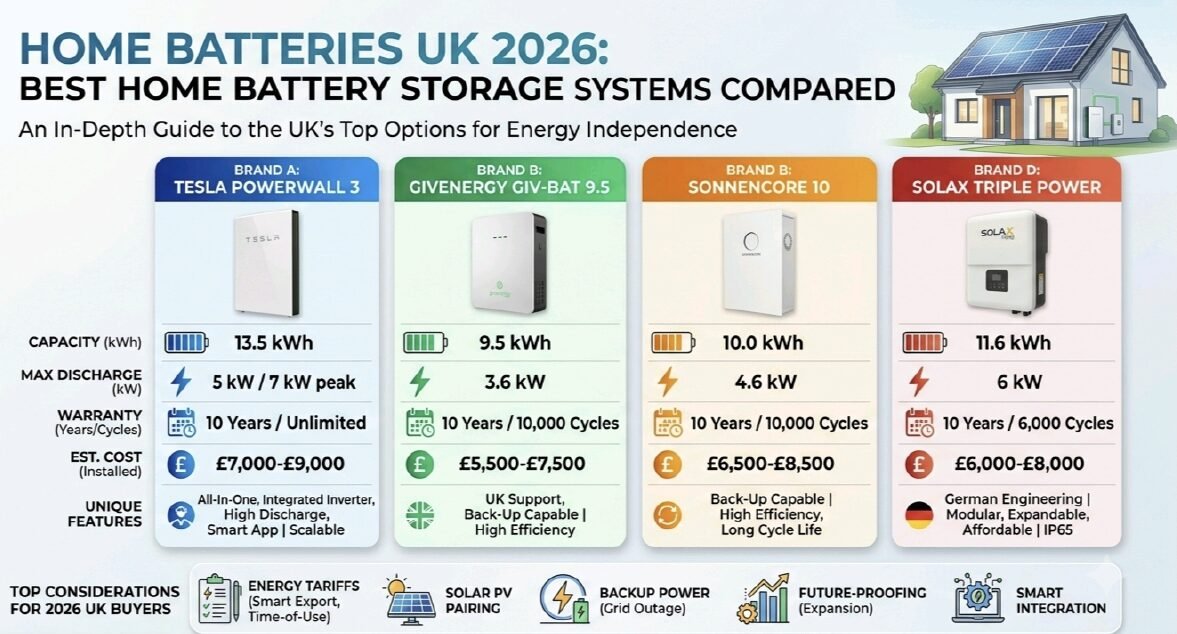
If you are looking for a way to make better use of solar energy, reduce electricity costs, or become less dependent on the grid, home batteries are worth considering.
A home battery storage system allows you to store electricity and use it later when your home needs it. For households with solar panels, this can be particularly useful because excess electricity generated during the day can be stored instead of being exported to the grid.
However, choosing the best home battery in the UK is not simply about buying the battery with the largest capacity. You also need to consider usable capacity, power output, installation cost, warranty, efficiency, backup power, solar compatibility and electricity tariffs.
In this guide, we compare some of the leading home batteries UK 2026 options and explain what you should know before buying a battery storage system.
Home Battery Storage UK: What Is a Home Battery?
A home battery storage system is designed to store electricity for use at a later time.
For example, if your solar panels produce more electricity than your home needs during the afternoon, the excess electricity can be used to charge your battery.
Later in the evening, when your solar panels are producing little or no electricity, the stored energy can be used to power your home.
The basic process is:
- Solar panels generate electricity.
- Your home uses the electricity it needs.
- Excess electricity charges the battery.
- The battery stores the energy.
- Your home uses the stored electricity later.
- The grid supplies additional electricity when the battery is empty.
This can increase your solar self-consumption and potentially reduce the amount of electricity you need to buy from the grid.
Importantly, you do not always need solar panels to use a home battery. Some systems can charge from the grid, which can be useful when combined with a time-of-use electricity tariff.
How Home Battery Storage Works in the UK
Modern home batteries are more advanced than simple energy storage devices.
A typical system can include a battery, inverter, battery management system, monitoring software and safety equipment.
Your solar panels generate DC electricity, while most household appliances use AC electricity. The inverter manages the conversion between these forms of electricity.
Imagine a typical summer afternoon.
Your solar panels are producing 4 kW, but your home is only using 1.5 kW. Instead of sending all the remaining electricity to the grid, the system can use the surplus to charge your battery.
Later, at 7 pm, your solar production may have fallen considerably. The battery can then discharge and provide electricity for your home.
This is one of the main reasons solar battery storage UK systems are becoming increasingly popular.
Best Home Batteries UK 2026: Top Systems Compared
There is no single battery that is perfect for every home.
A small household with low electricity consumption may only need a 5 kWh battery, while a larger home with an EV, heat pump and high electricity consumption could benefit from 10–20 kWh or more.
Here are several home battery systems worth considering in 2026.
Tesla Powerwall 3: Best Premium Home Battery
Tesla Powerwall 3 is one of the best-known premium home battery systems available in the UK.
It provides 13.5 kWh of energy capacity and includes an integrated solar inverter. Tesla also provides a 10-year warranty for Powerwall 3.
One of the main advantages of Powerwall 3 is that it combines battery storage and solar inverter technology in one system, which can make it particularly attractive for suitable new solar installations.
Key advantages include:
- 13.5 kWh capacity
- Integrated solar inverter
- Strong power output
- Home backup capability
- App-based energy monitoring
- 10-year warranty
- Expandable storage options
The main disadvantage is the higher upfront cost compared with some modular battery systems.
Best for: Homeowners looking for a premium battery with strong performance, monitoring and backup capabilities.
Fox ESS: Best Value Home Battery Storage
Fox ESS offers a range of battery and inverter solutions for residential energy storage.
One of the advantages of a modular battery system is flexibility. Depending on the model, homeowners can select a storage capacity that suits their energy requirements and potentially expand the system later.
Fox ESS is also often considered by homeowners looking for a balance between battery capacity and installation cost.
Best for: Homeowners looking for competitive pricing and flexible storage options.
Sunsynk: Flexible Home Battery System
Sunsynk is another recognised name in the solar and battery storage market.
Its products can provide flexible options for homeowners who want to combine solar generation, battery storage and smart energy management.
The exact system configuration depends on the battery, inverter and installation design.
Therefore, when comparing Sunsynk with another battery brand, it is important to compare the complete installed system, rather than just the battery price.
Best for: Homeowners who want flexibility and a system that can be designed around their existing solar installation.
BYD Battery-Box: Premium Modular Home Battery Storage
BYD Battery-Box is a modular energy-storage solution designed for residential applications.
Its modular design allows storage capacity to be configured according to the requirements of the installation.
Another advantage is its compatibility with different inverter platforms, although compatibility should always be confirmed before purchasing.
Best for: Homeowners looking for a premium modular battery solution.
myenergi libbi: Best for the myenergi Ecosystem
The myenergi libbi is particularly interesting for homeowners who already use products such as the myenergi zappi EV charger or eddi energy diverter.
libbi is available in different configurations, with systems ranging from 5 kWh to 20 kWh.
The system can be managed through the myenergi ecosystem, making it attractive to households that want their solar, battery and EV energy management to work together.
Best for: Homeowners who already use myenergi products or want an integrated home energy ecosystem.
Best Home Batteries UK 2026: Quick Comparison
| Battery | Capacity | Best For | Main Advantage |
|---|---|---|---|
| Tesla Powerwall 3 | 13.5 kWh | Premium homes | Integrated inverter and strong backup |
| Fox ESS | Modular | Value buyers | Flexible storage |
| Sunsynk | Modular | Flexible installations | System flexibility |
| BYD Battery-Box | Modular | Premium installations | Modular design |
| myenergi libbi | 5–20 kWh | myenergi users | Integrated ecosystem |
Battery specifications, availability and installation prices can change, so always check the exact model before buying.
Home Battery Storage Cost UK: How Much Does a Battery Cost?
The home battery storage cost UK homeowners pay depends on several factors.
These include:
- Battery capacity
- Battery brand
- Inverter requirements
- Installation complexity
- Electrical work
- Backup equipment
- Existing solar system
- Battery location
- Additional equipment
As a general 2026 guide, installed systems can range from a few thousand pounds for smaller batteries to £10,000 or more for large premium systems.
A rough guide is:
| Battery Size | Typical Installed Cost |
|---|---|
| 3–5 kWh | £2,500–£4,000 |
| 5–10 kWh | £3,500–£7,000 |
| 10–15 kWh | £5,000–£9,000 |
| 15–20 kWh | £8,000–£13,000+ |
These are indicative ranges, not guaranteed prices.Your final quotation could be different depending on the equipment and installation work required.
Why Do Home Battery Prices Vary?
Two homeowners can receive very different quotes for what appears to be the same battery capacity.
One installation might require a new inverter, additional electrical work and backup equipment.
Another might be a straightforward installation using existing equipment.
For this reason, always compare the total installed price, not just the battery itself.
Solar Battery Storage UK: How Batteries Work With Solar Panels
For many homeowners, the biggest benefit of a battery is the ability to store surplus solar electricity.
Without a battery, your solar panels may generate more electricity than your home can use during the day.
That excess electricity can be exported to the grid.
With a battery, some of the surplus can instead be stored for later.
For example:
Afternoon: Solar generation is high → battery charges.
Evening: Solar generation falls → battery supplies electricity.
Night: Stored electricity can continue powering the home until the battery reaches its minimum state of charge.
This can help increase your solar self-consumption.
However, a battery does not automatically make every solar installation financially worthwhile.
You should consider:
- Your annual solar generation
- Household electricity consumption
- Export payments
- Import electricity prices
- Battery efficiency
- Battery cost
- Battery degradation
- Electricity tariff
Home Battery Size: What Size Battery Do You Need?
Choosing the right home battery size is one of the most important decisions you will make.
A bigger battery is not automatically better.
If your household only uses a small amount of electricity overnight, installing a very large battery may leave much of its capacity unused.
On the other hand, a larger household with an EV, heat pump and high electricity consumption may benefit from additional storage.
A basic starting point could look like this:
| Household | Possible Battery Size |
|---|---|
| Small household | 3–5 kWh |
| Typical family | 5–10 kWh |
| Large household | 10–15 kWh |
| High electricity use | 15–20 kWh+ |
These figures are only a starting point.
The best battery size should be based on your actual electricity consumption and solar generation.
Home Battery Capacity vs Power: What Is the Difference?
When comparing batteries, you will see two important numbers:
Capacity — kWh
Power — kW
They are not the same thing.
Battery capacity tells you how much energy the battery can store.
Power output tells you how quickly the battery can supply electricity.
For example, a battery could have:
- 10 kWh capacity
- 5 kW power output
This means the battery can store a significant amount of energy while being capable of delivering up to a certain amount of power at once.
This distinction matters because high-power appliances can require significant electricity.
Therefore, don’t compare batteries based only on kWh capacity.
Always check the battery’s continuous and peak power output as well.
Home Battery Backup: Can a Battery Power Your Home During a Blackout?
Some batteries can provide backup power, but not every battery installation automatically provides backup.
Additional hardware and appropriate installation may be required.
There is also a difference between whole-home and partial-home backup.
Whole-Home Backup
A suitable system can be designed to supply power to most or all household circuits during an outage.
Partial-Home Backup
Only selected circuits are protected.
For example, an installer might connect essential circuits such as:
- Refrigerator
- Internet router
- Lighting
- Security system
- Selected sockets
If backup power is important to you, ask your installer:
“Which appliances and circuits will continue working during a power cut?”
Do not assume that buying a battery automatically means your entire house will remain powered.
LFP Home Batteries: Are Lithium Iron Phosphate Batteries Safe?
Many modern energy-storage systems use lithium battery technology.
Lithium iron phosphate (LFP) is one chemistry used in energy-storage applications.
LFP batteries are known for their durability and thermal characteristics, but battery safety depends on the complete system and installation.
A professionally installed battery should have appropriate:
- Battery management
- Electrical protection
- Isolation equipment
- Monitoring
- Ventilation or installation clearances where required
- Manufacturer-approved installation procedures
Never modify or install a home battery system yourself unless you have the appropriate qualifications.
Home Battery Warranty and Lifespan: How Long Do Batteries Last?
Battery warranties vary between manufacturers and models.
Many residential batteries come with warranties of around 10 years, but the details can be very different.
When comparing warranties, don’t look only at the number of years.
Check:
- Warranty length
- Minimum capacity guarantee
- Cycle limitations
- Operating conditions
- Replacement terms
- Inverter warranty
- Labour coverage
- UK warranty support
For example, Tesla lists a 10-year warranty for Powerwall 3.
The important point is to read the warranty conditions for the exact model you are buying.
Battery Storage Without Solar Panels: Is It Worth It?
You don’t necessarily need solar panels to use a home battery.
A battery can potentially charge from the electricity grid during cheaper periods and discharge during more expensive periods.
This can be particularly interesting with a time-of-use tariff.
For example:
Cheap electricity period: Battery charges.
Expensive electricity period: Battery supplies the home.
However, the financial benefit depends on the difference between electricity prices, battery efficiency, charging limits and your household consumption.
Therefore, calculate the potential savings before investing.
Home Battery Savings UK: How Much Can You Save?
It is impossible to give one guaranteed annual saving for every UK home.
Your potential savings depend on how you use the battery.
A home battery may help by:
- Increasing solar self-consumption
- Reducing electricity imports
- Charging during cheaper tariff periods
- Discharging during expensive periods
- Reducing reliance on peak electricity prices
However, batteries also have conversion losses and degradation.
This means that not every unit of electricity put into a battery will come back out as usable electricity.
For this reason, you should calculate the expected savings based on usable capacity and round-trip efficiency, rather than relying on the headline battery size.
Time-of-Use Tariffs and Home Batteries: Can They Reduce Bills?
A time-of-use electricity tariff charges different prices at different times.
This can create an opportunity for battery owners.
For example, if electricity is cheaper overnight, the battery can potentially charge during that period and supply the home during more expensive hours.
Solar households can also combine solar generation with time-of-use charging.
However, electricity tariffs can change.
Before choosing a tariff, check:
- Cheap-rate hours
- Peak electricity prices
- Standing charge
- Export rates
- Battery compatibility
- Charging restrictions
The cheapest tariff is not necessarily the best tariff for every battery owner.
AC-Coupled vs DC-Coupled Home Batteries: Which Is Better?
You may come across the terms AC-coupled and DC-coupled when researching home batteries.
AC-Coupled Batteries
An AC-coupled battery is connected on the AC side of the electrical system.
This can be useful for retrofit solar installations, particularly when you already have solar panels and an existing inverter.
DC-Coupled Batteries
A DC-coupled system connects more directly with the solar generation side before electricity is converted to AC.
This can be attractive for some new solar-and-storage installations.
Neither design is automatically better for every home.
The right option depends on your:
- Existing solar system
- Inverter
- Battery
- Solar generation
- Electricity consumption
- Installation requirements
How to Choose the Best Home Battery in the UK
Before choosing a brand, understand your home’s energy requirements.
1. Check Your Electricity Usage
Start with your electricity bills or smart-meter data.
Look at how much electricity you use during:
- Daytime
- Evening
- Overnight
- Weekends
This information will help you choose a suitable battery capacity.
2. Calculate Your Required Battery Capacity
Compare your electricity usage with your expected solar surplus.
A battery should be large enough to provide useful storage without being unnecessarily oversized.
3. Compare Usable Capacity and Power
Look at both:
Usable capacity: How much energy you can actually use.
Power output: How much electricity the battery can supply at one time.
4. Check the Warranty
Read the warranty carefully.
Look for capacity retention, cycle limits and replacement conditions.
5. Consider Backup Power
If you want backup power during outages, make sure the system is specifically designed for it.
Ask whether you are getting:
- Whole-home backup
- Partial-home backup
- Automatic changeover
- Manual backup operation
6. Compare the Complete Installation Price
Ask for a detailed quotation covering:
- Battery
- Inverter
- Installation
- Electrical work
- Backup equipment
- Monitoring
- VAT
- Any additional equipment
Getting two or three quotes can make it easier to compare your options.
Home Battery Installation UK: What Should You Ask an Installer?
Before signing a contract, ask the installer:
- What is the usable battery capacity?
- What is the continuous power output?
- Can the battery charge from the grid?
- Which electricity tariffs can it work with?
- Can it provide backup power?
- Which circuits will be backed up?
- What inverter is included?
- Can I expand the battery later?
- What exactly does the warranty cover?
- What is the total installed price?
A good installer should be able to explain the system without relying on confusing technical language.
Home Battery Storage Cost vs Long-Term Value
The cheapest battery is not necessarily the best battery.
For example, imagine two systems.
System A costs £4,000 but has limited power output and fewer features.
System B costs £6,000 but offers higher usable capacity, stronger power output, better monitoring and a longer warranty.
The second system costs more initially, but it could potentially provide greater long-term value depending on how it is used.
This is why you should compare cost per usable kWh, not simply the purchase price.
However, even cost per kWh is not enough.
The battery also needs to be compatible with your solar system, inverter, electricity tariff and backup requirements.
Are Home Batteries Worth It in the UK in 2026?
For many UK households, home batteries can be a worthwhile investment in 2026.
They can be particularly attractive if you have:
- Solar panels
- High evening electricity consumption
- An EV
- A heat pump
- A suitable time-of-use tariff
- A desire for backup power
However, a battery may provide less value if your electricity consumption is very low or if you already receive attractive payments for exporting most of your solar electricity.
The best way to decide is to calculate your expected annual savings and compare them with the total installed battery cost.
Best Home Batteries UK 2026: Final Verdict
The best home battery in the UK depends on your individual energy needs.
Tesla Powerwall 3 is a strong premium option for homeowners looking for high capacity, integrated technology and backup capability.
Fox ESS can be attractive for buyers looking for flexible and competitive storage options.
Sunsynk is worth considering when flexibility is important.
BYD Battery-Box offers a modular approach for suitable installations.
myenergi libbi is particularly interesting for homeowners already using the myenergi ecosystem.
However, the most important thing is not choosing the battery with the biggest capacity.
Instead, choose a system that matches your:
- Electricity consumption
- Solar generation
- Battery capacity requirements
- Power requirements
- Electricity tariff
- Backup needs
- Budget
- Long-term energy goals
A properly sized home battery storage system can help you make better use of renewable electricity, reduce grid imports and gain greater control over your home’s energy use.
Before buying, compare several complete installation quotes and carefully check the battery’s usable capacity, power output, warranty, efficiency and compatibility.
Frequently Asked Questions About Home Batteries UK
What is the best home battery in the UK in 2026?
There is no single best battery for every home. Tesla Powerwall 3, Fox ESS, Sunsynk, BYD Battery-Box and myenergi libbi are all worth considering, depending on your budget and energy requirements.
How much does a home battery cost in the UK?
The cost can range from a few thousand pounds for a smaller system to £10,000 or more for larger premium installations. Installation requirements and equipment can significantly affect the final price.
Is a 5 kWh battery enough for a home?
A 5 kWh battery can be suitable for a smaller household or a home with relatively low electricity consumption. Larger households may need more storage.
Can I use a battery without solar panels?
Yes. Some battery systems can charge from the electricity grid, particularly when used with a suitable time-of-use tariff.
How long do home batteries last?
Many residential batteries come with warranties of around 10 years, although the actual lifespan depends on the battery model, usage and operating conditions.
Can a home battery work during a power cut?
Some systems can provide backup power, but additional equipment and the correct installation configuration may be required.
Should I buy the biggest home battery available?
No. Battery size should be based on your electricity consumption and solar generation. An oversized battery may not provide the best financial return.
What should I compare when buying a home battery?
Compare usable capacity, power output, installed cost, warranty, efficiency, inverter compatibility, backup capability, tariff compatibility and expansion options.
Final Takeaway
A home battery can be an excellent addition to a UK energy system, particularly when it is correctly sized and matched with your solar panels or electricity tariff.
Don’t choose a battery simply because it has the highest kWh capacity or the lowest price.
Instead, look at the whole system and its long-term value.
The right battery can help you store excess solar electricity, use cheaper electricity more effectively and reduce your dependence on expensive grid power.
For UK homeowners considering battery storage in 2026, the smartest first step is simple:
Understand your energy usage, compare suitable systems and get professional installation quotes before making your decision.

Finally found a platform that takes the gaming experience seriously without the usual hassle. The interface is clean and everything loads quickly. I already recommended it to my circle. idmpo08
This gaming hub has completely changed how I approach online entertainment. The variety of live dealer tables is impressive and the payout speed is honestly unmatched in this space. Highly recommend giving it a spin. naga15gaming
Solid performance and very fair gameplay. I’ve had some great wins here recently. Definitely give id838win a shot if you want some real excitement.