
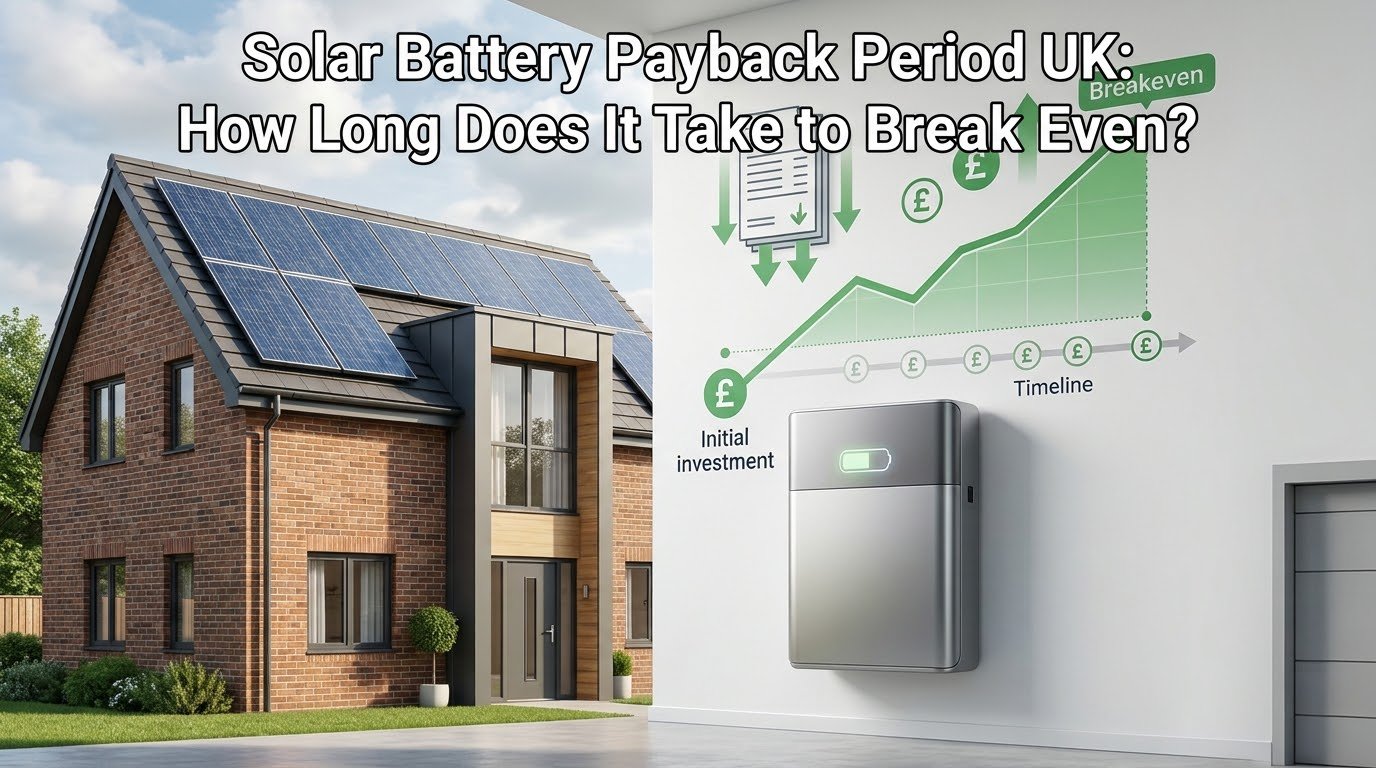
The solar battery payback period UK homeowners can expect depends on much more than the battery’s purchase price. Your electricity usage, solar panel output, battery size, energy tariff, export rate and the amount of stored electricity you actually use can all change the result.
For one household, a battery could make financial sense relatively quickly. For another, the same battery might take considerably longer to pay for itself.
That is why there is no single payback figure that applies to every UK home.
The good news is that working out an estimated payback period is not particularly difficult once you understand the numbers. In this guide, we explain how solar battery payback works, what affects it, how to calculate it and whether battery storage can still be a worthwhile investment in the UK in 2026.
Key Takeaways
- The solar battery payback period UK homeowners achieve varies from property to property.
- A simple payback calculation is based on the battery’s net installed cost divided by annual savings.
- Using more of your own solar electricity can increase the value of battery storage.
- Time-of-use tariffs can potentially improve battery economics when charging and discharging are managed correctly.
- A battery that is too large can reduce your return because you may not use enough of its capacity.
- Battery degradation, efficiency and future energy prices should be considered in a realistic calculation.
- Don’t choose a battery simply because it has a larger capacity. Choose one that matches your electricity consumption and solar generation.
- The cheapest battery is not necessarily the battery with the fastest payback.
What Is a Solar Battery Payback Period?
The solar battery payback period is the estimated amount of time required for the financial benefits of a battery to recover its initial cost.
In simple terms:
Payback Period = Net Battery Cost ÷ Annual Financial Benefit
For example, imagine you pay £5,000 for a battery and it produces an estimated £625 of annual savings.
£5,000 ÷ £625 = 8 years
Your simple estimated payback period would therefore be around 8 years.
But real life is rarely that simple.
A battery doesn’t automatically save the same amount of money every year. Your solar generation changes with the seasons, electricity prices can change, battery efficiency isn’t 100%, and battery capacity can gradually decline.
That’s why a good payback calculation should use realistic household data rather than simply dividing the battery price by an optimistic savings figure.
How Long Does a Solar Battery Take to Pay for Itself in the UK?
There is no guaranteed payback period for every UK home.
A useful starting point is to model different scenarios rather than relying on one headline number. Recent UK industry examples show battery payback estimates can vary significantly depending on system cost, annual savings and tariff assumptions. For example, one 2026 example uses a £5,200 battery investment and an estimated annual benefit of £780, producing a simple payback of about 6.7 years.
Another recent UK analysis suggests a properly sized home battery may often fall into a broad 7–15 year range, although that should be treated as an illustrative range rather than a promise.
Your actual result could be shorter or longer.
A battery could pay back faster if you:
- Use a lot of electricity in the evening
- Have plenty of surplus solar generation during the day
- Have a suitable time-of-use electricity tariff
- Regularly cycle the battery
- Have a relatively high electricity import price
- Avoid exporting large amounts of solar electricity at a low rate
- Choose a battery that is correctly sized for your home
Payback could take longer if you:
- Use very little electricity
- Already consume most of your solar electricity during the day
- Buy an unnecessarily large battery
- Have limited solar surplus
- Rarely cycle the battery
- Pay a high installation price
- Receive a strong export payment that makes exporting more attractive
The important point is this:
Your neighbour’s battery payback period may have very little to do with yours.
Why Do Solar Batteries Have a Financial Benefit?
During a sunny day, your solar panels can produce more electricity than your home needs.
Without a battery, that unused electricity may be exported to the grid.
With a battery, some of that surplus electricity can be stored and used later.
Imagine your solar panels generate 5kWh of surplus electricity at 1pm.
You aren’t using much power because everyone is at work or school.
Instead of exporting all 5kWh, your battery can store some of it.
At 7pm, the family is home. The cooker is running, lights are on, the TV is being used and other appliances are consuming electricity.
Your battery can then supply stored energy rather than you buying as much electricity from the grid.
This is where the financial value of a battery comes from.
Solar Battery Payback Formula
The basic calculation is straightforward:
Solar Battery Payback Period = Net Installed Battery Cost ÷ Annual Battery Savings
For example:
- Battery and installation: £5,000
- Estimated annual savings: £600
- Payback: £5,000 ÷ £600
- Estimated payback: 8.3 years
But there’s an important detail.
You should calculate the net cost rather than simply looking at the advertised battery price.
Your actual investment could include:
- Battery
- Inverter or hybrid inverter
- Installation
- Wiring and protection equipment
- Backup equipment, if required
- Additional electrical work
- Monitoring or control equipment
- Any other installation-related costs
Likewise, your annual financial benefit can come from more than one source.
What Counts Towards Annual Battery Savings?
A battery can potentially provide financial value in several ways.
1. Using More of Your Own Solar Electricity
This is one of the biggest reasons homeowners install batteries.
Instead of exporting surplus solar during the afternoon and buying electricity again in the evening, you can store some of that energy for later.
The financial benefit comes from avoiding some grid electricity purchases.
2. Charging During Cheaper Tariff Periods
Some UK electricity tariffs offer cheaper electricity at certain times.
A compatible battery system may be able to charge during a cheaper period and provide electricity later when the price is higher.
However, this strategy needs careful calculation.
The battery isn’t creating free electricity.
You are buying electricity at one price, storing it with some losses and then using it later.
The price difference needs to be large enough to make the process worthwhile after considering efficiency, standing charges, tariff rules and battery wear.
3. Exporting Excess Electricity
If your solar system produces more electricity than your home and battery can use, you may be able to export the surplus.
The Smart Export Guarantee (SEG) allows eligible small-scale generators to receive payments from participating electricity suppliers for electricity exported to the grid. Ofgem confirms that suppliers set their own SEG rates and contract terms, so rates can vary between suppliers.
This creates an important choice.
Sometimes storing a unit of solar electricity for later household use is more valuable than exporting it.
But not always.
If you have an attractive export tariff, sending electricity to the grid could be financially competitive.
That’s why your payback calculation should compare both options.
Solar Battery Payback Example
Let’s look at a simple fictional example.
Imagine a UK homeowner buys a battery for:
£5,000 installed
After analysing their solar generation, electricity consumption and tariff, they estimate the battery will provide:
£600 of annual financial benefit
The calculation becomes:
£5,000 ÷ £600 = 8.33 years
So the simple payback period is approximately:
8 years and 4 months
But this doesn’t mean the battery suddenly becomes worthless after 8 years.
Payback simply means that, under the assumptions used, the accumulated financial benefit has approximately matched the initial investment.
The battery may continue operating afterwards.
That is an important distinction.
What Happens After the Battery Pays for Itself?
This is where looking only at payback can be misleading.
Suppose:
- Battery cost = £5,000
- Annual benefit = £600
- Simple payback = about 8.3 years
If the battery continues providing useful service after that point, the electricity savings beyond the payback date can still have financial value.
However, you shouldn’t assume the battery will produce exactly £600 every year forever.
Battery performance can change with age and usage.
Therefore, a more realistic financial model should consider:
- Battery degradation
- Remaining usable capacity
- Efficiency
- Tariff changes
- Electricity price changes
- Maintenance
- Possible inverter replacement
- Warranty period
- Future energy consumption
Battery Degradation and Payback
Battery degradation is one of the most overlooked parts of payback calculations.
A new battery may have a certain usable capacity, but its ability to hold energy can gradually decline over time.
For example, a battery might initially provide around 10kWh of usable storage.
Years later, its available capacity may be lower.
That doesn’t necessarily mean the battery has failed.
It simply means its performance has changed.
For this reason, a realistic long-term calculation shouldn’t assume the battery will deliver identical performance every year.
Always check the manufacturer’s warranty terms, including:
- Warranty duration
- Guaranteed capacity
- Cycle limits
- Throughput limits
- Performance conditions
How Battery Size Affects Payback
Bigger isn’t automatically better.
This is one of the most important things to understand before buying a solar battery.
Imagine two households.
Home A
- Low electricity consumption
- Small solar PV system
- Very little evening usage
A huge 15kWh battery might spend much of its time partially empty.
Home B
- High electricity consumption
- Large solar PV system
- Heavy evening usage
- Electric vehicle
- Regular battery cycling
The same 15kWh battery could potentially be used much more effectively.
The second home may therefore get more financial value from the larger battery.
This is why battery sizing should be based on energy usage and solar surplus, not simply the biggest capacity available.
Solar Battery Payback and Self-Consumption
One of the main advantages of battery storage is increasing the amount of solar energy your home can use itself.
For example:
Without storage:
Solar generation → Home → Grid export
With storage:
Solar generation → Home → Battery → Home later
The battery effectively shifts some of your solar electricity from the middle of the day to the evening.
That can be particularly useful for households where people are away during daylight hours and use more electricity after returning home.
But if you already use most of your solar electricity during the day, adding a large battery may provide less additional value.
Does a Time-of-Use Tariff Improve Battery Payback?
It can.
Time-of-use tariffs can make battery storage more interesting because electricity prices may vary depending on the time of day.
A battery can potentially:
- Charge when electricity is cheaper.
- Store that electricity.
- Discharge when electricity is more expensive.
However, this isn’t guaranteed profit.
You need to account for:
- Battery charging losses
- Discharging losses
- Tariff rates
- Standing charges
- Battery cycling
- Export rates
- Any tariff restrictions
The best battery strategy is the one that works with your actual tariff and household consumption.
Solar Battery Payback With Existing Solar Panels
You don’t necessarily need to install solar panels and a battery at the same time.
A homeowner who already has solar panels may later decide to add battery storage.
This can make sense if the existing system regularly exports significant amounts of solar electricity during the day while the home buys electricity from the grid later.
A retrofit battery can potentially capture some of that unused solar generation.
However, compatibility matters.
Before buying a battery, check:
- Existing solar inverter
- Battery compatibility
- Available installation space
- Electrical requirements
- Backup requirements
- Monitoring system
- Whether an inverter upgrade is required
The cheapest-looking retrofit isn’t always the best long-term option.
Can a Battery Be Charged From the Grid?
Yes, depending on the system and tariff.
Some battery systems can charge from the grid when electricity is cheaper and discharge later.
This can be particularly relevant for homeowners using time-of-use tariffs.
But remember:
Cheap electricity is not automatically free electricity.
The battery loses some energy during charging and discharging.
For example, if you purchase 10kWh from the grid, you may not get the full 10kWh back for household use because of system losses.
That’s why your calculation should use the battery’s real-world round-trip efficiency rather than assuming 100%.
What Is the Biggest Factor in Solar Battery Payback?
If we had to simplify the entire calculation, we’d focus on one question:
How much useful electricity can your battery move from a low-value time to a high-value time?
For solar households, that often means:
Midday solar → Evening electricity use
The bigger the useful difference between those two situations, the more valuable the battery can potentially become.
For example, if you generate lots of solar electricity while nobody is home and then use lots of electricity after 6pm, a battery has a natural role to play.
If your household uses most of its electricity during sunny daytime hours, there may be less work for the battery to do.
7 Ways to Improve Your Solar Battery Payback
Want to make your battery investment work harder?
Here are some practical steps.
1. Choose the Right Battery Size
Don’t automatically buy the biggest battery.
Use your electricity consumption, solar generation and typical daily usage to estimate how much storage you can realistically use.
2. Study Your Electricity Usage
Your annual electricity bill is useful, but half-hourly smart meter data can tell you much more.
Look at:
- Morning consumption
- Daytime consumption
- Evening consumption
- Weekend usage
- Seasonal changes
This gives you a clearer picture of when a battery could actually help.
3. Compare Electricity Tariffs
Don’t automatically stick with your existing tariff.
Look at tariffs that work with battery storage and compare the actual rates rather than focusing only on a headline offer.
4. Compare Export Rates
A battery isn’t always better than exporting solar.
If your export tariff is attractive, you need to compare the financial value of exporting electricity against storing and using it later.
5. Avoid Oversizing
An oversized battery can increase your upfront cost without producing proportionally higher savings.
The goal isn’t maximum capacity.
The goal is maximum useful capacity for your home.
6. Check Warranty Terms
A cheaper battery with weaker warranty protection isn’t necessarily the better investment.
Look at the expected operating life, usable capacity and warranty conditions before making your decision.
7. Consider Future Energy Usage
Your electricity consumption may change.
Perhaps you’re planning:
- An EV
- Heat pump
- Home office
- Electric heating
- More solar panels
A battery that is suitable today may need to work differently in a few years.
Are Solar Batteries Worth It If the Payback Is 10 Years?
Potentially, yes.
A 10-year payback doesn’t automatically mean a battery is a bad investment.
You need to consider the expected useful life of the system and what happens after the payback point.
For example, a battery with an estimated 10-year payback may still provide value if it continues operating beyond that period.
But there’s another important question:
What else could you do with the same money?
If you’re spending £5,000 on a battery, you should compare the expected financial return with alternative uses for that money.
The battery may also provide benefits that aren’t purely financial, such as greater energy independence or backup capability where the system supports it.
So the decision isn’t always as simple as “payback under 10 years = good”.
Does 0% VAT Improve Battery Payback?
For qualifying residential installations, UK VAT rules currently provide a temporary zero rate for certain energy-saving materials, including electrical storage batteries in qualifying circumstances. HMRC’s VAT guidance specifically covers batteries installed in residential accommodation and certain battery retrofit situations.
This can reduce the upfront cost compared with a scenario where standard VAT applies.
Because tax rules can change, homeowners should check the current HMRC guidance and confirm how VAT is being applied to their specific installation before using it in a long-term payback calculation.
Solar Battery Payback vs Solar Panel Payback
Solar panels and batteries solve different problems.
Batteries store electricity.
A solar panel system can therefore generate financial benefits even without a battery.
Adding a battery increases the overall investment but can allow more generated electricity to be used at another time.
This means you shouldn’t calculate the payback of a solar-and-battery system in exactly the same way as a solar-only system.
You need to identify the additional benefit created by the battery.
For example:
Solar only annual benefit = £900
Solar + battery annual benefit = £1,350
The battery’s additional annual benefit would be approximately:
£1,350 − £900 = £450
If the battery costs £4,500, the battery’s incremental payback would be:
£4,500 ÷ £450 = 10 years
This is often a more useful way to evaluate a battery added to an existing solar system.
Solar Battery Payback Calculator: What Numbers Do You Need?
You don’t need a complicated spreadsheet to get a first estimate.
Collect these numbers:
Battery information
- Battery installed price
- Usable capacity
- Round-trip efficiency
- Warranty period
- Expected degradation
Solar information
- Solar system size
- Annual generation
- Typical daytime surplus
- Current export amount
Electricity information
- Current import rate
- Off-peak rate
- Export rate
- Annual electricity consumption
Household information
- Daytime usage
- Evening usage
- Weekend usage
- EV charging
- Electric heating
- Future electricity needs
Once you have these figures, you can create a much more realistic estimate than simply using a national average.
A Simple Solar Battery Payback Example
Let’s put everything together.
Imagine a household has:
Battery installed cost: £5,000
Estimated annual saving from solar storage: £450
Estimated annual tariff benefit: £180
Total estimated annual benefit:
£450 + £180 + £50 = £680
Now calculate:
£5,000 ÷ £680 = 7.35 years
The estimated simple payback is therefore approximately:
7 years and 4 months
But remember: this is an illustration, not a guaranteed return.
If electricity consumption changes, tariffs change or battery performance changes, the actual result will also change.
What Can Make Your Payback Calculation Wrong?
There are several common mistakes.
Using the battery’s headline capacity
A 10kWh battery doesn’t necessarily deliver 10kWh of useful electricity every day.
Assuming 100% efficiency
Energy is lost during charging and discharging.
Ignoring export income
If you would have earned money by exporting solar electricity, that lost export income should be considered.
Using today’s savings for every future year
Energy prices and tariffs can change.
Ignoring degradation
Battery capacity can decline over time.
Choosing a battery based only on price
A cheap battery that doesn’t suit your usage may produce a worse financial return.
Forgetting installation costs
The battery price isn’t necessarily the complete project cost.
What Should You Ask an Installer?
Before signing a solar battery quote, ask the installer to show you exactly how they calculated the projected savings.
A useful quote should explain:
- Battery model
- Usable capacity
- Installed cost
- Expected annual savings
- Solar generation assumptions
- Electricity consumption assumptions
- Import tariff used
- Export tariff used
- Battery efficiency
- Expected cycles
- Warranty
- Estimated payback period
Don’t be afraid to ask:
“What happens to the payback if electricity prices or export rates change?”
A good installer should be able to explain the assumptions rather than simply giving you one attractive number.
Final Verdict: Is a Solar Battery Worth It in the UK?
The answer depends on your home.
There is no magic solar battery payback period UK number that works for everyone.
A battery is generally more financially interesting when you have plenty of surplus solar generation, meaningful evening electricity demand and a tariff that rewards smart energy management.
But a battery can be less attractive if your electricity consumption is low, your solar surplus is small or the system is significantly oversized.
The best approach is to forget the question:
“How quickly does a solar battery pay for itself?”
Instead, ask:
“How much financial value can this particular battery create for my home over its useful life?”
That is the number that really matters.
Before buying, compare the installed cost, annual savings, export income, tariff opportunities, battery efficiency, degradation and warranty. Then calculate the payback using your own electricity data.
A properly sized battery can be more than just another piece of solar equipment. It can help you use more of the electricity you generate, reduce your dependence on grid electricity and give you greater control over when your home uses energy.
And ultimately, the best solar battery isn’t necessarily the biggest or cheapest one — it’s the one that works hardest for your household.
Frequently Asked Questions
What is the average solar battery payback period in the UK?
There is no fixed average that applies to every household. Recent UK examples show payback estimates varying considerably depending on battery cost, electricity consumption, solar generation and tariff assumptions. A broad 7–15 year range can be used as an initial illustration, but your own calculation is much more useful.
How do I calculate solar battery payback?
Divide the net installed battery cost by the estimated annual financial benefit.
Payback Period = Net Battery Cost ÷ Annual Benefit
For a more realistic result, include battery losses, export income, tariff savings and degradation assumptions.
Can a solar battery pay for itself in 5 years?
It is possible in some circumstances, but you shouldn’t assume a five-year payback without checking the actual numbers. A low installed cost combined with high electricity savings and strong battery utilisation can produce a shorter payback.
Does a bigger battery mean faster payback?
Not necessarily. A battery that is too large for your solar generation and electricity usage can increase the upfront cost without generating proportionally higher savings.
Is battery storage worth it without solar panels?
It can be, depending on the electricity tariff and how the battery is operated. Some systems can charge from the grid during cheaper periods and supply electricity later. However, the economics should be calculated separately from a solar-plus-battery system.
Does battery degradation affect payback?
Yes. Battery capacity can decline over time, so a long-term financial model should consider degradation rather than assuming identical performance throughout the battery’s life.
Does the Smart Export Guarantee affect battery payback?
Yes. Export payments can affect the value of sending surplus solar to the grid instead of storing it for later use. Ofgem confirms that SEG suppliers set their own tariff rates and terms, so homeowners should compare the available options.
Should I buy a battery based on payback alone?
No. Payback is useful, but also consider warranty, usable capacity, efficiency, expected lifespan, installation quality, backup functionality and how well the battery matches your future energy needs.