
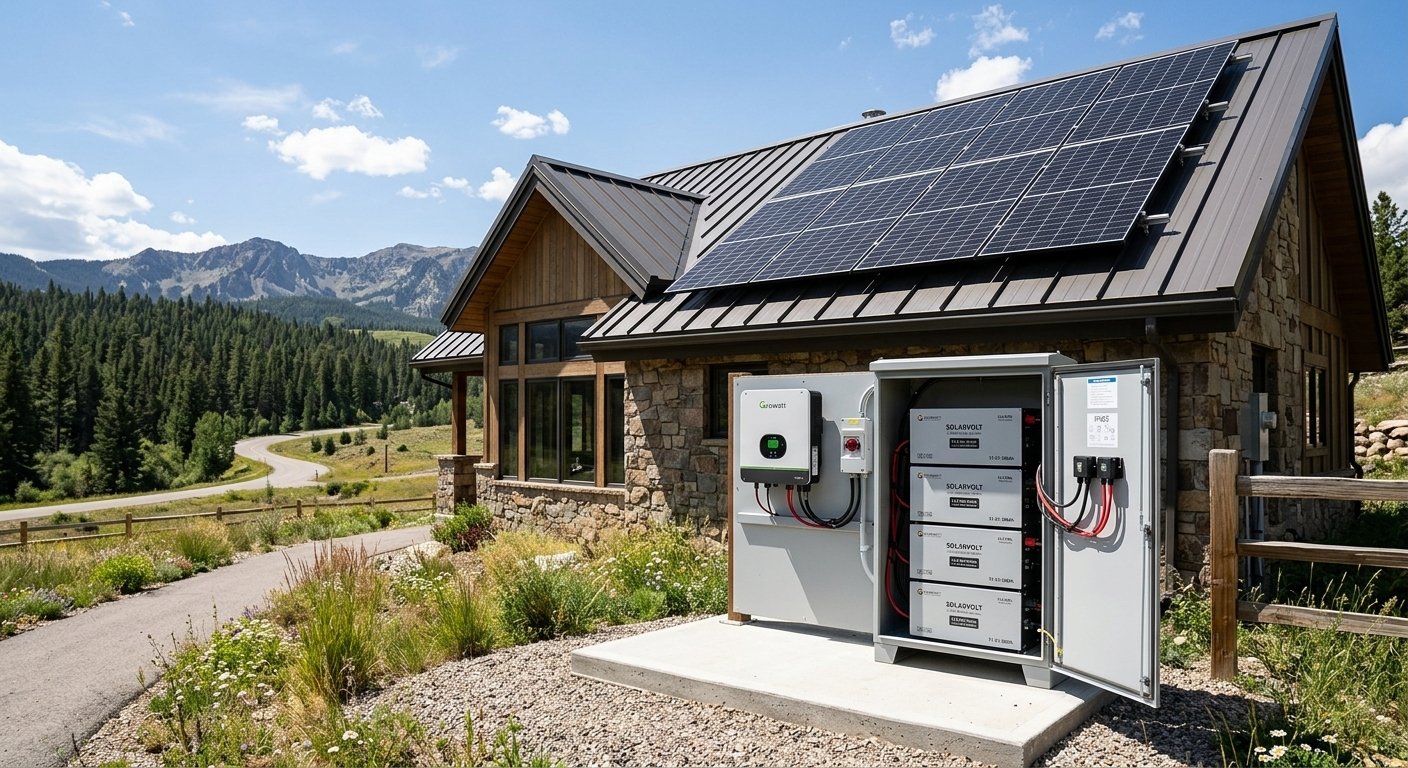
If you already have solar panels on your roof, you may have noticed something interesting: your panels produce the most electricity during the day, but your home may use the most electricity in the evening. So what happens to all that extra solar power? That is where a solar panel battery comes in.
A solar battery stores electricity generated by your solar panels so you can use that energy later. Instead of sending all your unused daytime energy away, you can save some of it for nighttime, cloudy periods, or even power outages.
In this guide, we’ll explain how solar batteries work, the different types, how much they cost, how much capacity you need, and what to look for before buying one.
Solar Battery: What Is It and How Does It Work?
A solar battery is an energy-storage device connected to a solar power system. It stores electricity produced by solar panels and makes that electricity available when your panels aren’t producing enough power.
The basic process is simple:
Solar panels → inverter/charge system → battery → home appliances
During a sunny afternoon, for example, your solar panels might produce more electricity than your home needs. Instead of wasting that extra electricity, the system can send it to the battery. Later, when the sun goes down, the battery can supply stored energy to your home.
A typical system includes:
- Solar panels that generate electricity
- A solar inverter that manages electrical conversion
- A battery that stores energy
- Electrical equipment that controls and distributes the power
- Your home’s appliances and electrical loads
The exact setup depends on the equipment and whether the system is AC-coupled or DC-coupled.
Solar Battery Storage: How Energy Storage Works
- The idea behind solar battery storage is easier to understand with a real-life example.
- Imagine your solar panels produce 10 kWh of electricity during the day.
- Your home uses 6 kWh during those daylight hours.
- That leaves approximately 4 kWh of surplus energy.
- Without storage, depending on your system and utility arrangement, that electricity may be exported to the grid or otherwise not be available to you later.
With a battery, the surplus can be stored. In the evening, when your solar panels stop producing electricity, you can use some of that stored energy. This changes the way you use solar power:
Home Solar Battery: Is It Right for Your Home?
A home solar battery isn’t automatically necessary for every solar installation.
It makes the most sense when you have a specific reason for storing electricity.
You may want a battery if:
- You use lots of electricity at night.
- You want backup power during outages.
- You want to use more of your own solar electricity.
- Your electricity pricing makes stored energy valuable.
- You want greater energy independence.
- You have an existing solar system and want to add storage.
For example, imagine a family that leaves for work and school in the morning. Their solar panels generate plenty of electricity while everyone is away.
When the family comes home at 6 p.m., solar production is falling. A battery allows some of that daytime solar energy to be used after sunset. That is a much better match between when solar energy is produced and when the family actually needs it.
Solar Storage: How Much Energy Can You Store?
- Solar energy storage is usually measured in kilowatt-hours (kWh).
- Think of kWh as the amount of electricity the battery can store.
- A 10 kWh battery theoretically stores more energy than a 5 kWh battery.
- However, you shouldn’t assume that every kWh of the battery will always be available for use.
- This is where depth of discharge becomes important.
Common residential battery sizes vary considerably, but systems around 10–15 kWh are frequently discussed for home storage. However, bigger isn’t automatically better.
Your ideal capacity depends on:
- Your daily electricity consumption
- How much solar energy your panels produce
- How much electricity you use after sunset
- Whether you want backup power
- Which appliances you want to keep running
- Your budget
- Your available installation space
For example, suppose your home needs about 20 kWh per day. You don’t necessarily need a 20 kWh battery. If your solar panels directly power the home during the day, you may only need enough storage to cover your evening and overnight usage.
A simple sizing example
Suppose you use:
- 5 kWh during the evening
- 3 kWh overnight
That’s approximately 8 kWh of energy you might want available after sunset. A battery around this usable capacity could be a starting point for discussion with an installer. However, actual sizing should consider your peak loads and the battery’s usable capacity rather than just its advertised capacity.
Depth of Discharge: What Does DoD Mean?
- Depth of discharge (DoD) tells you how much of a battery’s stored energy can normally be used.
- For example, if a battery has a 10 kWh capacity and a 90% DoD:
- 10 kWh × 90% = 9 kWh usable energy
- So although the battery is advertised as 10 kWh, around 9 kWh may be considered usable under that specification.
- DoD matters because two batteries with the same advertised capacity can have different amounts of usable energy.
- When comparing batteries, therefore, don’t look at capacity alone.
Check:
- Total capacity
- Usable capacity
- DoD
- Round-trip efficiency
- Warranty
- Expected lifespan
- Maximum power output
Solar Battery Types: Lithium-Ion, LiFePO4, Lead-Acid & More
There are several solar battery types, and they don’t all perform the same way.
The main technologies you will encounter include:
- Lithium-ion
- Lithium iron phosphate (LiFePO4)
- Lead-acid
- AGM
- Gel batteriese.
Let’s look at the major options.
Lithium-Ion Solar Battery: Benefits and Drawbacks
A lithium-ion solar battery is one of the most common modern choices for residential energy storage.
Lithium batteries are popular because they generally offer:
- High energy density
- Good efficiency
- Relatively long service life
- Higher usable capacity
- Compact design
- Low routine maintenance
They can cost more initially than traditional lead-acid batteries, but their performance characteristics can make them attractive for long-term residential use.
Lithium-ion batteries include different chemistries, including NMC and LFP.
LiFePO4 Battery: Why Is It Popular for Solar Storage?
A LiFePO4 battery, or lithium iron phosphate battery, is a type of lithium battery.
LiFePO4 technology has become popular in solar applications because it offers a combination of:
- Long cycle life
- Good thermal stability
- High usable capacity
- Low maintenance
- Strong performance for repeated charging and discharging
For many homeowners, LiFePO4 is an attractive option when the goal is long-term solar energy storage. Still, don’t choose a battery solely because it says “LiFePO4” on the label. The complete system matters.
Look at the battery’s:
- Warranty
- Manufacturer
- Safety features
- Operating temperature range
- Inverter compatibility
- Installation requirements
- Usable capacity
- Power output
Lead-Acid Battery: Is It Still a Good Choice?
A lead-acid battery is an older and well-established battery technology. Lead-acid batteries can have a lower upfront purchase price, which is one reason they remain relevant in some applications. However, compared with modern lithium systems, they can be:
- Heavier
- Larger
- Less efficient
- More limited in usable depth of discharge
- More demanding in some installation environments
For basic or budget-focused systems, lead-acid may still make sense.
But for many modern residential solar installations, lithium technology deserves serious consideration.
Solar Inverter: Why Is It Important for Battery Storage?
The solar inverter is a key part of a solar-plus-storage system.
Solar panels produce DC electricity, while most household appliances use AC electricity.
The inverter helps manage this conversion and, depending on the system design, manages the flow of energy between the solar panels, battery, grid, and home.
There are different system designs, so don’t assume that every solar battery works with every inverter.
Before purchasing, confirm:
Battery compatibility + inverter compatibility + system voltage + installer support
This can prevent expensive problems later.
Solar Battery System: AC-Coupled vs. DC-Coupled
A solar battery system can generally be connected using an AC-coupled or DC-coupled design.
AC-coupled system
In an AC-coupled system, the battery is connected on the AC side of the electrical system.
This approach can be particularly useful when adding a battery to an existing solar installation.
DC-coupled system
A DC-coupled system connects the battery more directly with the DC side of the solar system.
This can reduce some conversion steps and may improve overall efficiency in certain configurations.
The right choice depends on your existing equipment and whether you’re installing solar and storage together or adding storage later.
Solar Battery Cost: How Much Does a Solar Battery Cost?
Solar battery cost varies widely depending on capacity, brand, chemistry, installation requirements, inverter equipment, location, and other factors.
As a current 2026 reference point, EnergySage reports an average installed home battery cost of about $15,647, with an average price of roughly $1,159 per kWh in its marketplace data. These are U.S. figures and should not be treated as a universal price or a Saudi-market quote.
A quote can become more expensive when you need:
- More battery capacity
- Additional batteries
- A new inverter
- Electrical upgrades
- Complex installation
- New wiring
- Backup-load equipment
- Additional protection equipment
Don’t compare batteries by price alone
A $7,000 battery isn’t necessarily cheaper than a $10,000 battery if the cheaper option has:
- Less usable capacity
- Shorter warranty
- Lower efficiency
- Shorter expected life
- Lower power output
The better question is:
“How much usable energy and performance am I getting for the total installed price?”
Solar Battery Lifespan: How Long Does It Last?
Solar battery lifespan depends on the battery chemistry, usage, temperature, charging pattern, installation quality, and manufacturer specifications.
Modern lithium-ion home batteries can often provide many years of service, with some systems designed around a 10–15 year service-life expectation.
However, lifespan isn’t simply a calendar number. Battery degradation happens gradually. A battery that starts with 10 kWh of capacity may eventually hold less energy than it did when new. That’s why the warranty is extremely important.
Check these warranty details
Before buying, ask:
- How many years is the warranty?
- Is there a cycle limit?
- Is there a minimum guaranteed capacity?
- What conditions can void the warranty?
- Who handles warranty service?
A strong warranty can give you much more confidence in a major purchase.
Battery Backup: How Long Can a Solar Battery Run Your Home?
One of the most common questions is:
How long will my battery last during a power outage?
There isn’t one universal answer.
It depends on both battery capacity and your electrical load.
For example, imagine you have 10 kWh of usable energy.
If your home is using 1 kW continuously:
10 kWh ÷ 1 kW = approximately 10 hours
But if your home is using 3 kW:
10 kWh ÷ 3 kW = approximately 3.3 hours
Real-world runtime can be shorter because of system losses and changing loads.
You can extend backup time by powering only essential appliances.
For example:
- Refrigerator
- Lights
- Wi-Fi router
- Phone chargers
- Security system
- Selected fans
- Essential medical equipment where appropriately supported
You may not need to run everything during an outage.
Solar Battery Installation: Step-by-Step Guide
Solar battery installation should normally be handled by a qualified professional because batteries contain significant amounts of stored electrical energy.
A typical installation process looks like this:
Step 1: Evaluate your electricity use
The installer reviews your electricity consumption and identifies your goals.
Step 2: Choose battery capacity
The system is sized according to your energy needs, solar production, backup requirements, and budget.
Step 3: Check compatibility
The installer confirms compatibility between:
- Solar panels
- Battery
- Inverter
- Electrical panel
- Backup equipment
- Monitoring system
Step 4: Select an installation location
The battery needs an appropriate location that meets the manufacturer’s requirements.
Step 5: Install and wire the equipment
The installer mounts the battery and completes the necessary electrical connections.
Step 6: Configure the system
Settings are configured for charging, discharging, backup, monitoring, and other operating requirements.
Step 7: Test everything
The installer checks that the system works correctly and that the battery communicates with the inverter and monitoring equipment.
Solar Battery Maintenance: How to Keep It Working Properly
One advantage of modern lithium battery systems is that they generally require relatively little routine maintenance.
Still, solar battery maintenance shouldn’t be ignored.
Keep the battery area:
- Clean
- Dry
- Accessible
- Free from unnecessary objects
- Within the manufacturer’s temperature requirements
You should also monitor the system through its available app or monitoring platform.
Watch for unusual:
- Error messages
- Temperature warnings
- Sudden performance changes
- Charging problems
- Communication failures
Don’t open or repair the battery yourself unless you’re specifically qualified to do so.
Solar Battery and Hot Weather: Does Temperature Matter?
Temperature matters for battery performance and longevity.
This is especially important in hot climates.
A battery should be installed according to the manufacturer’s specified operating and storage temperature ranges.
Good installation planning may include:
- Appropriate shade or enclosure where permitted
- Proper ventilation
- Avoiding direct extreme heat
- Following manufacturer spacing requirements
- Professional installation
Never assume that because a battery is marketed for outdoor use, it can simply be installed anywhere.
Always check the manufacturer’s specifications.
Solar Panel Battery: Pros and Cons
Before buying, it’s worth looking at both sides.
Pros
- Stores unused solar energy
- Provides backup power
- Can increase solar self-consumption
- Can reduce dependence on the grid
- Helps shift solar energy from daytime to evening
- Modern lithium systems can offer long service life
- Can provide greater energy independence
Cons
- High upfront cost
- Batteries eventually degrade
- Installation adds complexity
- Not every home needs storage
- Battery capacity is limited
- Extreme temperatures can affect performance
- A poorly sized system may provide disappointing results
The important point is that a battery should solve a real problem for your home.
Solar Panel Battery: Is It Worth Buying?
A solar panel battery can be worth buying if you value energy independence, backup power, or using more of your own solar electricity.
But it isn’t automatically a good financial investment for every homeowner.
Before buying, ask yourself three questions:
1. Do I need backup power?
If electricity outages are a serious concern, a battery may provide valuable peace of mind.
2. Do I produce excess solar electricity?
If you regularly generate more solar energy than you can use during the day, storage can help you use that energy later.
3. Does the financial calculation make sense?
Compare the battery’s total installed price with the value you expect to receive from:
- Avoided electricity purchases
- Increased solar self-consumption
- Backup capability
- Available incentives
- Possible time-of-use savings
EnergySage’s 2026 data shows that home batteries represent a significant investment, so determining whether one is “worth it” depends heavily on the homeowner’s specific circumstances.
Solar Panel Battery Buying Guide: What Should You Look For?
Buying the right battery isn’t just about choosing the biggest battery or the cheapest price.
Use this checklist before signing a contract.
1. Usable capacity
Don’t look only at the advertised kWh.
Ask for the usable capacity.
2. Battery chemistry
Compare lithium-ion, LiFePO4, lead-acid, AGM, and other options based on your requirements.
3. Warranty
Look for a clear warranty with understandable capacity and cycle terms.
4. Power output
A battery may have plenty of energy capacity but still be unable to power certain high-demand appliances simultaneously.
Check the battery’s continuous and peak power output.
5. Inverter compatibility
Make sure the battery works with your existing or planned inverter.
6. Temperature rating
This is especially important in hot environments.
7. Safety features
Ask about the battery management system and built-in electrical and thermal protections.
8. Monitoring
A good monitoring system allows you to see:
- Battery charge
- Solar production
- Home consumption
- Grid usage
- Charging and discharging activity
9. Installer experience
A good battery installed badly can become a bad investment.
Choose an installer who understands both solar and energy storage.
How to Choose the Right solar panel battery in 5 Steps
If all these specifications feel confusing, use this simple process.
Step 1: Determine your goal
Do you want:
- Backup power?
- Lower electricity bills?
- More solar self-consumption?
- Energy independence?
Start with the goal.
Step 2: Check your electricity usage
Look at your electricity bills and determine your typical daily consumption.
Step 3: Identify your evening usage
Determine how much electricity you normally use after solar production falls.
Step 4: Compare total installed prices
Don’t compare battery prices alone.
Compare the complete system.
Step 5: Get professional quotes
Ask at least two or three qualified installers to explain their recommendations.
If one installer recommends a 5 kWh battery and another recommends 20 kWh, don’t simply choose the cheaper quote.
Ask:
“Why is your recommended capacity different?”
A professional installer should be able to explain the calculation.
Solar Battery vs. Solar Panels: What’s the Difference?
Solar panels and batteries do different jobs.
| Equipment | Main Job |
|---|---|
| Solar panels | Generate electricity |
| Solar battery | Store electricity |
| Solar inverter | Converts/manages electrical power |
| Electrical panel | Distributes electricity around the home |
Think of solar panels as the energy generator and the battery as the energy storage tank.
You can have solar panels without a battery.
You can also have a battery system in some circumstances without solar panels.
However, combining the two can create a powerful home energy system.
Can You Add a Battery to Existing Solar Panels?
Yes, in many cases you can add a battery to an existing solar system.
This is often called a solar battery retrofit.
An AC-coupled battery system can be useful for certain retrofit situations because it can work alongside existing solar equipment.
However, compatibility needs to be checked carefully.
Before purchasing, provide the installer with:
- Solar panel specifications
- Existing inverter model
- System size
- Electrical panel information
- Previous installation documents
This can help determine what equipment is required.
What Happens When the solar panel battery Is Full?
A common question is:
“What happens if my battery reaches 100%?”
Once the battery is full, the solar system doesn’t simply keep forcing electricity into it.
Depending on the system, excess solar energy may:
- Power the home
- Be exported to the grid
- Be curtailed
The exact behavior depends on your system configuration and utility rules.
This is another reason why battery sizing matters.
You don’t necessarily want an enormous battery that rarely gets properly charged.
Can a Solar Battery Power an Entire House?
It can, but whether it can do so depends on the battery’s energy capacity, power output, inverter, and electrical configuration.
A battery might easily run:
- Lights
- Internet
- Refrigerator
- TVs
- Small appliances
But running several high-power appliances at once can require much more power.
Large loads such as:
- Air conditioners
- Electric heaters
- Electric ovens
- Water heaters
- Pumps
can consume significant electricity.
If whole-home backup is your goal, tell the installer exactly which appliances you want to operate during an outage.
Solar panel battery FAQs
How many solar batteries do I need for my home?
It depends on your electricity consumption, solar production, desired backup duration, and battery capacity. Some homes may need one battery, while larger homes or whole-home backup systems may require multiple units.
How long does a solar battery last?
Many modern lithium-ion home batteries are designed for long-term use, with some systems commonly discussed around a 10–15 year service-life range. Actual lifespan depends on chemistry, cycling, temperature, installation, and manufacturer specifications.
What is the best solar battery type?
There isn’t one battery that is best for every home. Lithium-ion, particularly LiFePO4, is a strong option for many modern residential systems, while lead-acid can still make sense in some budget or specialized applications.
Is a 10 kWh battery enough for a house?
It may be enough for some homes, particularly for evening use or essential backup loads. However, a 10 kWh battery does not automatically mean it can run an entire house for a full day.
How much does a solar battery cost?
Prices vary significantly by location, battery size, installation, chemistry, and equipment. In 2026, EnergySage reports an average U.S. installed home battery price of approximately $15,647.
Can solar batteries work during a power outage?
Yes, batteries designed and installed for backup can provide electricity during outages. However, the system must be configured for backup, and not every solar installation automatically provides backup power.
Do solar batteries need maintenance?
Modern systems generally require limited routine maintenance, but monitoring, inspections, clean installation areas, and following manufacturer instructions remain important.
Can I install a solar battery myself?
Battery installation involves significant electrical equipment and should normally be performed by a qualified professional who understands the applicable electrical and safety requirements.
Final Thoughts: Should You Buy a Solar Panel Battery?
A solar panel battery can turn a basic solar system into a more flexible energy-storage system.
Instead of thinking only about producing electricity during sunny hours, you can think about when your home actually needs that electricity.
The right battery can help you:
- Store surplus solar energy
- Use more solar power at night
- Keep important appliances running during outages
- Reduce reliance on grid electricity
- Gain more control over your home’s energy use
However, don’t buy a battery simply because someone tells you that every solar system needs one.
Start with your electricity usage, your solar production, your backup requirements, and your budget.
Then compare usable capacity, battery chemistry, power output, warranty, inverter compatibility, installation quality, and total cost.
Most importantly, get professional quotes and ask the installer to show you exactly how they calculated the recommended battery size.
When you understand what you’re buying, why you need it, and how much value it can provide, you can make the decision with much more confidence.
Quick solar panel battery Buying Checklist
Before you buy, make sure you know:
- Battery capacity
- Usable capacity
- Depth of discharge
- Battery chemistry
- Power output
- Solar inverter compatibility
- Warranty period
- Expected lifespan
- Operating temperature
- Installation cost
- Backup capability
- Monitoring features
- Total installed price
- Installer qualifications
A solar battery is a serious investment, but with the right size, technology, and installation, it can become one of the most useful parts of a modern home energy system.
The goal isn’t to buy the biggest battery. The goal is to buy the battery that fits your home.