If you have solar panels on your home, you may already know that they produce the most electricity during the daytime. The problem is that many households use most of their electricity in the morning and evening, when the sun is no longer producing much power.That is where a solar PV battery can make a big difference.
Instead of sending all your unused solar electricity back to the grid, a solar battery can store some of that energy and make it available later. You can then use your stored electricity when your solar panels are producing little or nothing.
In the UK, battery storage is becoming an increasingly important part of home energy systems. The Energy Saving Trust explains that battery storage can store excess renewable electricity and help households use more of their generated energy when they need it.
This complete guide explains solar PV battery storage in the UK, including how it works, battery sizes, costs, benefits, battery types, lifespan, installation, and what you should check before buying one.
What Is a Solar PV Battery?
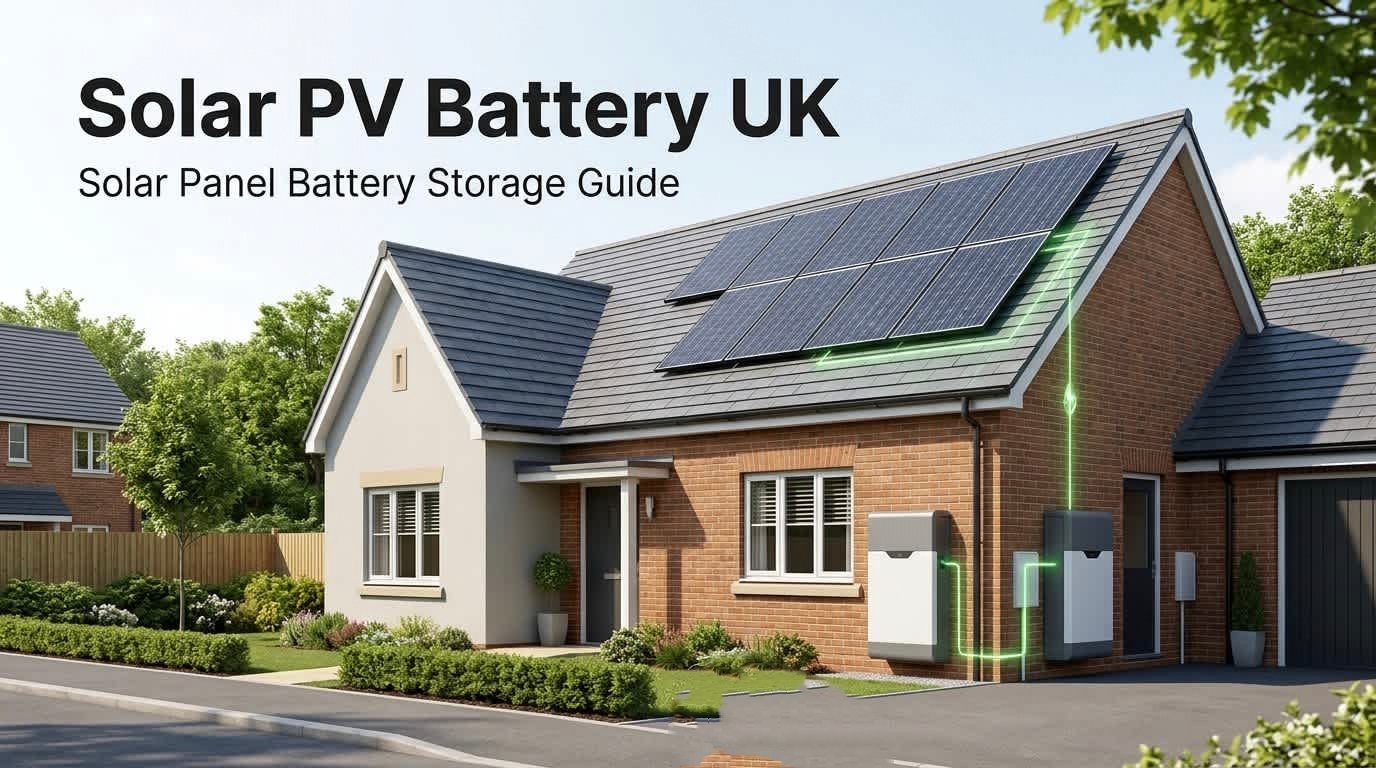
A solar PV battery is a rechargeable battery connected to a solar photovoltaic (PV) system.
Solar panels generate electricity when sunlight reaches them. Your home can use that electricity immediately. However, if your panels produce more electricity than your home needs at that moment, the excess electricity can be stored in the battery.
Later, when your solar panels are producing less electricity, your home can draw power from the battery.
For example, imagine your solar panels generate 5kWh of electricity between late morning and afternoon, but your household only uses 2kWh during that period.
Instead of wasting the opportunity to use that extra energy later, around 3kWh could potentially be stored, subject to system losses and the battery’s usable capacity.
That stored energy could then help power your home in the evening.
The basic idea is simple:
Solar panels → Home → Excess electricity → Battery → Home later
The Energy Saving Trust notes that solar generation and household electricity use do not always happen at the same time, which is one of the main reasons battery storage can be useful.
How Does Solar PV Battery Storage Work?
A solar PV battery storage system normally works automatically.
During sunny periods, your solar panels generate electricity. The system first supplies your home’s current electricity demand.
If your solar panels produce more electricity than your home needs, the excess can be directed towards your battery.
Once the battery reaches its usable charging limit, additional surplus electricity may be exported to the grid, depending on your system and tariff.
Later in the day, when solar generation falls, your home can use electricity stored in the battery.
A simplified example looks like this:
- Morning: Solar panels begin generating electricity.
- Afternoon: Solar generation reaches its highest level.
- Battery charging: Excess solar electricity charges the battery.
- Evening: Solar generation falls.
- Battery discharging: The battery supplies electricity to your home.
- Night: Your home may use remaining battery energy or electricity from the grid.
This means a battery can shift some of your solar electricity from the time it is generated to the time you actually need it.
Solar Panel Battery Benefits for UK Homes
There are several reasons homeowners consider adding a solar panel battery to their system.
1. Use More of Your Own Solar Electricity
Without a battery, surplus solar electricity may be exported to the grid.
A battery gives you another option: store some of that electricity for later.
This can increase your solar self-consumption because you are using more of the electricity generated by your own panels.
2. Reduce Grid Electricity Use
Your solar panels may generate plenty of electricity during the day, but your home can still need electricity after sunset.
A battery can help bridge that gap.
For example, you might generate electricity at 1pm but need to run your television, lights, washing machine or cooking appliances at 7pm.
Instead of buying all that electricity from the grid, you may be able to use stored solar energy.
3. Make Better Use of Time-of-Use Tariffs
Some UK electricity tariffs have different prices at different times.
A compatible battery system can potentially charge during cheaper periods and discharge during more expensive periods.
This can be particularly useful for households that have predictable electricity usage.
However, the actual financial benefit depends on your tariff, battery efficiency, battery size and electricity consumption.
4. Greater Energy Independence
A home battery storage system can reduce your reliance on electricity from the grid.
Some battery systems can provide backup power during a grid outage.
It does not normally make a home completely independent of the grid, but it can provide another source of electricity for everyday use.
5. Potential Backup During Power Cuts
However, this is not automatic with every solar battery.
If backup power is important to you, ask the installer whether the system supports backup operation and which circuits or appliances can continue working during an outage.
Solar Battery Cost UK: How Much Does a Solar PV Battery Cost?
One of the biggest questions homeowners ask is: how much does a solar battery cost in the UK?
There is no single price because the total cost depends on:
- Battery capacity
- Battery brand
- Battery chemistry
- Inverter requirements
- Installation complexity
- Whether you already have solar panels
- Whether additional electrical work is required
- Backup functionality
- Monitoring and control equipment
The Energy Saving Trust currently gives a broad battery-storage cost range of around £1,500 to £10,000, with a 5kWh battery system costing around £4,600 as a general reference point.
Current market research also shows considerable variation between battery models and system configurations.
Therefore, don’t choose a battery simply because it has the lowest purchase price.
A cheaper battery may have different warranty terms, usable capacity, power output or installation requirements.
Instead, compare the total installed cost and expected performance.
Solar Battery Size: How Many kWh Do You Need?
Choosing the correct solar battery size is one of the most important decisions.
Battery capacity is normally measured in kilowatt-hours (kWh).
For example:
- 5kWh battery = smaller storage capacity
- 8kWh battery = medium-sized storage
- 10kWh battery = larger household storage
- 13.5kWh battery = high-capacity system
But bigger does not automatically mean better.
A battery should match your:
- Daily electricity consumption
- Solar panel generation
- Evening electricity usage
- Electricity tariff
- Budget
- Future energy needs
Recent UK battery-sizing research puts residential battery capacity across a wide range and highlights the importance of matching capacity with household usage rather than simply buying the largest available system.
Example
Suppose your home regularly uses around 8kWh of electricity after your solar panels have stopped generating enough power.
A 3kWh battery may be too small for your pattern of use.
On the other hand, installing a very large battery when your solar system rarely produces enough excess energy to charge it could mean paying for capacity you rarely use.
The goal is not the biggest battery. The goal is the right battery.
Usable Capacity vs Total Battery Capacity
When comparing batteries, don’t look only at the headline capacity.
There is an important difference between total capacity and usable capacity.
A battery might have a stated capacity of 10kWh, but the amount of energy available for normal use can depend on its depth-of-discharge settings and manufacturer specifications.
What Is Depth of Discharge?
Depth of Discharge (DoD) tells you how much of the battery’s capacity can normally be used.
For example, a battery with a 10kWh capacity and 90% usable capacity would provide around 9kWh of usable energy under the manufacturer’s specified conditions.
Modern battery systems can have high usable-capacity percentages, but specifications differ between models.
This is why you should compare usable kWh, not just the number printed on the battery.
Solar Battery Types: Which Battery Technology Is Used?
Most modern residential solar batteries use lithium-based battery technology.
Two terms you may encounter are LFP and NMC.
LFP Batteries
LFP stands for Lithium Iron Phosphate.
These batteries are widely used in modern energy-storage systems.
Potential advantages include:
- Good cycle life
- Strong thermal characteristics
- High durability
- Suitability for stationary energy storage
When comparing battery technologies, don’t focus on chemistry alone.
Look at the complete system, including:
- Warranty
- Usable capacity
- Efficiency
- Power output
- Operating temperature
- Installation requirements
- Safety certifications
- Manufacturer support
Solar Battery Efficiency: Why It Matters
Not every unit of electricity put into a battery will necessarily come back out as usable electricity.
There are losses during charging, storage and discharging.
This is why battery efficiency matters.
For example, if a battery system has a round-trip efficiency of 90%, some energy is lost during the complete charge-and-discharge process.
When comparing products, look for the manufacturer’s efficiency figures and check whether they refer to DC or AC round-trip efficiency.
A battery with a slightly higher purchase price may have different long-term economics depending on its efficiency and usage pattern.
Solar Battery Lifespan: How Long Does a Battery Last?
A common question is:
How long does a solar battery last?
The answer depends on the battery technology, usage, operating conditions and manufacturer warranty.
Many modern residential batteries are sold with warranties around 10 years, although the exact terms vary considerably.
The warranty may specify:
- Number of years
- Maximum number of cycles
- Minimum retained capacity
- Throughput limit
- Operating conditions
For example, a warranty might guarantee a certain percentage of the original capacity after a specified period.
Therefore, don’t just ask:
“Is it covered for 10 years?”
Ask:
“What capacity will the manufacturer guarantee after 10 years?”
That gives you a much clearer picture of long-term performance.
Solar Battery Degradation Explained
Like other rechargeable batteries, solar batteries gradually lose some capacity over time.
This process is called battery degradation.
Imagine buying a battery with 10kWh of usable capacity. After years of use, it may no longer hold exactly the same amount of energy.
This is normal.
The important thing is understanding how quickly capacity is expected to decline and what the manufacturer guarantees.
Look at:
Warranty period + guaranteed capacity + cycle limit + throughput limit
rather than focusing on the warranty length alone.
AC-Coupled vs DC-Coupled Solar Battery Systems
If you are researching solar PV battery installation, you may come across the terms AC coupling and DC coupling.
AC-Coupled Battery
An AC-coupled battery connects on the AC side of your electrical system.
This can be useful when you already have solar panels and want to add battery storage later.
It can make retrofitting a battery to an existing solar PV system practical, depending on the equipment already installed.
DC-Coupled Battery
A DC-coupled system connects the battery more directly with the solar PV system on the DC side.
This arrangement can be particularly attractive for a new solar-and-battery installation.
The best configuration depends on your existing equipment and the system design.
A professional installer should assess your current inverter, solar array, electrical setup and planned battery before recommending the configuration.
Can You Add a Solar Battery to Existing Solar Panels?
Yes, in many cases you can add a battery to an existing solar PV system.
This is often called a retrofit.
However, compatibility needs to be checked carefully.
Your installer may need to assess:
- Existing solar inverter
- Solar panel capacity
- Electrical connection
- Battery compatibility
- Available installation space
- Export limitations
- Backup requirements
- Existing protection equipment
Some modern batteries are specifically designed to work with existing solar installations, while others may require additional equipment.
So don’t buy a battery first and assume it will work with your existing system.
Check compatibility before purchasing.
Can You Have a Solar Battery Without Solar Panels?
Yes.
A battery does not necessarily need solar panels to operate.
A battery-only system can potentially charge from the electricity grid during cheaper periods and discharge during more expensive periods, depending on the tariff and system controls.
The Energy Saving Trust also notes that battery storage can be used without solar panels, including alongside time-of-use tariffs.
However, the financial case needs to be calculated carefully.
You should compare:
Cost of electricity used to charge the battery
against
Value of electricity avoided when the battery discharges
while also considering efficiency losses, battery degradation and installation cost.
Solar Battery and Smart Export Guarantee (SEG)
If your solar PV system exports electricity to the grid, you may be able to receive payments through the Smart Export Guarantee (SEG) if you meet the relevant requirements.
The important point is that exporting electricity and storing electricity are not necessarily competing ideas.
A smart system can potentially:
- Use solar electricity in the home
- Charge the battery
- Export surplus electricity
- Charge from the grid at suitable times
The best approach depends on your electricity tariff and household consumption.
Always check the current tariff terms before calculating your expected savings.
Solar Battery Installation UK: What You Should Expect
A battery should be installed by a suitably qualified professional.
The installation process generally involves several stages.
Step 1: Assess Your Electricity Usage
Look at your electricity bills and smart-meter data if available.
Try to understand:
- Daily electricity consumption
- Daytime usage
- Evening usage
- Overnight usage
- Seasonal changes
Step 2: Check Your Solar System
If you already have solar panels, the installer should assess your existing system.
This includes your:
- Solar inverter
- Panel capacity
- Electrical connection
- Existing protection equipment
Step 3: Choose Battery Capacity
Use your actual energy consumption rather than guessing.
For example, if your household consistently has high evening electricity demand, you may benefit from more usable storage than a household that uses most of its electricity during daylight hours.
Step 4: Compare Battery Specifications
Compare:
- Usable capacity
- Power output
- Efficiency
- Warranty
- Cycle life
- Battery chemistry
- Dimensions
- Weight
- Operating temperature
- Backup functionality
Step 5: Compare Installation Quotes
Don’t automatically accept the first quote.
The Energy Saving Trust recommends getting at least three quotes from MCS-certified installers when considering battery storage installation.
Step 6: Review the Warranty
Before signing anything, read the battery warranty.
Make sure you understand what is actually guaranteed.
Step 7: Confirm Monitoring and Controls
Ask how you will monitor:
- Battery charge
- Solar generation
- Home consumption
- Grid import
- Grid export
A good monitoring system can help you understand whether your battery is operating as expected.
Where Can a Solar Battery Be Installed?
Depending on the battery model and installation requirements, a battery may be installed in places such as:
- Garage
- Utility room
- Suitable internal area
- External wall
The exact location depends on the manufacturer’s requirements, environmental conditions, ventilation, access and local installation standards.
The battery also needs enough physical space for safe installation and maintenance.
The Energy Saving Trust notes that battery systems can be installed in garages, utility rooms or on external walls depending on the system selected.
Solar Battery Safety: What Should You Check?
Safety should be part of your buying decision.
Don’t select a battery purely because it is cheap or has a large capacity.
Check:
- Manufacturer specifications
- Installation requirements
- Safety certifications
- Warranty
- Battery chemistry
- Operating temperature
- Installer qualifications
- Manufacturer support
You should also follow the manufacturer’s instructions regarding installation, maintenance and operating conditions.
How to Choose a Solar PV Battery in the UK
When comparing solar PV batteries, use a simple checklist.
Capacity
How many kWh can the battery store?
Usable Capacity
How much of that storage can you actually use?
Power Output
How much power can the battery provide at one time?
This matters if you want to run several high-power appliances together.
Efficiency
How much energy is lost during charging and discharging?
Warranty
How long is the warranty, and what capacity is guaranteed?
Battery Chemistry
Is it LFP, NMC or another technology?
Scalability
Can you add additional battery modules later?
Backup
Does the system support backup during power cuts?
Monitoring
Does it have a useful app or energy-management system?
Installation Cost
What is the complete installed price rather than simply the battery’s advertised price?
Common Solar Battery Buying Mistakes
Buying the Biggest Battery
A huge battery isn’t necessarily useful if your solar system cannot regularly charge it or your household doesn’t use enough electricity.
Looking Only at the Purchase Price
A low-cost battery may have different specifications from a more expensive system.
Compare the whole package.
Ignoring Usable Capacity
Always check usable kWh rather than relying on the headline capacity.
Forgetting Power Output
Capacity tells you how much energy the battery stores.
Power output tells you how quickly it can supply that energy.
These are different measurements.
Ignoring Your Electricity Tariff
Your tariff can have a major effect on the economics of battery storage.
Buying Without Checking Compatibility
If you already have solar panels, check your existing inverter and system before buying a battery.
Assuming Every Battery Provides Backup
Some systems do not automatically provide backup power during a grid outage.
Confirm this with the installer.
Is a Solar PV Battery Worth It in the UK?
There is no universal answer because every household has a different electricity profile.
A battery may be more attractive if you:
- Already have solar panels
- Produce significant surplus solar electricity
- Use lots of electricity in the evening
- Have a suitable time-of-use tariff
- Want to increase solar self-consumption
- Want optional backup functionality
- Expect your electricity usage to increase
On the other hand, the financial case may be weaker if your household uses most electricity during the day, your solar system produces very little surplus energy, or the battery installation cost is high.
The Energy Saving Trust similarly cautions that battery savings can be significant but may not always be enough on their own to justify the upfront cost.
That is why you should calculate the expected savings based on your own electricity usage rather than relying on a generic claim.
A Simple Solar Battery Payback Example
Imagine a battery system costs £5,000 installed.
If you estimate that the battery helps you save an average of £500 per year, a very simple calculation would be:
£5,000 ÷ £500 = 10 years
This is only a basic illustration.
Real-world payback can be different because electricity prices, tariffs, battery degradation, solar generation, usage patterns and maintenance can all change.
Therefore, treat payback estimates as estimates rather than guarantees.
Questions to Ask a Solar Battery Installer
Before agreeing to an installation, ask:
- What usable capacity will I get?
- What is the battery’s maximum power output?
- What is the round-trip efficiency?
- What is the warranty?
- What capacity is guaranteed at the end of the warranty?
- How many cycles are covered?
- Can I add more battery capacity later?
- Will it work with my existing solar inverter?
- Does it provide backup power?
- What exactly is included in the installation price?
- Which electricity tariffs can the system work with?
- How will I monitor the system?
Getting clear answers to these questions can help you avoid expensive surprises later.
Solar PV Battery UK: Final Buying Checklist
Before buying a solar PV battery, check these ten things:
- Battery capacity
- Usable capacity
- Power output
- Round-trip efficiency
- Battery chemistry
- Warranty
- Expected lifespan
- Installation cost
- Compatibility
- Backup and smart-tariff features
Don’t compare batteries using price alone.
A good battery is one that matches your solar system, household consumption, available space and energy goals.
Final Thoughts on Solar PV Battery Storage
A solar PV battery can turn a solar PV system into a more flexible home energy system.
Instead of relying mainly on electricity while the sun is shining, you can store some of your surplus solar generation and use it later.
For many UK households, the biggest attraction is simple: use more of your own solar electricity and reduce the amount of electricity you need to buy from the grid.
However, a battery is a significant investment. The right choice depends on your solar generation, electricity consumption, tariff, battery size, installation cost and expected lifespan.
Before buying, compare several systems and get multiple professional installation quotes. The Energy Saving Trust recommends obtaining at least three quotes from MCS-certified installers.
Most importantly, don’t ask only:
“Which solar battery is the best?”
Ask:
“Which solar battery makes sense for my home, my electricity usage and my solar PV system?”
That question will help you make a much more informed decision.