
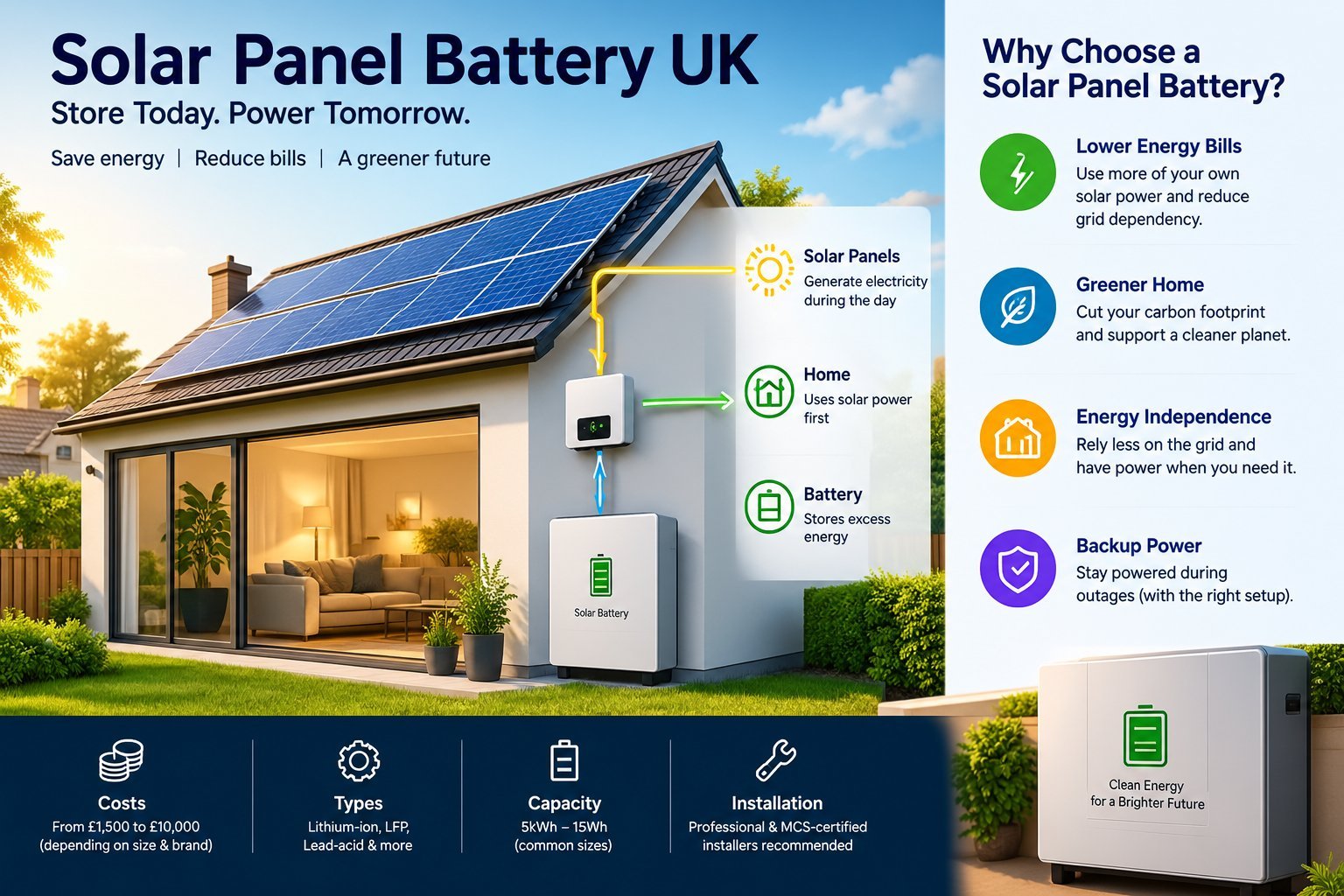
If you have solar panels on your home, you may already know that they can generate plenty of electricity during the day. But there is one common problem: your solar panels often generate the most electricity when your household does not need the most electricity.
For example, your solar panels might produce lots of energy around lunchtime while you are at work. Later, when you return home, switch on the lights, cook dinner and use other appliances, solar generation may have dropped significantly.
This is where a solar panel battery can make a big difference.
A solar battery stores surplus electricity generated by your solar panels so you can use that energy later. Instead of sending all your unused solar electricity to the grid, you can keep some of it in your battery and use it during the evening, overnight or when your panels are producing less energy.
In this complete Solar Panel Battery UK guide, we will look at how solar batteries work, typical costs, battery types, storage capacity, benefits, installation, lifespan, potential savings and the things you should check before buying one.
What Is a Solar Panel Battery?
A solar panel battery is a rechargeable battery designed to store electricity generated by a solar photovoltaic (PV) system.
During sunny periods, your solar panels generate electricity. Your home uses some of that electricity immediately. If your panels produce more electricity than your home needs, the surplus can be sent to the battery instead of being exported to the grid.
Later, when your solar panels are not generating enough electricity, the battery can discharge its stored energy and supply your home.
The basic process looks like this:
Solar panels → Home electricity → Battery storage → Home electricity later
Energy Saving Trust explains that battery storage can store excess electricity from solar panels and allow households to use that electricity when solar generation is lower.
Simple Example
Imagine your solar panels generate 8 kWh of electricity during the day.
Your home uses 3 kWh while the panels are generating.
That leaves around 5 kWh of surplus energy.
Instead of exporting all of it, a suitable battery system could store some of that energy for later use.
In the evening, when your solar panels are no longer producing much electricity, your battery can provide stored energy for your home.
This is one of the main reasons homeowners consider solar panel battery storage.
How Does Solar Panel Battery Storage Work?
Solar PV panels convert sunlight into electricity during daylight hours.
The amount of electricity produced changes throughout the day and across the year.
A sunny summer afternoon may produce much more electricity than a cloudy winter morning.
Step 2: Your Home Uses Solar Electricity
The electricity generated by the panels is first available for your home’s appliances and electrical loads.
For example, it can help power:
- Lights
- Refrigerators
- TVs
- Computers
- Washing machines
- Dishwashers
- Electric heating systems
- Heat pumps
- EV charging
Step 3: Excess Electricity Charges the Battery
If your solar system is generating more electricity than your home currently needs, the surplus can be directed into the battery.
The battery continues charging until it reaches its usable capacity.
Step 4: The Battery Stores the Energy
The electricity remains stored until your home needs it.
This could be later in the afternoon, during the evening or at another suitable time depending on how your system is configured.
Step 5: The Battery Discharges
When solar generation falls, your home can draw electricity from the battery.
This can reduce the amount of electricity you need to buy from the grid.
Step 6: Extra Electricity Can Still Go to the Grid
If your battery is full and your solar panels are still producing more electricity than your home needs, surplus electricity may be exported to the grid.
The Smart Export Guarantee (SEG) allows eligible generators to receive payments for exported electricity through participating suppliers.
Solar Battery UK Cost: How Much Does a Solar Battery Cost in 2026?
One of the first questions homeowners ask is: how much does a solar battery cost in the UK?
There is no single price because the total cost depends on battery capacity, brand, inverter requirements, installation, electrical work and whether the battery is being installed with a new solar PV system or added to an existing system.
Energy Saving Trust currently gives a broad battery-storage cost range of approximately £1,500 to £10,000, with around £4,600 for a 5 kWh battery system. It also notes that prices vary according to the type and size of battery.
Another Energy Saving Trust guide puts typical battery storage systems at around £5,000–£8,000, showing why it is important to compare actual system specifications rather than relying on one headline price.
What Affects the Price?
Several factors influence the final installed cost:
- Battery capacity
- Battery brand
- Battery chemistry
- Inverter requirements
- Installation complexity
- Whether you already have solar panels
- Electrical upgrades
- Backup-power equipment
- Number of battery modules
- Installer and location
For this reason, don’t compare batteries on price alone.
A £2,000 battery and a £5,000 battery may have very different usable capacities, power outputs, warranties and features.
Solar Battery Capacity: How Many kWh Do You Need?
Battery capacity is normally measured in kilowatt-hours (kWh).
It tells you approximately how much electrical energy the battery can store.
For example:
- 5 kWh battery = approximately 5 kWh of nominal storage
- 10 kWh battery = approximately 10 kWh of nominal storage
- 15 kWh battery = approximately 15 kWh of nominal storage
However, nominal capacity is not the same as usable capacity.
Some battery systems have a recommended minimum state of charge, meaning you may not use every single kWh of the stated capacity.
Is a 5 kWh Solar Battery Enough?
A 5 kWh battery may be suitable for some smaller households, but it is not automatically the right choice for everyone.
If your electricity consumption is relatively low and your solar system is small, a 5 kWh battery may be sufficient.
However, a household with high electricity usage, an EV or heat pump may need substantially more storage.
Energy Saving Trust says there is no exact one-size-fits-all formula for battery capacity and recommends considering your energy use and circumstances.
Is a 10 kWh Solar Battery Better?
A 10 kWh battery provides more storage, but bigger does not automatically mean better.
If your solar panels rarely generate enough surplus energy to charge a large battery, you may pay for capacity that you do not regularly use.
The right approach is to consider:
Solar generation + household consumption + evening usage + electricity tariff + future energy needs.
Best Solar Panel Battery Type for UK Homes
There are several battery technologies, but modern residential systems commonly use lithium-ion battery technology.
Lithium-Ion Solar Batteries
Lithium-ion batteries are widely used in residential energy storage because they can offer:
- Good energy density
- High efficiency
- Compact design
- Good cycle performance
- Relatively low maintenance
- Fast charging and discharging
Within lithium-based systems, different chemistries are available.
Lithium Iron Phosphate (LFP)
Lithium iron phosphate (LFP) batteries are increasingly used in home energy storage.
They are known for good cycle performance and thermal characteristics.
However, the battery chemistry is only one part of the buying decision. The complete system, including its inverter, controls, warranty and installation, matters too.
Lead-Acid Batteries
Lead-acid batteries have been used for energy storage for many years.
They can have a lower initial cost in some applications, but they are generally heavier and less attractive for many modern residential solar-storage installations.
Flow Batteries
Flow batteries use liquid electrolytes stored in tanks.
They can offer different characteristics from conventional lithium batteries, including potentially long operating lifetimes, but they are not as common in ordinary UK homes.
For most homeowners, the practical comparison is more likely to involve different lithium-based home battery systems.
Solar Battery Benefits: Why Install a Battery With Solar Panels?
A solar battery can provide several benefits, although the financial value depends heavily on your household and tariff.
1. Use More of Your Own Solar Energy
Without a battery, surplus solar electricity may be exported when your home cannot use it immediately.
With a battery, some of that electricity can be stored and used later.
This can increase your self-consumption of solar energy.
2. Reduce Grid Electricity Use
Using stored solar electricity later can reduce the amount of electricity you need to purchase from the grid.
This is particularly useful during evening periods when solar generation is low.
3. Make Better Use of Solar Panels
Solar panels produce electricity during daylight hours, but household electricity demand does not always follow the same pattern.
Battery storage helps bridge this timing gap.
4. Combine Solar With Time-of-Use Tariffs
A battery does not necessarily have to be charged only from solar panels.
Some systems can also charge from the grid when electricity prices are lower and discharge when prices are higher.
Energy Saving Trust highlights battery storage as one way households can make better use of time-of-use tariffs.
5. Potentially Lower Electricity Bills
The financial benefit comes from changing when and where you obtain electricity.
For example, you may use free solar electricity instead of buying electricity from the grid later.
However, battery savings are not guaranteed.
Energy Saving Trust specifically notes that battery savings can be significant but may not always be enough to justify the upfront cost.
6. Greater Energy Independence
A battery can reduce your reliance on electricity imports from the grid.
It does not necessarily make your home completely energy independent, but it can increase the amount of electricity you can obtain from your own solar system.
Solar Battery and Smart Tariffs
One of the more interesting developments in home energy storage is the combination of:
Solar panels + battery + smart tariff
Instead of simply charging the battery from solar, some systems can be programmed to charge during cheaper electricity periods.
For example:
Cheap electricity → Battery charges → Expensive period → Battery discharges
This can potentially reduce electricity costs.
However, tariff prices and terms change, so you should calculate the expected benefit using the actual tariff available to you.
Don’t choose a battery purely because an installer says it will save a certain amount every year.
Ask for the assumptions behind the calculation.
Solar Battery Installation UK: How Is a Battery Installed?
Installing a solar battery is not simply a case of putting a box on a wall and connecting a cable.
The system needs to be correctly integrated with your solar PV system, inverter and household electrical installation.
Step 1: Review Your Existing Solar System
If you already have solar panels, the installer should check:
- Solar panel capacity
- Existing inverter
- System age
- Electrical setup
- Available installation location
- Existing battery compatibility
Step 2: Calculate Your Energy Requirements
Look at your electricity consumption rather than choosing a battery based only on its advertised capacity.
Your installer should consider your current and future electricity use.
Step 3: Choose the Battery
Compare:
- Usable capacity
- Maximum power output
- Round-trip efficiency
- Warranty
- Cycle information
- Operating temperature
- IP rating where relevant
- Monitoring software
- Backup capability
- Expandability
Step 4: Check the Inverter
Some batteries have an integrated inverter, while others require a separate inverter.
This can make a significant difference to installation complexity and cost.
Step 5: Choose the Location
Battery systems can potentially be installed in locations such as:
- Garages
- Utility rooms
- Suitable external walls
- Other approved areas
The exact location depends on the battery, installation requirements and property.
Step 6: Professional Installation
Battery installation involves electrical work and should be completed by a suitably qualified professional.
Energy Saving Trust recommends getting quotes from at least three MCS-certified installers when choosing an installer.
AC-Coupled vs DC-Coupled Solar Batteries
When researching a solar panel battery, you may come across the terms AC-coupled and DC-coupled.
AC-Coupled Battery
An AC-coupled battery is generally connected on the AC side of the electrical system.
This can be useful when you already have solar panels installed and want to add battery storage later.
DC-Coupled Battery
A DC-coupled system connects the battery more directly with the solar PV system through suitable power electronics.
This can be attractive when designing a new solar-plus-battery system.
The best configuration depends on your existing equipment and the system being installed.
For a retrofit, don’t assume that every battery will work with your existing inverter.
Solar Battery Lifespan: How Long Does a Battery Last?
A solar battery is not normally expected to last as long as solar panels.
Energy Saving Trust currently states that a typical battery lifespan is around 10–12 years, although the actual lifespan depends on the battery and how it is used.
Factors affecting battery life can include:
- Charging and discharging patterns
- Operating temperature
- Depth of discharge
- Number of cycles
- Battery chemistry
- System management
- Manufacturer specifications
Check the Warranty
The warranty is one of the most important documents to check before buying.
Look for:
- Warranty duration
- Capacity retention guarantee
- Cycle limits
- Conditions of use
- Installation requirements
- Who provides warranty support
A long warranty is useful, but always read what it actually guarantees.
Solar Battery Efficiency: How Much Energy Is Lost?
A battery does not operate with 100% efficiency.
When electricity is stored and later discharged, some energy is lost through conversion and system operation.
This is known as round-trip efficiency.
For example, if you put 10 kWh into a battery, you may not receive exactly 10 kWh back for household use.
The actual figure depends on the complete system.
This matters when calculating savings.
A battery with a large capacity but poor system efficiency may not deliver the same practical value as a smaller, highly efficient system.
Can a Solar Battery Work During a Power Cut?
This is an important point that many homeowners misunderstand.
Having a solar battery does not automatically mean your home will have electricity during a power cut.
A standard grid-connected system may shut down during a grid outage unless it has suitable backup functionality and the required equipment.
Energy Saving Trust also notes that a battery system normally does not provide power during a power cut unless additional equipment and configuration are included.
If backup power is important to you, ask the installer specifically:
“Will this system power selected circuits or my home during a grid outage?”
Also ask:
- How quickly does backup activate?
- Which appliances can run?
- What is the maximum backup output?
- Is additional equipment required?
- Is the backup function included in the quoted price?
Solar Panel Battery vs Exporting Electricity
When your solar panels generate surplus electricity, you generally have two broad options:
Option 1: Export Surplus Electricity
You can export surplus electricity to the grid through an eligible export arrangement such as SEG.
Option 2: Store It in a Battery
You can store some of the electricity and use it later.
Neither option is automatically better in every situation.
The right choice depends on:
- Your export rate
- Your electricity import rate
- Your battery cost
- Battery efficiency
- Your electricity consumption
- How often the battery cycles
- Your tariff
This is why a solar battery payback calculation should be based on your own numbers rather than a generic online estimate.
Solar Battery Payback: How Long Does It Take?
Payback is one of the most important questions for homeowners.
A simple calculation looks like this:
Battery cost ÷ estimated annual savings = simple payback period
But real calculations are more complicated.
For example, suppose a battery costs £5,000.
If your estimated annual benefit is £500:
£5,000 ÷ £500 = 10 years
That does not mean the battery will definitely pay for itself in exactly 10 years.
Electricity prices can change. Export payments can change. Your electricity consumption can change. Battery performance can also decline over time.
Therefore, treat payback estimates as scenarios rather than guarantees.
What Size Solar Battery Should You Buy?
There is no universal answer.
A sensible battery size should be based on your actual electricity profile.
Consider these questions:
How much electricity do you use?
A low-energy household may not need a very large battery.
How much solar electricity do your panels generate?
A large battery is less useful if there is rarely enough surplus solar energy to charge it.
When do you use electricity?
If most of your electricity consumption happens in the evening, battery storage may be particularly useful because solar generation is usually lower at that time.
Do you have an EV?
An electric vehicle can significantly increase electricity consumption.
Do you use a heat pump?
Heat pumps can also increase electricity demand, so future energy use should be considered when choosing battery capacity.
Energy Saving Trust recommends considering both current and future energy needs when determining storage requirements.
Popular Solar Battery Brands in the UK
The UK market includes many residential battery manufacturers and energy-storage systems.
Examples commonly encountered in the market include:
- Tesla Powerwall
- GivEnergy
- Enphase
- Fox ESS
- SolaX
- Sunsynk
- Huawei
- Sigenergy
- Puredrive
- Anker SOLIX
- EcoFlow
The available products and specifications change over time.
For example, The Eco Experts’ 2026 research covers a range of systems including Tesla Powerwall 3, Enphase IQ Battery 5P, Sigenergy SigenStor, Huawei Luna and other residential storage products.
Rather than choosing a brand simply because it is famous, compare the specific battery model and its specifications.
How to Compare Solar Panel Batteries
Before buying, create a simple comparison table.
| Feature | What to Check |
|---|---|
| Capacity | How many kWh can it store? |
| Usable capacity | How much can you actually use? |
| Power output | How much electricity can it deliver at once? |
| Efficiency | How much energy is lost? |
| Warranty | How long is the manufacturer’s coverage? |
| Cycle life | How many cycles is it designed for? |
| Backup | Can it operate during outages? |
| Expandability | Can you add more battery capacity later? |
| Monitoring | Is there a useful mobile app? |
| Installation | What is included in the quoted price? |
| Compatibility | Will it work with your existing solar system? |
This approach makes it much easier to compare products objectively.
Solar Battery Mistakes to Avoid
Buying a battery is a significant investment, so avoid rushing into the first quotation.
Mistake 1: Choosing the Biggest Battery
A larger battery is not automatically more economical.
Mistake 2: Looking Only at the Battery Price
The installed system cost is more important than the price of the battery unit alone.
Mistake 3: Ignoring Usable Capacity
Always distinguish between nominal capacity and usable capacity.
Mistake 4: Ignoring Your Electricity Usage
Your battery should match your household’s energy pattern.
Mistake 5: Assuming Backup Power Is Included
Ask specifically about power cuts and backup functionality.
Mistake 6: Ignoring the Warranty
A battery may look cheap until you compare its warranty and capacity-retention terms with competing systems.
Mistake 7: Accepting the First Quote
Energy Saving Trust recommends getting at least three quotes from MCS-certified installers.
Mistake 8: Believing Guaranteed Savings Claims
No installer can know exactly how your household will consume electricity years into the future.
Ask for the assumptions behind any savings estimate.
Is a Solar Panel Battery Worth It in the UK?
The answer depends on your circumstances.
A battery may make more sense if:
- You already have solar panels.
- You regularly export surplus solar electricity.
- You use a significant amount of electricity in the evening.
- You have a suitable time-of-use tariff.
- You have high electricity consumption.
- You plan to install an EV or heat pump.
- You want greater use of your own solar generation.
- You value having battery backup capability and are prepared to install the required equipment.
On the other hand, a battery may be less attractive if your electricity consumption is very low, your solar system is small, or the installation cost is high compared with the savings you can realistically achieve.
Energy Saving Trust makes the same broader point: batteries can provide meaningful benefits, but the upfront cost and expected savings need to be considered together.
Solar Panel Battery Installation Checklist
Before signing a contract, ask the installer these questions:
- What is the battery’s usable capacity?
- What is the maximum charge and discharge power?
- What is the expected round-trip efficiency?
- How long is the warranty?
- What capacity retention does the warranty cover?
- Can the battery be expanded later?
- Can it charge from the grid?
- Is backup power available?
- What happens during a power cut?
- Will it work with my existing inverter?
- What is the complete installed price?
- Are monitoring and commissioning included?
- Who handles warranty claims?
- Is the installer MCS-certified where applicable?
- What estimated annual savings are you predicting, and what assumptions are being used?
A good installer should be comfortable answering these questions clearly.
Solar Panel Battery Maintenance
One advantage of modern home battery systems is that they generally do not require the same type of routine maintenance associated with some older battery technologies.
However, you should still:
- Monitor the battery through its app.
- Pay attention to warning messages.
- Keep the installation area suitable and unobstructed.
- Follow the manufacturer’s instructions.
- Arrange professional inspection if required.
- Keep warranty and installation documents.
If you notice unusual behaviour, error messages or physical damage, contact the installer or manufacturer rather than attempting electrical repairs yourself.
Frequently Asked Questions About Solar Panel Batteries
How much does a solar panel battery cost in the UK?
Prices vary considerably depending on capacity, brand, inverter requirements and installation. Energy Saving Trust currently gives a broad range of around £1,500–£10,000, with a 5 kWh battery system around £4,600.
How long does a solar battery last?
A typical battery lifespan is around 10–12 years, although the actual lifespan depends on the product, usage and operating conditions.
Can I add a battery to existing solar panels?
Yes, battery storage can be added to an existing solar PV system, but compatibility and inverter configuration need to be checked by an installer.
Is a 5 kWh battery enough for a home?
It can be enough for some households, but the correct size depends on electricity consumption, solar generation and your usage pattern.
Can a solar battery charge from the grid?
Some battery systems can charge from the grid, particularly when combined with suitable time-of-use tariffs.
Can solar batteries work without solar panels?
Yes. Energy Saving Trust notes that batteries can also be used with smart time-of-use tariffs without solar panels.
Will my solar battery work during a power cut?
Not necessarily. Additional equipment and configuration may be required for backup operation.
Is a solar battery better than exporting electricity?
It depends on your electricity import price, export rate, battery cost, efficiency and usage pattern. Calculate both scenarios before making a decision.
Can I use a battery with an EV?
Yes. A battery can be part of a wider home energy system that includes an EV. However, EV charging can significantly increase household electricity demand, so it should be considered when sizing the system.
Do solar batteries work in winter?
Yes, but the amount of solar electricity available to charge the battery can be lower during winter because solar generation is generally lower.
Final Thoughts: Choosing the Right Solar Panel Battery UK System
A solar panel battery can turn a solar PV system into a more flexible home energy system.
Instead of using solar electricity only when your panels are generating it, you can store some surplus energy and use it later.
The biggest advantage is not simply having a large battery. The real goal is to choose a system that matches your solar generation, household electricity consumption, tariff and budget.
Before buying, compare usable capacity, power output, efficiency, warranty, compatibility, installation cost and backup functionality.
Most importantly, don’t rely on a generic claim that a battery will save you a specific amount of money every year. Ask the installer to calculate the expected savings using your actual electricity usage and tariff.
For UK homeowners, getting several quotations and comparing the complete system rather than just the battery price can help you understand what you are actually paying for.
A carefully sized battery can help you use more of your own solar energy, reduce some grid electricity purchases and make better use of smart electricity tariffs. But the financial case is individual, so the numbers should always be checked before making the investment.
Useful UK Solar Battery Resources
For further research, these sources are useful:
- Energy Saving Trust – Battery Storage: practical information about how batteries work, costs, sizing, lifespan and installation.
- Energy Saving Trust – Energy Storage: information about batteries, solar and time-of-use tariffs.
- Energy Saving Trust – Solar Panels: information about combining solar panels with battery storage.
- Evergreen Power – Solar Batteries Explained: an additional UK-focused explanation of solar battery systems.
- The Eco Experts – Solar Storage Batteries: 2026 research comparing residential battery systems and specifications.

Laro777, man, classic vibes. Lots of familiar games. I’ve had some good runs on there. Give it a whirl if you’re feeling lucky. See for yourself!: laro777