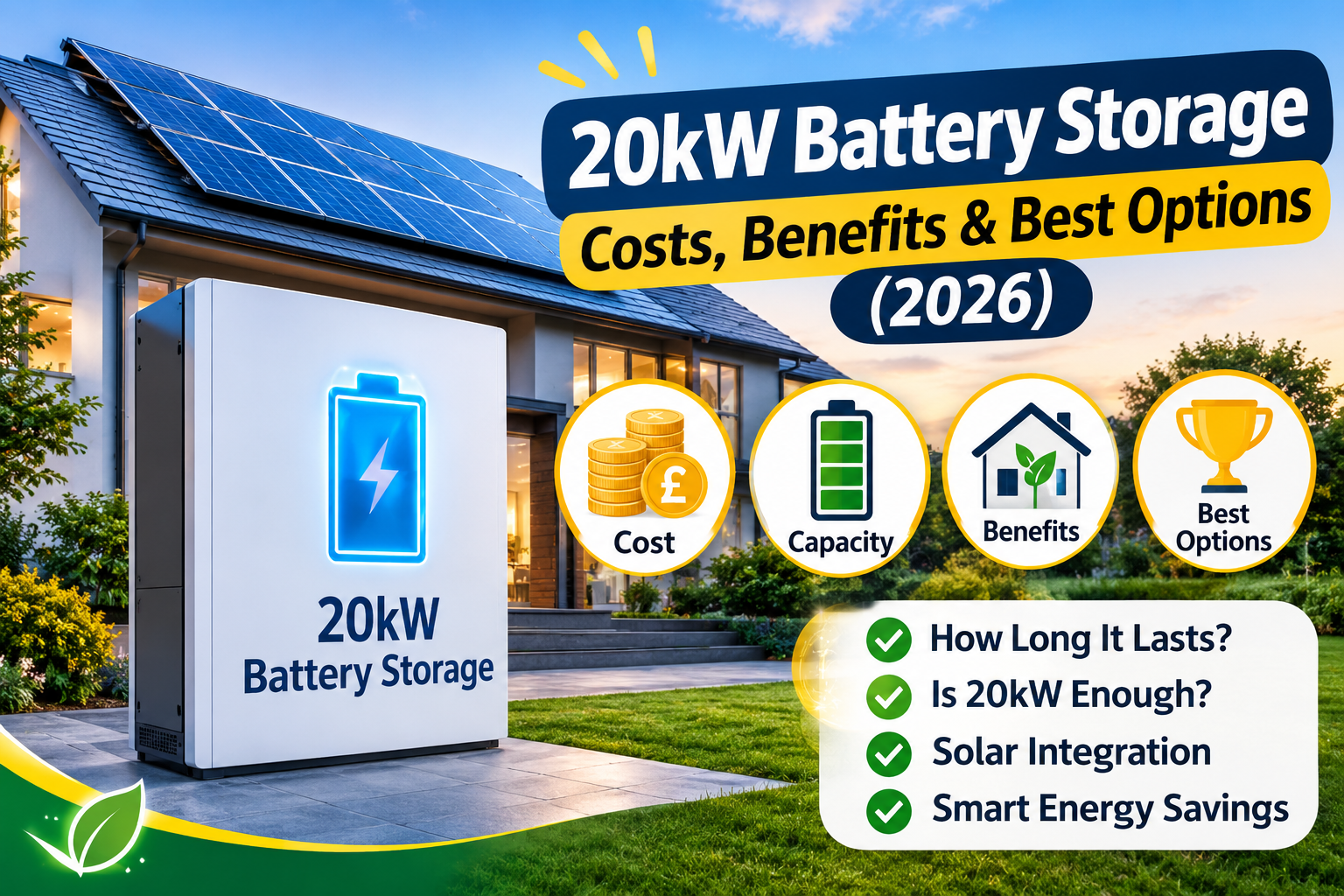
If you are considering 20kW battery storage, you may be looking for a large energy storage solution for your home, solar system, business, or other high-energy application. A battery of this size can store and deliver a substantial amount of energy, but choosing the right system requires more than simply looking at its headline capacity.
One of the first things to understand is the difference between kW and kWh. These two measurements are often confused, but they describe different aspects of a battery system.
In this guide, we explain what 20kW battery storage means, how much a 20kWh battery can store, how long it can last, potential costs, benefits, disadvantages, and what to consider before choosing a system in 2026.
Key Takeaways
- kW and kWh measure different things in a battery system.
- A 20kWh battery can store up to 20kWh of energy under its rated conditions.
- Large battery storage can be useful for homes and businesses with high electricity consumption.
- The actual cost depends on battery capacity, inverter, installation and system requirements.
- A bigger battery is not always the most economical choice.
- Solar panels, EV charging and time-of-use electricity tariffs can increase the potential value of battery storage.
What Is 20kW Battery Storage?
The phrase 20kW battery storage is often used when discussing large battery systems. However, technically, kW refers to power, while kWh refers to energy capacity.
For example, a battery system could have:
- 20kW maximum output and 20kWh capacity
- 10kW output and 20kWh capacity
- 20kW output and 40kWh capacity
These are different systems.
The kW rating tells you how much power the battery can deliver or accept at a particular time.
The kWh rating tells you how much energy the battery can store.
For most people comparing home batteries, the kWh figure is especially important because it determines how much stored electricity is available.
20kW vs 20kWh: What’s the Difference?
The easiest way to understand the difference is to think about a water tank.
The kWh capacity is similar to the amount of water the tank can hold.
The kW power rating is similar to how quickly water can flow out of the tank.
So, a battery with a high kWh capacity can store a lot of energy, but it also needs an adequate kW output if you want to operate several high-power appliances at once.
This means you should always check both power and capacity before buying a battery.
How Much Does 20kW Battery Storage Cost?
There is no single price for a 20kW battery storage system.
The final cost can depend on:
- Battery brand
- Storage capacity
- Inverter
- Installation
- Electrical upgrades
- Number of battery modules
- Backup requirements
- Monitoring equipment
- Solar integration
If by 20kW battery storage you actually mean a 20kWh battery, prices can vary significantly depending on the equipment and installation.
A larger battery system can cost considerably more than a standard residential battery, particularly when additional inverter capacity or electrical work is required.
For this reason, it is better to compare complete installed system prices rather than looking at the battery price alone.
Is a 20kWh Battery Enough for a Home?
For some homes, a 20kWh battery can provide a substantial amount of stored energy.
However, whether it is enough depends on your electricity consumption.
For example, imagine a household uses around 15kWh of electricity per day. A 20kWh battery could potentially cover a large portion of that consumption.
But actual usable energy can be lower than the headline capacity because of:
- Usable capacity limits
- Depth of discharge
- Inverter losses
- Battery efficiency
- System operating conditions
A household with an EV, electric heating, heat pump or other high-energy appliances may also consume electricity much faster.
How Long Can a 20kWh Battery Last?
Battery runtime depends mainly on the amount of power being used.
The basic calculation is:
Runtime = Usable battery capacity ÷ Average power consumption
For example:
20kWh ÷ 1kW = 20 hours
20kWh ÷ 2kW = 10 hours
These are theoretical examples. Real-world runtime can be shorter because of efficiency losses and the battery’s usable capacity.
If you only power essential appliances such as lighting, refrigeration, internet equipment and electronics, the battery may last considerably longer than if you run high-power appliances.
What Can a 20kWh Battery Run?
A 20kWh battery can potentially supply many household appliances.
Lower-power loads may include:
- LED lighting
- Refrigerator
- Television
- Wi-Fi router
- Laptop
- Security equipment
Higher-power appliances include:
- Oven
- Electric shower
- Washing machine
- Dishwasher
- Tumble dryer
- Heat pump
- EV charger
The important point is that energy consumption varies significantly between appliances.
Running several high-power appliances simultaneously can drain a battery much faster.
Why Combine Battery Storage With Solar Panels?
One of the biggest advantages of battery storage is the ability to store excess solar electricity for later use.
Solar panels generally produce the most electricity during daylight hours.
However, many households use more electricity during the evening.
Without a battery:
Solar generation → Home consumption → Excess electricity exported
With a battery:
Solar generation → Home consumption → Battery charging → Stored electricity used later
This can increase the amount of solar energy you use yourself.
For example, if your solar panels generate more electricity than your home currently needs, the surplus can be directed into the battery instead of being immediately exported.
Later, when solar production falls, the battery can discharge to help supply the home.
Can a 20kWh Battery Charge From the Grid?
Depending on the battery and inverter configuration, a battery can potentially be charged from the electricity grid as well as solar panels.
This can be useful with time-of-use electricity tariffs.
You could potentially charge the battery during lower-price periods and use the stored electricity when prices are higher.
However, the financial benefit depends on:
- Electricity prices
- Battery efficiency
- Charging and discharge limits
- Tariff structure
- Battery degradation
- Daily electricity consumption
It is therefore important to calculate the potential savings rather than assuming grid charging will always be profitable.
Benefits of 20kW Battery Storage
1. Large Energy Capacity
A larger battery can store more electricity than a small residential battery.
This can be useful for properties with significant energy consumption.
2. Better Solar Self-Consumption
Battery storage allows more excess solar generation to be stored and used later.
3. Support for EV Charging
Electric vehicles can significantly increase electricity consumption.
A battery can help manage when electricity is purchased and used.
4. Support for High-Energy Appliances
Homes and businesses using electric heating, heat pumps or other high-demand equipment may benefit from additional storage.
5. Backup Power
Some battery systems can provide backup electricity during a grid outage.
However, backup functionality depends on the battery, inverter and installation configuration.
6. Energy Management
Modern battery systems can integrate with solar panels, smart energy controls and EV chargers.
This can help automate charging and discharging according to energy production, consumption and electricity prices.
Disadvantages of Large Battery Storage
A large battery system also has some disadvantages.
Higher Initial Investment
Large battery systems generally cost more than smaller systems.
More Space Required
Additional battery modules require suitable installation space.
Bigger Is Not Always Better
If your electricity consumption is low, you may not use enough of the additional capacity to justify the extra cost.
More Complex Installation
Large systems may require more powerful inverters, additional electrical equipment or property upgrades.
Battery Degradation
Like all rechargeable batteries, energy storage systems gradually lose capacity over time.
This makes warranty terms, cycle life and guaranteed capacity important factors when comparing systems.
How to Choose the Right Battery Size
Instead of choosing a battery simply because it has a large capacity, start by analysing your electricity consumption.
Consider:
- Daily electricity usage
- Peak electricity demand
- Solar panel generation
- Evening electricity consumption
- EV charging
- Heating requirements
- Electricity tariff
- Backup power requirements
Your battery should be large enough to provide useful storage without paying for capacity that regularly remains unused.
What to Look for When Buying 20kW Battery Storage
Usable Capacity
Don’t only look at the advertised capacity. Check how much energy you can actually use.
Power Output
Check the maximum continuous and peak power output.
Efficiency
A more efficient system wastes less energy during charging and discharging.
Warranty
Look at warranty length, cycle limits and guaranteed remaining capacity.
Expandability
Some systems allow additional battery modules to be installed later.
Backup Capability
If backup power is important, check whether the system can provide whole-home or selected-load backup.
Smart Energy Features
Smart controls can help coordinate solar generation, battery charging, electricity consumption and EV charging.
Is 20kW Battery Storage Worth It?
For a high-energy property, 20kW-class battery storage can be worthwhile.
It can be particularly useful if you have:
- High electricity consumption
- A large solar PV system
- An electric vehicle
- Electric heating
- A heat pump
- Significant evening electricity use
- A suitable time-of-use tariff
- A need for backup power
However, a large battery is not automatically the most cost-effective option.
If your property uses relatively little electricity, a smaller battery may provide a better return on investment.
The best approach is to compare the additional cost of larger capacity against the additional energy you are actually able to use.
20kWh Battery vs Smaller Battery
| Feature | Smaller Battery | 20kWh-Class Battery |
|---|---|---|
| Upfront cost | Lower | Higher |
| Storage capacity | Lower | Higher |
| Space required | Less | More |
| High-energy properties | May be insufficient | Better suited |
| EV households | Depends on usage | More suitable |
| Backup duration | Shorter | Potentially longer |
| Risk of unused capacity | Lower | Higher |
| Installation requirements | Usually simpler | May be more complex |
The right choice depends on your individual energy profile.
Frequently Asked Questions
Is a 20kW battery the same as a 20kWh battery?
No. kW measures power, while kWh measures energy storage capacity.
How long will a 20kWh battery last?
It depends on the electricity load. At a theoretical average load of 2kW, 20kWh of usable energy would provide around 10 hours. Actual runtime will vary.
Can a 20kWh battery run a whole house?
It can supply many household loads, but runtime depends on consumption. High-power appliances can use stored energy quickly.
Can I use a 20kWh battery without solar panels?
Yes, depending on the battery and inverter configuration. Some systems can charge from the grid and discharge later.
Is a bigger battery always better?
No. The ideal capacity depends on electricity consumption, solar generation, tariff structure and your intended use.
Can a 20kWh battery be expanded?
Some battery systems are modular and can be expanded, but this depends on the manufacturer and inverter configuration.
Final Verdict
20kW battery storage can be a powerful energy solution for properties with high electricity demand. However, it is important to distinguish between 20kW of power and 20kWh of storage capacity before comparing systems.
A 20kWh-class battery can provide substantial stored energy, improve solar self-consumption, support EV charging and potentially provide backup power.
But the biggest battery is not necessarily the best battery.
Before buying, compare your energy consumption, solar generation, peak demand, tariff, battery efficiency, usable capacity, power output, warranty and installation cost.
Choosing the right-sized system can help you get more value from your battery investment while avoiding unnecessary storage capacity.