
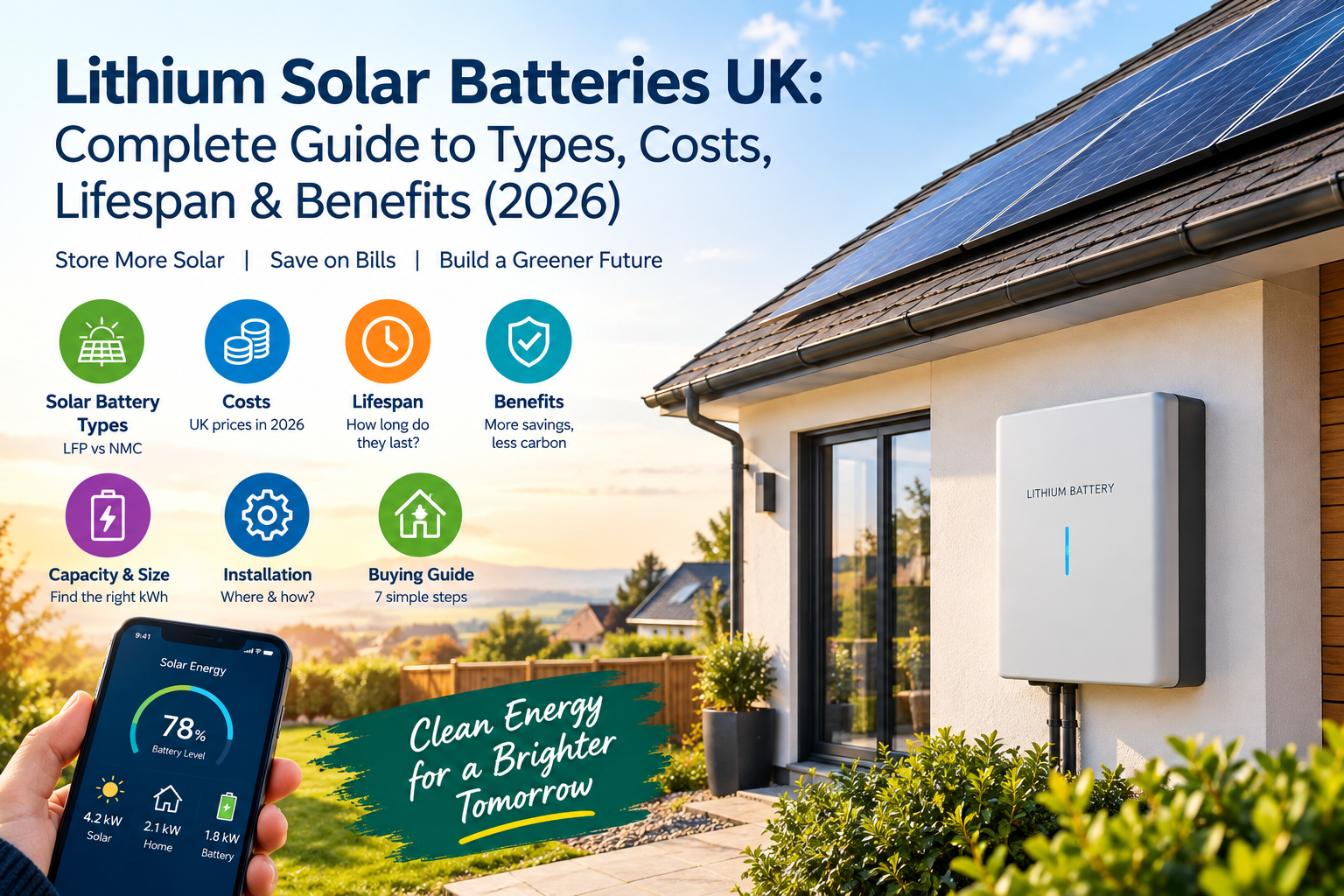
Lithium solar batteries are becoming increasingly popular in UK homes with solar panels. They allow homeowners to store surplus solar electricity during the day and use it later when solar generation falls.
Instead of sending all unused solar power to the grid, you can store some of it for the evening, overnight or other periods when your panels are producing less electricity. A suitable battery can also work with time-of-use electricity tariffs, allowing some households to charge when electricity is cheaper.
But choosing a battery isn’t simply about buying the biggest capacity or the cheapest product. Battery chemistry, usable capacity, power output, lifespan, warranty, inverter compatibility and installation cost all matter.
In this complete guide, we’ll explain lithium solar batteries in the UK, including how they work, different types, costs, lifespan, benefits, sizing, installation and what to check before buying.
What Are Lithium Solar Batteries?
Lithium solar batteries are rechargeable energy-storage systems that use lithium-ion technology to store electricity.
When your solar panels generate more electricity than your home currently needs, the surplus can be sent to the battery. The stored electricity can then be used later.
For example:
- Your solar panels generate electricity during the morning.
- Your home uses some of that electricity.
- Extra electricity charges the battery.
- Solar generation falls during the evening.
- Your battery discharges stored energy.
- Your home imports less electricity from the grid.
This is particularly useful for households that generate plenty of solar power during the day but use most of their electricity in the evening.
According to the Energy Saving Trust’s battery storage guidance, batteries can also be charged from the grid using suitable time-of-use tariffs.
How Do Lithium Solar Batteries Work?
A typical solar battery storage system works alongside your solar panels, inverter and home’s electrical system.
Solar panels produce DC electricity. Depending on the system design, an inverter manages this electricity so it can be used by your home, stored in the battery or exported to the grid.
Step 1: Solar panels generate electricity
During daylight hours, your solar panels generate electricity.
Your home normally uses available solar electricity first, depending on how the system is configured.
Step 2: Surplus electricity charges the battery
If your solar panels produce more electricity than your home needs, the surplus can be directed towards your battery.
Step 3: The battery stores the electricity
The lithium-ion cells store the energy until you need it.
Step 4: The battery powers your home
When solar generation drops, the battery can discharge to supply electricity to your home.
This can help increase solar self-consumption and reduce some grid imports.
Step 5: The inverter manages energy flow
A hybrid inverter can manage solar generation and battery storage in one system. Other installations may use separate equipment depending on the system design.
The exact efficiency depends on the battery, inverter, wiring, operating conditions and configuration.
Lithium Solar Battery Types: LFP vs NMC
One of the most important things to understand when choosing a battery is battery chemistry.
Two lithium-ion chemistries you may come across are Lithium Iron Phosphate (LFP or LiFePO4) and Nickel Manganese Cobalt (NMC).
LFP Lithium Solar Batteries
LFP batteries use lithium iron phosphate as their cathode material.
They are widely used for stationary energy storage because of their thermal stability and cycle-life characteristics.
For home solar storage, LFP is an important chemistry to consider because batteries may be charged and discharged regularly for many years.
NMC technology has a high energy density and has been widely used where compact size and weight are important.
For home solar storage, however, it is better to compare the complete battery system rather than assuming one chemistry is automatically better.
LFP vs NMC: Which Is Better?
| Feature | LFP | NMC |
|---|---|---|
| Thermal stability | Generally strong | Generally lower than LFP |
| Energy density | Good | Typically higher |
| Cycle-life potential | Generally strong | Varies by product |
| Home storage | Very common | Available |
| Cobalt in cathode | No | Yes |
| Best approach | Compare complete system | Compare complete system |
For many homeowners, LFP is an attractive option for stationary solar storage, but always check the individual manufacturer’s specifications.
Lithium Solar Battery Voltage: Low Voltage vs High Voltage
Another important specification is battery voltage.
Low-Voltage Lithium Batteries
Many residential low-voltage systems operate around the 48V range.
They can be suitable for certain solar and off-grid installations and are available in different capacities.
High-Voltage Lithium Batteries
High-voltage systems operate at substantially higher voltages.
For a given power level, higher voltage can reduce the current required, which may help with certain electrical losses and cable requirements.
However, high voltage doesn’t automatically mean a better battery.
The battery, inverter and electrical installation must all be compatible.
Modular Lithium Solar Batteries: Are Expandable Systems Worth It?
A modular battery system uses multiple battery modules rather than one permanently fixed unit.
Some systems allow you to start with a smaller capacity and add more modules later.
This can be useful if you expect your electricity consumption to increase.
For example, imagine installing solar today and buying an electric vehicle two years later. Your electricity consumption could increase significantly. An expandable battery may allow you to increase storage without replacing the complete system.
Before buying, check:
- Maximum expandable capacity
- Compatible battery modules
- Installation requirements
- Warranty conditions
- Whether adding modules affects the warranty
- Whether your inverter supports the larger system
Modularity can be particularly useful when your future energy needs are uncertain.
Lithium Solar Battery Capacity: How Many kWh Do You Need?
Battery capacity is normally measured in kilowatt-hours (kWh).
A 5 kWh battery can theoretically store 5 kWh of energy, while a 10 kWh battery can store twice as much.
However, advertised capacity isn’t necessarily the amount of electricity you can use every day.
You should also check the usable capacity.
For example, a 10 kWh battery with 90% usable capacity would provide approximately 9 kWh of usable energy.
The exact figure depends on the manufacturer’s specifications and system settings.
The Energy Saving Trust says a typical home battery system may be around 10 kWh, but the appropriate size depends on factors such as household electricity consumption and solar generation.
Don’t Automatically Buy the Biggest Battery
A larger battery normally costs more.
If your solar panels only produce a small amount of surplus electricity, a very large battery may frequently remain underused.
On the other hand, a household with high electricity consumption, an EV or heat pump may benefit from more storage.
The right battery is the one that matches your energy profile, not necessarily the one with the highest kWh rating.
Lithium Solar Battery Cost UK: How Much Does It Cost in 2026?
The lithium solar battery cost in the UK varies considerably depending on capacity, brand, chemistry, inverter requirements, installation and additional electrical work.
The Energy Saving Trust currently gives a broad battery-storage cost range of around £1,500 to £10,000, with approximately £4,600 for a 5 kWh system.
These figures refer to battery-storage systems and should not automatically be treated as the price of battery hardware alone.
What Affects Lithium Battery Price?
Important cost factors include:
- Battery capacity
- Battery chemistry
- Brand
- Usable capacity
- Inverter requirements
- Installation complexity
- Backup capability
- Monitoring equipment
- Electrical upgrades
- Number of battery modules
- Warranty and support
Battery-Only Price vs Installed Price
This distinction is extremely important.
A battery advertised online for a few thousand pounds may be the battery hardware only.
Your final project cost may also include:
- Labour
- Inverter
- Mounting equipment
- Cabling
- Protection equipment
- Commissioning
- Electrical work
- Grid/DNO requirements
- VAT and other project-specific costs
Therefore, always ask for the complete installed price rather than comparing battery-only prices.
Lithium Solar Battery Lifespan UK: How Long Do They Last?
The lithium solar battery lifespan depends on chemistry, cell quality, charging and discharging behaviour, temperature, depth of discharge and the number of cycles.
The Energy Saving Trust currently gives a typical battery-storage lifespan of around 10–12 years, although individual products can have different warranty periods and performance specifications.
What to Check in the Battery Warranty
Don’t only look at the number of warranty years.
Check:
- Warranty length
- Guaranteed remaining capacity
- Cycle limit
- Throughput limit
- Operating temperature conditions
- Installation requirements
- Warranty exclusions
- Whether the warranty is transferable
For example, a battery may have a 10-year warranty but also have a specified energy-throughput limit.
The warranty terms tell you much more than a simple “10-year warranty” headline.
Lithium Battery Management System: Why BMS Matters
A Battery Management System (BMS) is a critical part of a modern lithium battery.
The BMS monitors conditions such as:
- Cell voltage
- Temperature
- Current
- State of charge
- Charging conditions
- Discharging conditions
It helps keep the battery operating within its specified limits.
Some modern batteries also include:
- Active cell balancing
- Bluetooth monitoring
- CAN communication
- RS485 communication
- Battery heating
- Inverter communication
These features can be important when connecting the battery with an inverter and wider energy-management system.
Lithium Solar Batteries Benefits: Why Choose Lithium?
There are several reasons lithium batteries are popular for residential energy storage.
1. Higher Usable Energy
Modern lithium batteries can provide a substantial amount of usable energy in a relatively compact package.
2. Long Service Life
Quality lithium systems can be designed for years of regular cycling, although actual lifespan varies by product and operating conditions.
3. Low Maintenance
Compared with older lead-acid technologies, modern lithium systems generally require little routine maintenance.
4. Good Charging and Discharging Performance
Lithium technology can provide strong charge and discharge performance, depending on the battery specification.
5. Better Use of Solar Electricity
A battery allows you to store some of your daytime solar electricity for later use.
6. Time-of-Use Tariff Flexibility
A compatible battery can potentially charge when electricity is cheaper and discharge during more expensive periods.
7. Potential Backup Power
Some systems can provide backup power during a grid outage.
However, backup power isn’t automatically included with every solar battery. The battery, inverter, backup equipment and electrical configuration must support it.
Lithium Solar Batteries vs Lead-Acid Batteries
Lithium isn’t the only battery technology available.
Lead-acid batteries have been used for renewable-energy systems for decades, especially in certain off-grid applications.
| Feature | Lithium | Lead-Acid |
|---|---|---|
| Energy density | Generally higher | Generally lower |
| Maintenance | Usually low | Can require more attention |
| Usable capacity | Generally higher | Often more limited |
| Charging speed | Generally faster | Generally slower |
| Cycle life | Usually longer | Usually shorter |
| Weight | Usually lighter | Usually heavier |
| Upfront cost | Usually higher | Usually lower |
| Residential solar use | Very popular | More specialised |
For many modern home solar battery systems, lithium offers an attractive combination of usable capacity, efficiency, cycle performance and compact design.
However, if the priority is simply the lowest upfront equipment cost, other battery technologies may still be considered for certain applications.
Are Lithium Solar Batteries Worth It in the UK?
The answer depends on your household.
A battery may be worth considering if:
- You already have solar panels.
- You export a significant amount of surplus solar.
- You use lots of electricity in the evening.
- You have a suitable time-of-use tariff.
- You have an EV.
- You have a heat pump.
- You want to reduce some grid imports.
- You want optional backup power.
However, a battery isn’t automatically financially worthwhile for every household.
The Energy Saving Trust notes that battery savings can be significant but may not always justify the upfront cost. Stored energy also involves conversion losses compared with using solar electricity directly.
This is why you should estimate your potential annual savings before making a purchase.
Key Point to Remember
Choosing the right lithium solar battery is about matching capacity, power output, warranty, efficiency and compatibility with your home’s actual energy needs—not simply choosing the biggest or cheapest battery.
This is the key principle to keep in mind throughout the buying process.
Lithium Solar Battery Without Solar Panels: Can You Have One?
Yes.
You don’t necessarily need solar panels to install a home battery.
A compatible battery can potentially charge from the grid during cheaper periods and discharge during more expensive periods if your tariff and system support this operation.
For example:
Cheap electricity → Battery charges → Expensive period → Battery discharges
This can be particularly interesting for households using time-of-use electricity tariffs.
However, the financial calculation depends on the difference between charging and discharging prices, battery efficiency, degradation, standing charges and the system’s upfront cost.
The Energy Saving Trust confirms that battery storage can be used without solar panels.
Lithium Solar Batteries and Time-of-Use Tariffs
A time-of-use tariff charges different electricity prices at different times.
If electricity is cheaper overnight, a compatible battery can charge during that period and supply your home later.
With solar panels, you may have another source of low-cost electricity:
Solar generation → Battery → Evening household use
This can increase solar self-consumption.
However, electricity tariffs can change. Don’t assume today’s price difference will remain unchanged for the next ten years.
Lithium Solar Battery Backup Power: Will It Work During a Power Cut?
This is an important question many homeowners overlook.
A normal grid-connected solar system may shut down during a power outage.
A battery system with suitable backup functionality can be designed to keep selected circuits running.
Depending on the system, backup power may support:
- Lights
- Refrigerator
- Router
- Security systems
- Selected sockets
High-power appliances such as electric showers, ovens or heat pumps may require considerably more power.
Before buying, ask your installer:
“Exactly which circuits will remain powered during a grid outage?”
Don’t assume that installing a battery automatically means your entire home will stay powered.
Lithium Solar Battery Installation UK: Where Can It Be Installed?
The appropriate installation location depends on the product, property and manufacturer’s requirements.
Depending on the system, batteries may be installed in places such as:
- Garages
- Utility rooms
- External walls
- Suitable indoor spaces
The Energy Saving Trust recommends professional installation and suggests getting at least three quotes from MCS-certified installers.
Before installation, your installer should consider:
- Ventilation
- Temperature
- Access
- Electrical protection
- Manufacturer requirements
- Fire-safety considerations
- Clearance
- Existing inverter
- Grid/DNO requirements where applicable
Never choose an installation location simply because it is the easiest empty wall.
How to Choose Lithium Solar Batteries in the UK: 7-Step Buying Guide
Choosing a battery becomes much easier when you follow a structured process.
Step 1: Check Your Daily Electricity Usage
Look at your electricity bills or smart-meter data.
Work out approximately:
- Daily electricity use
- Evening consumption
- Overnight consumption
- Peak electricity periods
- Seasonal changes
This gives you a starting point for battery sizing.
Step 2: Check Your Solar Generation
Find out how much electricity your solar system generates.
A battery makes more sense when there is enough surplus generation to charge it, although grid charging can also be useful with suitable tariffs.
Step 3: Compare Usable Capacity
Don’t compare batteries only by headline kWh.
Look for usable capacity.
Two batteries with the same advertised capacity may not necessarily provide exactly the same amount of usable energy.
Step 4: Compare Power Output
Capacity tells you how much energy the battery stores.
Power output tells you how quickly it can deliver that energy.
A battery with a large capacity but low power output may not be ideal for a home that regularly runs several high-power appliances at the same time.
Step 5: Check Inverter Compatibility
If you already have solar panels, check whether the battery works with your existing inverter.
You may need:
- A compatible battery
- A compatible hybrid inverter
- Additional inverter equipment
- AC-coupling equipment
Professional system design is particularly important here.
Step 6: Read the Warranty Carefully
Compare:
- Warranty years
- Cycle limit
- Throughput
- Guaranteed capacity
- Warranty conditions
- Installer requirements
Don’t choose a battery purely because it has the longest headline warranty.
Step 7: Get Multiple Installation Quotes
Where possible, get at least three installation quotes.
Ask installers to quote for a similar specification so you can compare like-for-like.
Common Lithium Solar Battery Buying Mistakes
Even a good battery can be a poor purchase if it doesn’t match your home.
Mistake 1: Buying the Biggest Battery
More storage isn’t automatically better.
Mistake 2: Looking Only at the Battery Price
Installation and associated equipment can significantly change the final cost.
Mistake 3: Ignoring Usable Capacity
Headline capacity isn’t the whole story.
Mistake 4: Forgetting Power Output
A battery’s kWh rating doesn’t tell you how much power it can deliver at once.
Mistake 5: Ignoring Your Electricity Tariff
A battery’s financial value can depend heavily on when you buy and use electricity.
Mistake 6: Assuming Backup Is Included
Backup capability varies between systems.
Mistake 7: Ignoring Future Electricity Demand
An EV, heat pump or home extension could increase your electricity consumption.
Mistake 8: Choosing Only by Brand
A well-known brand doesn’t automatically make a particular model the best match for your property.
What Happens When a Lithium Solar Battery Is Full?
When the battery reaches its configured maximum state of charge, it stops accepting additional energy.
If your solar panels are still generating electricity, the remaining electricity can be:
- Used by your home.
- Exported to the grid.
- Directed to another supported load or system.
If your installation and tariff are eligible, surplus electricity may be exported under the Smart Export Guarantee (SEG).
What Happens When a Lithium Solar Battery Is Empty?
A battery normally doesn’t discharge completely to absolute zero.
Instead, the system keeps a minimum state of charge.
For example, if a battery has a 20% reserve, it may stop discharging once it reaches that level.
Your home can then import electricity from the grid.
The exact minimum charge level depends on the battery and system settings.
How to Maintain Lithium Solar Batteries
Modern lithium batteries generally require little routine maintenance, but they shouldn’t be completely ignored.
Monitor the System
Use the manufacturer’s monitoring app or energy-management system to check:
- Battery state of charge
- Solar generation
- Household consumption
- Charging and discharging
- System alerts
Keep the Battery Environment Suitable
Follow the manufacturer’s requirements for:
- Temperature
- Moisture
- Ventilation
- Clearance
- Physical access
Don’t Modify the System Yourself
Battery and inverter systems involve significant electrical energy.
Electrical work should be carried out by a suitably qualified professional.
Final Verdict on Lithium Solar Batteries in the UK
Lithium solar batteries can be an excellent addition to the right UK home, particularly when solar generation, household consumption and electricity tariffs work together.
Their main advantages include the ability to store excess solar energy, increase self-consumption, reduce some grid imports and potentially take advantage of cheaper electricity periods.
However, the cheapest battery isn’t necessarily the best, and the largest battery isn’t necessarily the best either.
Before buying, compare:
- Battery chemistry
- Usable capacity
- Power output
- Efficiency
- Warranty
- Cycle and throughput limits
- Inverter compatibility
- Backup capability
- Installation cost
- Future energy requirements
Most importantly, look at the whole system rather than the battery alone.
A correctly sized lithium battery can provide useful energy storage for many years, but its financial value depends on your household electricity use, solar generation, tariff and installation cost.
Frequently Asked Questions About Lithium Solar Batteries
How long do lithium solar batteries last?
A typical home battery system may last around 10–12 years, according to current Energy Saving Trust guidance. Individual products can have different warranties, cycle limits and expected operating lives.
Are lithium batteries better than lead-acid batteries for solar?
For many residential applications, lithium batteries offer advantages in usable capacity, energy density, charging performance and cycle life. However, the best option depends on your budget and intended application.
What is the best lithium battery for a UK home?
There is no single best battery for every property. The right option depends on your electricity consumption, solar system, inverter, available space, budget, tariff and whether you need backup power.
How much does a lithium solar battery cost in the UK?
Current battery-storage system prices vary widely. Energy Saving Trust currently gives a broad range of around £1,500–£10,000, with approximately £4,600 for a 5 kWh system. Installation and system configuration can significantly affect the final price.
Can a lithium battery work without solar panels?
Yes. A compatible home battery can potentially charge from the electricity grid during cheaper periods and discharge during more expensive periods.
Is LFP better than NMC for home solar?
LFP is widely used for stationary energy storage because of its thermal stability and cycle-life characteristics. However, the specifications and quality of the complete battery system should also be considered.
Do lithium solar batteries need maintenance?
They generally require little routine maintenance, but the system should be monitored and kept within the manufacturer’s operating requirements.
Can a lithium solar battery power a home during a power cut?
Some systems can provide backup power, but not every battery installation has this capability. Ask your installer exactly which circuits and appliances will remain operational during an outage.
How big should my solar battery be?
There is no universal size. Your installer should consider your daily electricity consumption, solar generation, evening usage, tariff and future energy needs.
Conclusion
Choosing lithium solar batteries in the UK is ultimately about finding the right balance between storage capacity, performance, cost and your household’s electricity habits.
For many homes, LFP lithium batteries can be an attractive option because they combine good energy-storage performance with strong cycle-life characteristics. But battery chemistry is only one part of the decision.
Before purchasing, compare the usable capacity, power output, efficiency, warranty, inverter compatibility, backup capability and complete installation cost.
Most importantly, don’t buy a battery simply because it has the highest capacity or the lowest price. A correctly sized and professionally installed system is far more important for getting good long-term value.
Disclaimer: This article is for general information only and is not electrical, financial or legal advice. Battery prices, tariffs, warranties, installation requirements and grid-connection rules can change. Always confirm current specifications with the manufacturer, energy supplier, DNO and a qualified UK installer before purchasing or installing a battery.

kqeudyljqedqzzkihemdfojmdqodlh