A solar battery can help you use more of your own solar electricity, but the battery itself is only part of the savings equation. Choosing the right electricity tariff can make a major difference to how much value you get from your battery.
With a suitable tariff, you may be able to charge your battery when electricity is cheaper and use that stored energy when grid electricity costs more. If you also have solar panels, you can potentially combine solar generation, battery storage and export payments to reduce your overall energy costs.
This is where solar battery tariffs in the UK become important.
In this guide, we explain how battery tariffs work, what makes a tariff suitable for solar battery owners, how time-of-use tariffs can help, when importing cheap electricity makes sense, how solar export payments fit into the picture, and how to choose a tariff without focusing only on the lowest advertised rate.
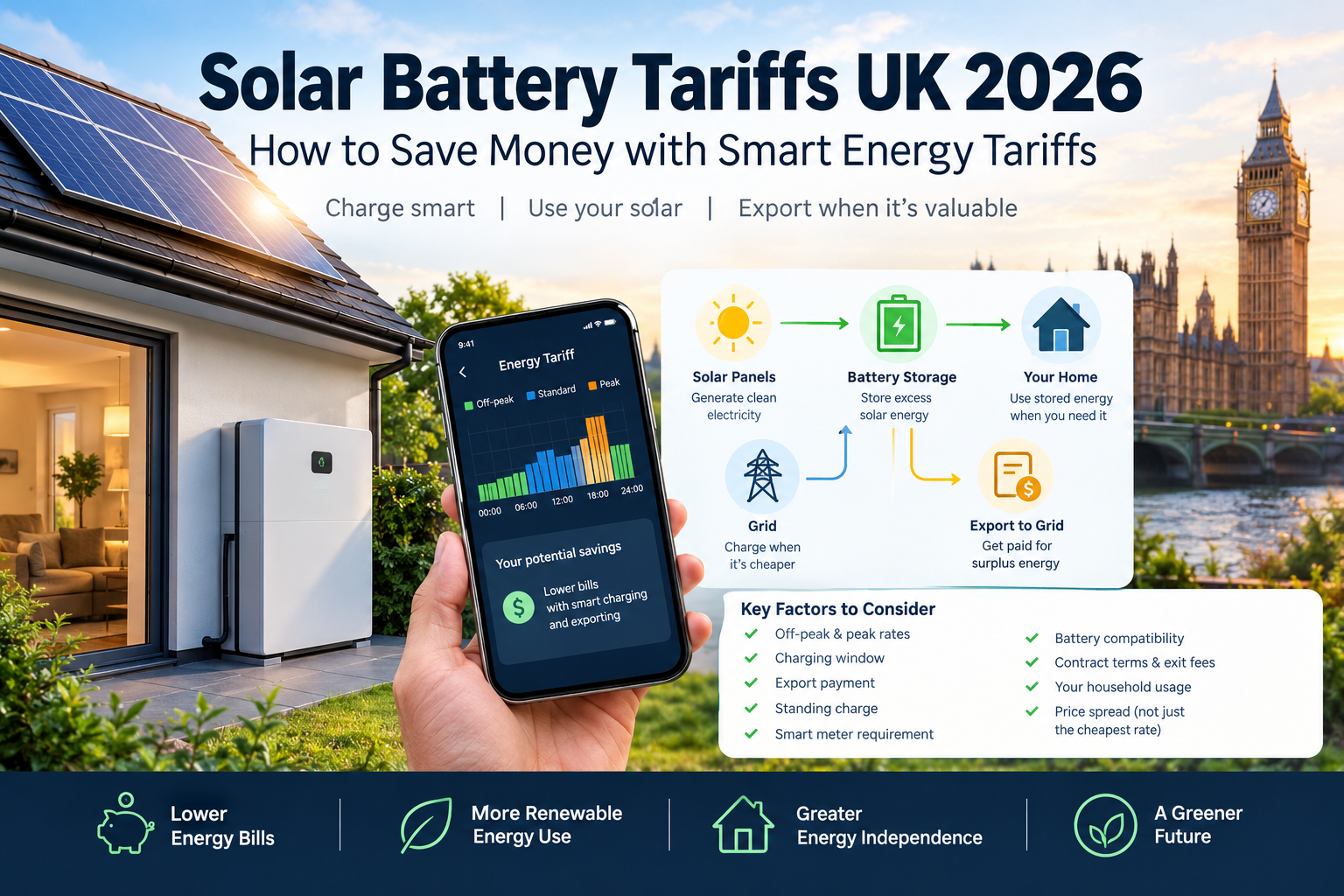
Quick answer: The best solar battery tariff is not necessarily the one with the lowest overnight price. You should compare the complete tariff, including off-peak and peak rates, charging window, export rate, standing charge, smart-meter requirements, battery compatibility and your household’s electricity usage.
Key Takeaways
- Solar battery tariffs can help you shift electricity use from expensive periods to cheaper periods.
- Time-of-use tariffs are particularly useful for households with batteries because charging and discharging can be scheduled around electricity prices.
- A cheap overnight rate is useful, but the difference between your charging rate and normal electricity rate can be even more important.
- Solar owners should consider both import costs and export payments.
- Your battery must have enough usable capacity and charging power to take advantage of the available cheap-energy window.
- A smart tariff is not automatically the cheapest option for every household.
- Standing charges, export rates, compatibility and contract conditions should all be checked before switching.
- Tariffs and prices change, so always check the supplier’s current terms before making a decision.
What Are Solar Battery Tariffs?
A solar battery tariff is an electricity tariff that can work particularly well with a home battery.
Traditional electricity tariffs usually charge a similar unit rate throughout the day. With a time-of-use tariff, electricity prices can vary depending on when you use energy.
For example, a supplier may offer:
- A cheaper overnight rate
- A higher daytime rate
- Different prices during evening peak periods
- A specific period when your battery can charge cheaply
- Different rates for exporting electricity to the grid
This creates an opportunity for battery owners.
Instead of buying all your electricity when prices are high, your battery can potentially store electricity during cheaper periods and supply your home later.
The basic idea is simple:
Cheap electricity → Charge battery → Expensive period → Use battery
However, the actual savings depend on your battery, household consumption, tariff structure, charging losses and how effectively your system is controlled.
Why Your Electricity Tariff Matters More When You Have a Battery
Imagine a household without a battery.
If electricity costs more in the evening, the household generally has little choice but to buy electricity at that price.
A battery changes this.
If the battery has enough stored energy, the household can use stored electricity instead of importing as much electricity from the grid during expensive periods.
This is sometimes called energy arbitrage.
For example, suppose your battery charges during a cheaper period and later supplies your home when electricity costs considerably more.
The larger the useful difference between the charging price and the avoided electricity price, the greater the potential benefit.
But there is an important catch.
A battery is not 100% efficient. Some electricity is lost during charging, discharging and conversion.
That means you should not simply compare:
Cheap rate vs expensive rate
Instead, consider the cost of the electricity that actually reaches your home after battery losses.
How Do Time-of-Use Tariffs Work With Solar Batteries?
A time-of-use (ToU) tariff divides the day into different pricing periods.
You might have:
- Off-peak hours
- Standard hours
- Peak hours
The exact times depend on the supplier and tariff.
For a battery owner, the important question is:
When is electricity cheapest, and when is electricity most expensive?
If the cheap period happens overnight, your battery may be programmed to charge during that window.
During the day, the battery can then supply some of your household demand.
This can be particularly useful for households that consume significant electricity during expensive evening periods.
However, a tariff with a short charging window may not work equally well with every battery.
For example, a battery with a large capacity may require more time to charge than a small battery.
Therefore, don’t choose a tariff simply because the advertised unit rate looks attractive.
Check the charging window and your battery’s charging power too.
Solar Battery Tariffs vs Standard Electricity Tariffs
The difference becomes easier to understand with a simple example.
Imagine a household currently paying a flat electricity rate.
During the day, electricity is imported from the grid.
In the evening, electricity is still imported from the grid.
With a suitable battery tariff, the household could potentially:
- Generate solar electricity during the day.
- Send surplus solar electricity into the battery.
- Use stored solar electricity later.
- Charge from the grid during a cheap tariff period when appropriate.
- Use stored electricity during a more expensive period.
This gives the household several ways to reduce expensive grid imports.
Ofgem currently publishes different rates for single-rate and multi-rate electricity tariffs, and actual prices vary by region and payment method.
Can You Charge a Solar Battery From the Grid?
Yes, depending on your battery system, tariff and installation configuration, a battery can potentially charge from the grid.
This is one of the biggest reasons a suitable time-of-use tariff can be useful.
Some homeowners assume that a solar battery should only ever charge from solar panels.
That’s not necessarily true.
A battery can potentially be used in two different ways:
Solar charging
Your panels generate electricity during the day.
Instead of exporting all surplus electricity, some of it is stored in the battery.
Later, you use the stored electricity in your home.
Grid charging
Your battery charges during a cheaper electricity period.
Later, it supplies electricity to your home when the applicable import rate is higher.
The second strategy can be useful even when there is little sunshine.
However, whether it is financially worthwhile depends on the tariff spread, battery efficiency and your system’s settings.
Solar Battery Tariffs and Solar Export Payments
If you have solar panels and a battery, you shouldn’t look only at electricity import prices.
You also need to consider export payments.
When your solar panels generate more electricity than your home and battery can use, the remaining electricity may be exported to the grid.
Depending on your eligibility and supplier, you may receive payment for exported electricity.
The UK Smart Export Guarantee (SEG) provides a framework under which eligible small-scale renewable generators can receive payment from licensed electricity suppliers for exported electricity.
This creates two sides to the calculation:
Import: What you pay for electricity.
Export: What you receive for electricity you send to the grid.
A good tariff strategy considers both.
Should You Export Solar Electricity or Store It in Your Battery?
This is one of the most important questions for solar battery owners.
Suppose your solar panels generate surplus electricity.
You have two broad choices:
Option 1: Export it
You send the electricity to the grid and receive the applicable export payment.
Option 2: Store it
You put the electricity into your battery and use it later.
Which option is better depends on the numbers.
If your export payment is relatively low and your battery allows you to avoid buying expensive electricity later, storing the energy may provide greater value.
But if your export rate is attractive, exporting some electricity could be better.
There is no universal answer.
You need to compare:
Value of using stored electricity later
against
Value of exporting the electricity now
This is why the best tariff for one solar household may not be the best tariff for another.
The Most Important Number: The Price Difference
When comparing solar battery tariffs, many people focus only on the cheapest advertised rate.
That’s a mistake.
Instead, look at the price difference between the cheap charging period and the expensive period.
For example, imagine:
- Off-peak electricity = 10p/kWh
- Expensive-period electricity = 30p/kWh
The difference is:
20p/kWh
Now imagine another tariff:
- Off-peak = 7p/kWh
- Expensive period = 22p/kWh
The difference is:
15p/kWh
The second tariff has a cheaper overnight rate, but the first tariff may provide a larger spread.
That doesn’t automatically make the first tariff better because standing charges, charging windows, export rates, household demand and other conditions also matter.
The key lesson is:
Don’t compare the cheap rate alone. Compare the whole tariff.
Current UK tariff comparisons similarly highlight the importance of the price spread rather than looking only at the off-peak rate.
How Much Can a Solar Battery Save With a Smart Tariff?
There is no single saving figure that applies to every UK home.
Your potential savings depend on:
- Battery capacity
- Usable battery capacity
- Battery efficiency
- Solar panel size
- Solar generation
- Household electricity consumption
- Electricity tariff
- Export tariff
- Charging window
- Battery charging power
- How often the battery cycles
- Seasonal solar production
For example, a household that uses lots of electricity in the evening may benefit more from battery storage than a household that uses most of its electricity during sunny daytime hours.
Similarly, a larger battery isn’t automatically better.
If your household doesn’t use enough electricity to make good use of the additional capacity, the extra cost may take longer to recover.
Example: How Battery Tariff Savings Could Work
Let’s use a simple example rather than promising a specific annual saving.
Suppose a battery imports:
8 kWh
during a cheap period at:
10p/kWh
The electricity cost would be:
8 × £0.10 = £0.80
Now suppose the battery later supplies electricity that would otherwise have been purchased at:
28p/kWh
At a simplified level:
8 × £0.28 = £2.24
The theoretical difference is:
£2.24 − £0.80 = £1.44
But this is not your actual profit.
Why?
Because battery charging and discharging involve losses. There may also be limits on usable capacity, battery degradation and other household energy flows.
This example simply demonstrates why the gap between cheap and expensive electricity can matter.
What Is the Best Tariff for Solar Battery Owners?
There isn’t one tariff that is best for every household.
Instead, there are several types worth investigating.
1. Time-of-Use Tariffs
These offer different electricity prices at different times.
They can work well when you can shift battery charging to cheaper periods.
2. Dynamic Tariffs
These can have prices that change more frequently, potentially reflecting wholesale market conditions.
They can offer attractive prices at certain times but may also require more active management and a household comfortable with changing rates.
3. Economy 7
Economy 7 provides cheaper electricity during a defined overnight period and a different rate at other times.
It can be worth considering for battery owners, particularly if the battery can charge effectively during the available off-peak window.
4. Solar-Specific or Battery-Friendly Tariffs
Some suppliers offer tariffs designed around homes with solar panels, batteries or smart energy systems.
These may combine import and export features.
5. Standard Tariffs
A standard tariff isn’t automatically a bad choice.
If your electricity consumption is low, your battery isn’t compatible with smart tariffs, or the available ToU rates don’t provide enough benefit, switching may not be worthwhile.
What Should You Check Before Choosing a Solar Battery Tariff?
Before switching, use this checklist.
1. Off-Peak Rate
How much does electricity cost during the battery charging window?
2. Peak Rate
How much will you pay when you are most likely to need grid electricity?
3. Charging Window
How many hours do you have to charge the battery?
A cheap rate lasting only a few hours may not be suitable for every battery.
4. Export Rate
If you have solar panels, check how much the supplier pays for exported electricity.
5. Standing Charge
Don’t ignore the daily standing charge.
A tariff with a low unit rate can still have a less attractive overall cost if its standing charge is high.
6. Smart Meter Requirement
Many time-of-use tariffs require a compatible smart meter.
Check this before switching.
7. Battery Compatibility
Some tariffs rely on specific battery-control systems or compatible manufacturers.
Always check compatibility with your battery model.
8. Minimum Requirements
Some tariffs may have requirements relating to smart meters, EVs, batteries, solar systems or other equipment.
Read the supplier’s current terms.
9. Exit Fees and Contract Terms
If you are moving from a fixed tariff, check whether an exit fee applies.
10. Your Actual Usage
The tariff should match how your household actually uses electricity.
Do You Need a Smart Battery for a Smart Tariff?
Not necessarily.
The term smart tariff can mean different things depending on the supplier.
Some tariffs may simply provide different prices during different periods.
Others can integrate with compatible battery systems and automatically control when the battery charges or discharges.
A genuinely automated system can make life easier because you don’t have to manually change battery settings every day.
However, compatibility is important.
Before signing up, check whether your battery manufacturer, inverter and energy-management system can work with the tariff.
What Happens in Winter?
Winter is particularly important for solar battery owners.
Solar generation is usually lower during shorter, darker days.
This means your battery may receive less energy from the solar panels.
A suitable time-of-use tariff can become more useful during periods when solar generation is insufficient to fully charge the battery.
For example, you may use solar energy when available and supplement the battery from the grid during cheaper periods.
This can help make the battery useful throughout the year rather than relying entirely on summer solar generation.
What About Summer?
Summer presents the opposite situation.
Your solar panels may generate more electricity than your household can use.
The battery can absorb some of that surplus.
Once the battery is full, additional electricity may be exported.
This means a solar battery tariff strategy should change with the seasons.
A sensible system might prioritise:
Summer: Solar charging → home use → export surplus
Winter: Solar charging when available → cheap grid charging when worthwhile → battery discharge during expensive periods
The best setup depends on your tariff and battery controls.
Common Solar Battery Tariff Mistakes
Mistake 1: Choosing the Cheapest Overnight Rate
The cheapest rate isn’t necessarily the best overall tariff.
Always compare the complete pricing structure.
Mistake 2: Ignoring Export Payments
Solar households can lose potential value by looking only at import prices.
Mistake 3: Ignoring Battery Losses
You don’t get every unit of electricity back from the battery.
Charging and conversion losses matter.
Mistake 4: Buying a Bigger Battery Just for a Tariff
A bigger battery isn’t automatically more economical.
Battery size should match household demand and solar generation.
Mistake 5: Ignoring the Charging Window
Your battery needs enough time to charge during the cheap period.
Mistake 6: Forgetting the Standing Charge
Always compare total expected costs, not just the unit rate.
Mistake 7: Assuming a Tariff Will Stay the Same
Energy tariffs can change.
Always check the current supplier information before making a decision.
Solar Battery Tariff vs Solar Export Tariff
These terms can sound similar but they are different.
A solar battery tariff usually refers to an electricity tariff that works well with battery storage, often through time-of-use pricing.
A solar export tariff relates to the payment you receive for electricity exported to the grid.
A household with solar panels and a battery may need to consider both.
The ideal setup could involve:
Cheap electricity import + efficient battery charging + valuable solar export
But the best combination depends on your circumstances.
Is It Worth Switching to a Battery Tariff in 2026?
For many battery owners, it is worth comparing the available tariffs.
The current UK electricity market gives battery owners several ways to manage when they import electricity.
Ofgem’s October–December 2026 price-cap figure for average electricity is 26.32p/kWh, although this is an average default-tariff figure rather than a price that every household will pay.
That makes the relationship between cheap charging periods and expensive usage periods particularly important.
However, don’t switch simply because another supplier advertises a low overnight rate.
Calculate your likely annual usage first.
Then compare:
Annual import cost + standing charges − export income
for your current tariff and the alternative.
That gives you a much more realistic comparison.
A Simple Way to Compare Two Tariffs
You can create a basic comparison using five numbers.
Step 1: Estimate annual electricity consumption
For example:
4,000 kWh per year
Step 2: Estimate how much electricity the battery can shift
Don’t assume the battery will cycle at full capacity every day.
Use a realistic figure based on your usage and system.
Step 3: Compare charging rates
Find the cost of electricity during the cheap charging window.
Step 4: Compare avoided import costs
Work out what rate you would otherwise pay when using the battery.
Step 5: Add export income
If you have solar panels, estimate how much electricity you export and the payment you receive.
This gives you a much more useful estimate than simply asking:
“Which tariff has the cheapest electricity?”
Are Solar Batteries Still Worth It Without a Special Tariff?
Yes, potentially.
A battery can still provide value by storing surplus solar electricity and using it later.
The tariff is an additional part of the financial picture.
For example, if your solar panels generate electricity at lunchtime but your household uses more electricity in the evening, a battery can shift some of that solar generation from one period to another.
A suitable tariff can add another layer of flexibility by allowing the battery to charge from the grid when electricity is cheaper.
Therefore:
Solar + battery + suitable tariff
can potentially provide more flexibility than solar panels alone.
What About VAT on Solar Batteries in 2026?
This is another factor worth knowing when calculating the overall cost of a battery installation.
UK rules currently provide zero-rate VAT treatment for qualifying installations of energy-saving materials, including qualifying electrical storage batteries, until 31 March 2027, subject to the applicable rules. From 1 April 2027, the standard reduced rate of 5% is scheduled to apply.
This means anyone considering a new battery installation in 2026 should understand the VAT treatment applicable to their particular installation.
The installer should confirm the correct VAT treatment.
How to Get the Most From Your Solar Battery Tariff
Here is a practical strategy.
During sunny days
Use solar electricity directly in your home where possible.
When solar generation exceeds household demand
Charge the battery.
When the battery is full
Export surplus electricity if exporting is financially worthwhile.
During cheap grid periods
Consider grid charging if your tariff and battery system support it and the economics make sense.
During expensive periods
Use stored battery electricity to reduce grid imports.
Every few months
Review your tariff.
Energy prices and supplier offers can change, so the tariff that works well today may not remain the best option indefinitely.
Final Verdict: Which Solar Battery Tariff Should You Choose?
The best solar battery tariff UK homeowners can choose in 2026 depends on how their home actually uses electricity.
Don’t choose a tariff just because it has the lowest overnight price.
Instead, compare:
- Off-peak electricity rate
- Peak electricity rate
- Price spread
- Charging window
- Export payment
- Standing charge
- Smart-meter requirements
- Battery compatibility
- Contract terms
- Your household electricity demand
For a home with solar panels and a battery, the goal is simple:
Buy electricity when it is cheap, store electricity efficiently, use your own solar energy when it has the most value, and export surplus electricity when that makes financial sense.
A well-matched tariff can turn a home battery from a simple storage device into a much more flexible energy-management tool.
But remember that tariff rates change frequently. Always check the supplier’s latest prices, eligibility requirements and battery compatibility before switching.
The cheapest tariff on paper is not always the cheapest tariff for your home. The best tariff is the one that matches your battery, solar system and real electricity usage.