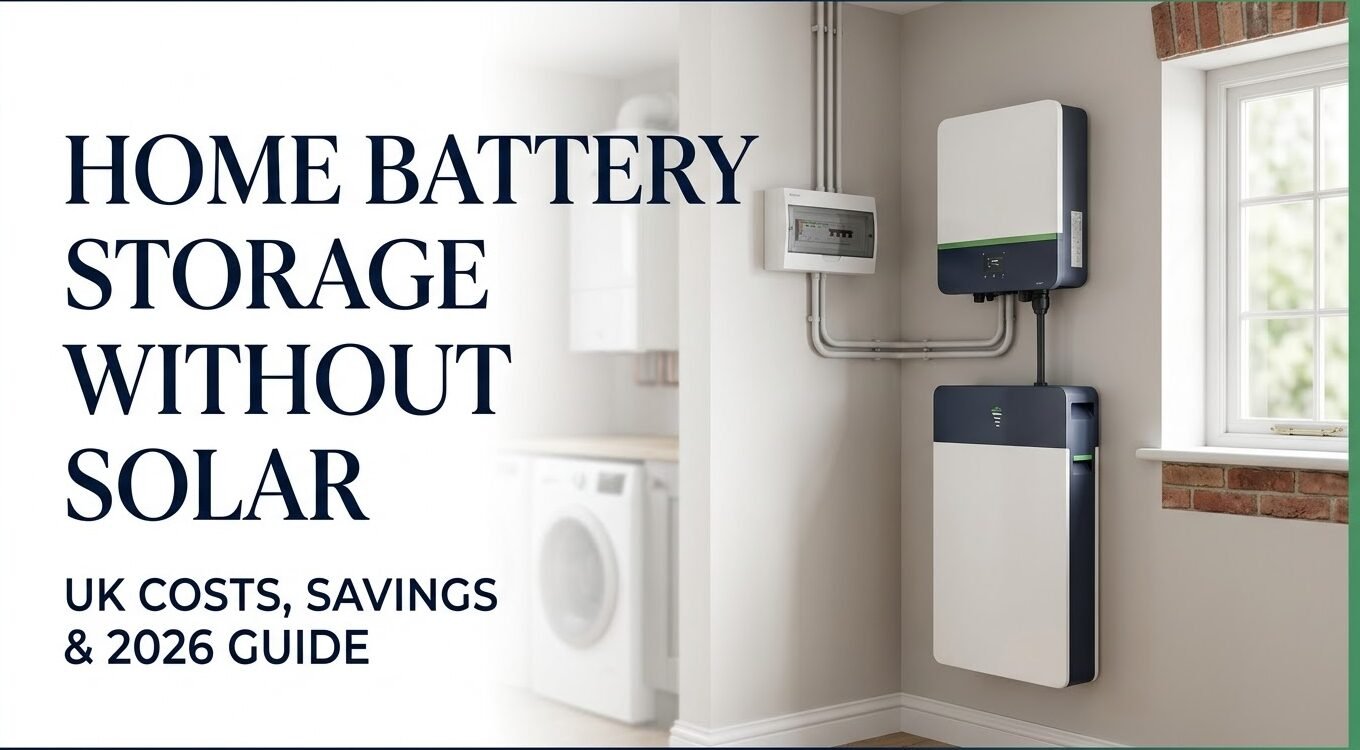
Home battery storage without solar in the UK allows homeowners to store electricity bought from the national grid and use it later when electricity prices are higher. Instead of generating electricity with solar panels, you charge the battery during cheaper periods, such as overnight, and use the stored energy during more expensive periods.
For UK households with a suitable smart electricity tariff, this approach may help reduce electricity bills. However, the results depend on the difference between cheap and expensive electricity rates, battery efficiency, installation costs and household energy consumption.
In this guide, we explain home battery storage without solar panels, typical installation costs, potential savings, battery sizes, charging methods, benefits, disadvantages and whether this technology is worth considering in 2026.
Key Takeaways
- Home battery storage without solar panels can store electricity purchased from the grid for later use.
- A time-of-use electricity tariff can help you charge your battery when electricity is cheaper.
- Battery storage systems can cost several thousand pounds, depending on capacity, equipment and installation requirements.
- A larger battery does not automatically mean greater savings.
- Battery efficiency, electricity price differences and upfront costs determine whether the system is financially worthwhile.
- Home batteries may also provide backup power, but only compatible systems with the necessary backup equipment can do this.
- Comparing installer quotes and calculating realistic savings before purchasing can help prevent an expensive mistake.
What Is Home Battery Storage Without Solar?
Home battery storage without solar is an electricity storage system that works without solar panels. It uses electricity supplied by your energy provider to charge a rechargeable battery installed in your home.
Once charged, the battery can supply electricity to compatible household circuits or appliances. This allows you to use electricity stored during cheaper periods instead of buying all your electricity during more expensive periods.
For example, imagine your electricity tariff offers a cheaper rate overnight. Your battery can charge during those hours and supply some of your home’s electricity during the following day.
This arrangement is sometimes called grid-charged home battery storage or battery storage without solar panels.
According to the Energy Saving Trust, batteries can be charged using cheaper electricity from the grid, including through suitable time-of-use tariffs.
Unlike a solar battery system, however, a grid-only battery does not generate free electricity. You must purchase the electricity you store, and some energy is lost during charging and discharging.
How Does Battery Storage Without Solar Panels Work?
A home battery system usually includes a rechargeable battery, a compatible inverter or power conversion equipment, a control system and the necessary electrical protection.
The exact configuration depends on the battery model and your home’s electrical installation.
Step 1: Choose a Suitable Electricity Tariff
First, check whether your electricity supplier offers a tariff with cheaper off-peak electricity.
Some tariffs offer lower rates overnight or during specific periods. Others use more flexible pricing arrangements.
A smart meter and a compatible tariff may be necessary to access these options.
Step 2: Charge the Battery From the Grid
The battery system is configured to charge during the cheaper period.
For example, a household might charge its battery overnight when the electricity rate is lower than the daytime rate.
The actual charging schedule depends on your tariff, battery capacity and energy requirements.
Step 3: Use Stored Electricity Later
After the cheaper period ends, the battery can supply electricity to your home.
Depending on the system settings, it may power selected circuits or help supply the wider household electrical load.
Step 4: Recharge When Electricity Is Cheap Again
The system can repeat this process automatically when properly configured.
However, the battery should not necessarily discharge completely. Battery management settings normally preserve a reserve to protect the battery and support any required backup function.
Important: Savings are not guaranteed. The electricity price difference must be large enough to cover battery losses and other costs.
Home Battery Storage Without Solar Cost UK (2026)
One of the first questions homeowners ask is how much a home battery costs without solar panels.
The total price depends on battery capacity, inverter requirements, installation complexity, electrical upgrades and whether backup power is included.
The Energy Saving Trust provides a general battery storage cost range of approximately £1,500 to £10,000, depending on the system, and notes that installation and system size affect the final cost.
A grid-only installation may have different requirements from adding a battery to an existing solar system. Therefore, obtain a quote specifically for battery storage without solar.
Estimated Home Battery Storage Costs
The following figures are illustrative budgeting ranges, not verified market quotations for October 2026. Actual installed prices can fall outside these ranges.
| Battery capacity | Illustrative installed budget | Suitable use |
|---|---|---|
| 5kWh | £3,000–£5,000 | Smaller households or partial daily use |
| 10kWh | £4,000–£7,000 | Many average-sized homes |
| 15kWh | £5,500–£9,000+ | Higher electricity consumption |
| 20kWh | £7,000–£12,000+ | Homes with substantial electricity demand |
These ranges are intended to help with initial planning. They are not supplier prices, and a 10kWh system will not necessarily cost twice as much as a 5kWh system.
Some products require a separate inverter, while others have integrated power electronics. Additional electrical work, installation location and backup equipment can also affect the price.
Before purchasing, ask the installer to confirm whether the quote includes the battery, inverter, labour, protection devices, commissioning, monitoring equipment and VAT where applicable.
What Affects the Installation Price?
Several factors determine your final home battery storage cost.
Battery capacity: Larger batteries generally cost more because they store more electricity.
Inverter compatibility: Some systems require a separate inverter or additional power conversion equipment.
Installation complexity: The distance from the consumer unit, cable routes, mounting requirements and available space can affect labour costs.
Backup functionality: Essential-load circuits, transfer equipment and other backup components may increase the total price.
Warranty and manufacturer: Warranty terms, product quality, monitoring features and manufacturer support can influence the purchase price.
For a more informed decision, compare at least three detailed installation quotations.
How Much Can You Save With a Home Battery Without Solar?
Potential savings depend mainly on how much cheaper your charging electricity is than the electricity you avoid purchasing later.
A battery cannot create energy. It moves electricity consumption from one period to another, while losing some energy in the process.
To understand the potential benefit, consider an illustrative example.
Suppose your electricity tariff charges:
- Off-peak electricity: 10p per kWh.
- Peak electricity: 30p per kWh.
- Battery round-trip efficiency: 90%.
These are example figures, not a claim about a currently available tariff.
To deliver 1kWh of usable electricity, the battery would need approximately 1.11kWh of electricity for charging if its round-trip efficiency were 90%.
The charging cost would therefore be approximately 11.1p, compared with 30p for buying 1kWh directly at the peak rate.
The gross difference would be approximately 18.9p per delivered kWh before battery degradation, standing charges that apply regardless, installation costs and other system expenses.
Example of Daily and Annual Savings
Suppose a battery delivers 5kWh of usable electricity per day, replacing electricity that would otherwise cost 30p per kWh.
With a charging rate of 10p per kWh and 90% round-trip efficiency:
- Cost of peak electricity avoided: £1.50 per day.
- Approximate electricity required to charge the battery: 5.56kWh.
- Charging cost: approximately £0.56 per day.
- Gross daily difference: approximately £0.94.
- Gross annual difference over 365 days: approximately £343.
This is a simplified calculation assuming the household uses all 5kWh of stored electricity to replace peak-rate consumption every day.
Actual savings may be lower because tariffs change, household demand varies, batteries degrade and some stored electricity may be used during periods when grid electricity is not expensive.
The example also excludes the initial purchase price. A gross annual saving of £343 does not mean that a battery costing £5,000 will pay for itself within a reasonable period.
Why Cheap Electricity Matters
A battery is usually more attractive when the difference between off-peak and peak electricity rates is substantial.
If you pay 22p per kWh to charge a battery and would otherwise pay 25p per kWh, the difference may be too small after battery losses.
On the other hand, a larger and consistent price difference can improve the economics.
Your household must also be able to use the stored electricity during the more expensive period. If you use very little electricity during the day, a large battery may sit partially unused.
Which Battery Size Do You Need Without Solar Panels?
The best battery size depends on your daily electricity consumption, the amount you can shift to cheaper periods and the power rating of the battery system.
Buying a battery based only on its advertised capacity can lead to unnecessary spending.
5kWh Home Battery
A 5kWh battery may suit a smaller household or someone who wants to shift a portion of their daily electricity use.
It may cover selected appliances and some evening consumption, depending on their energy requirements.
However, the amount of electricity available for everyday use can be lower than the advertised capacity because of reserve settings and conversion losses.
10kWh Home Battery
A 10kWh battery may suit a household with moderate electricity consumption and a suitable off-peak tariff.
It can offer more flexibility than a smaller battery, but it may cost more than necessary if your household cannot use the stored electricity regularly.
Before choosing this size, examine your smart meter data and estimate how much electricity you use during expensive periods.
15kWh or Larger Battery
A larger battery may be useful for households with high electricity demand, an electric vehicle, a heat pump or other energy-intensive equipment.
However, the battery’s maximum charging and discharging power also matters. A large battery with a low power rating may not be able to run several high-demand appliances simultaneously.
The correct system should match both your energy consumption and your peak power requirements.
Can You Charge a Home Battery From the Grid?
Yes. Many compatible home battery systems can charge from the electricity grid without solar panels.
However, you must select equipment that supports grid charging and arrange a suitable installation.
Before buying a system, confirm the following:
- The battery and inverter support grid charging.
- The system can follow your electricity tariff’s charging schedule.
- Your home’s electrical supply can support the required charging power.
- The installation complies with applicable electrical safety requirements.
- Your supplier’s tariff conditions are compatible with your intended use.
- Any export arrangements or restrictions are understood if you intend to export stored electricity.
Some batteries are designed primarily for solar installations, so do not assume every product supports standalone grid charging.
An installer should confirm the system’s capabilities before you commit to a purchase.
Best Electricity Tariffs for Battery Storage Without Solar
The electricity tariff you choose can have a major effect on the financial value of a battery.
Time-of-Use Tariffs
A time-of-use tariff charges different rates at different times of the day.
A battery can charge when electricity is cheaper and supply your home when the rate increases.
This is often the main reason households consider grid-only battery storage.
Overnight Electricity Tariffs
Some tariffs offer lower electricity prices overnight. These may be useful if you can charge the battery during the cheaper window and use the stored energy later.
Check the exact hours, eligibility conditions and unit rates before signing up.
Dynamic Electricity Tariffs
Some suppliers offer tariffs where prices change more frequently.
These may create opportunities to charge when prices are particularly low, but they can also introduce uncertainty. Your battery must support suitable controls, and you should understand how the tariff calculates charges.
Do not assume that every dynamic tariff will save you money.
How to Compare Tariffs
When comparing options, look at:
- The off-peak electricity price.
- The standard or peak electricity price.
- The number of cheap hours available.
- Whether the battery can charge quickly enough.
- Any tariff conditions or additional charges.
- Your likely electricity use during each period.
For current price-cap information and regional electricity rates, check Ofgem’s official energy price cap guidance.
Remember that the price cap applies to relevant default tariffs and does not mean every household pays the same rate. Your actual electricity prices depend on your tariff, region and payment method.
Benefits of Home Battery Storage Without Solar
1. Use Cheaper Electricity Later
The main advantage is the ability to shift electricity consumption from expensive periods to cheaper periods.
When the price difference is large enough, this can reduce the cost of running some household appliances.
2. No Solar Panels Required
A suitable system can work even if your property has an unsuitable roof, limited outdoor space or no solar panels.
This may make battery storage worth investigating for certain flats and homes where installing solar panels is impractical.
3. Automatic Charging and Discharging
Compatible systems can follow programmed schedules and manage charging automatically.
This reduces the need to manually control the battery every day, although settings and tariff compatibility should be checked.
4. Potential Support During Power Cuts
Some battery systems offer backup power, but this feature is not universal.
A battery may shut down during a power cut unless it has compatible backup functionality, the required transfer equipment and an appropriately configured electrical installation.
Ask which circuits can remain powered and how long the system is expected to run them.
5. More Control Over Electricity Use
A home battery may give you more flexibility over when you purchase and use electricity.
This can be helpful for households with predictable evening demand and access to lower off-peak prices.
Disadvantages of Battery Storage Without Solar
Despite the potential benefits, grid-only battery storage is not suitable for every home.
1. High Upfront Cost
The initial purchase and installation cost can be substantial.
Even if the battery saves money on electricity, the financial return may be poor if the annual savings are small.
2. Electricity Is Not Free
Without solar panels, you must pay for the electricity used to charge the battery.
The system makes financial sense only if shifting electricity consumption creates enough value to justify the cost.
3. Energy Losses
Batteries are not perfectly efficient.
Some electricity is lost during charging and discharging, so you must buy more electricity than the amount you later receive from the battery.
4. Battery Degradation
Battery capacity and performance can decline with age and use.
The actual lifespan depends on the product, operating conditions, charging patterns and warranty terms. Include possible replacement costs when assessing long-term savings.
5. Limited Backup Capability
Not every system can power a home during a power cut.
Even compatible backup systems have limits on output power, available capacity and the circuits they can support.
Home Battery Storage Without Solar vs With Solar Panels
Both approaches store electricity for later use, but the source of that electricity differs.
| Feature | Battery without solar | Battery with solar |
|---|---|---|
| Main energy source | Electricity grid | Solar panels and, where supported, the grid |
| Requires solar panels | No | Yes |
| Can use off-peak electricity | Yes, with a compatible system and tariff | Often, if supported |
| Can store surplus solar generation | No | Yes |
| Savings depend on tariff differences | Often a major factor | Can be a factor |
| Upfront equipment | Battery and required electrical equipment | Solar panels, battery and associated equipment |
| Suitable for homes without suitable roofs | Potentially | Not always |
A solar battery can store surplus electricity generated during the day, reducing the amount of electricity purchased later. A grid-only battery instead relies on buying electricity at a lower price and using it at a higher-price time.
If you already have solar panels, adding a battery may offer a different financial result from installing a standalone battery. Compare both options using your own electricity consumption and realistic installation quotations.
Is Home Battery Storage Without Solar Worth It in the UK in 2026?
The answer depends on your electricity tariff, daily energy consumption, system price and expected battery life.
It may be worth considering if:
- You have access to a consistently cheaper off-peak electricity rate.
- You regularly use electricity during more expensive periods.
- Your battery can charge and discharge at a suitable rate.
- The installation cost is reasonable compared with your expected savings.
- You intend to stay in the property long enough to benefit from the system.
It may not be worthwhile if:
- Your electricity tariff has little difference between cheap and expensive periods.
- You use very little electricity during peak-rate hours.
- Your installation quote is high.
- You would need to replace the battery before recovering its cost.
- You are buying a large battery that you will rarely use.
Calculate Your Potential Payback Period
A simple starting point is:
Simple payback period = Total installed cost ÷ Estimated annual net savings
For example, if your installed battery costs £5,000 and your estimated annual net savings are £500, the simple payback period would be 10 years.
This is only an illustration. It does not account for financing, changing electricity prices, degradation, repairs or the time value of money.
If your expected payback period is longer than the period for which you expect to benefit from the battery, the investment may not be attractive.
Use conservative savings estimates rather than relying only on the best possible charging prices.
How to Choose the Right Home Battery Without Solar
Choosing a suitable battery involves more than comparing prices and advertised capacity.
Check Usable Capacity
Battery capacity is measured in kilowatt-hours (kWh). Check the usable capacity rather than relying only on the total advertised capacity.
Also consider any reserve settings that limit how much energy can be discharged.
Compare Power Output
Power is measured in kilowatts (kW). It indicates how much electricity the battery can supply at one time.
A system with enough stored energy may still be unable to run several high-power appliances simultaneously if its output rating is too low.
Review Efficiency
Round-trip efficiency indicates how much of the electricity used to charge the battery can later be recovered.
A more efficient battery can reduce charging costs, all else being equal.
Check Warranty Terms
Ask about the warranty period, capacity-retention conditions, throughput limits and any requirements for maintaining the battery.
Do not compare warranty length alone; check what the manufacturer actually covers.
Confirm Installation Requirements
Ask a qualified installer to assess the electrical supply, consumer unit, proposed battery location, ventilation requirements and relevant safety measures.
The system must be compatible with your home’s wiring and intended operating mode.
Compare Multiple Quotes
Request at least three detailed quotations where possible.
Compare the complete installed cost, equipment, warranty, backup functionality, monitoring features and expected savings—not just the headline battery price.
Can a Home Battery Without Solar Power Your Entire House?
Potentially, but it depends on the system’s capacity, power output and installation design.
A battery’s capacity determines how much energy it can store. Its power rating determines how much electricity it can supply at one time.
For example, running a low-power appliance for several hours may require relatively little energy, while an electric shower or other high-power appliance may place a much greater demand on the system.
Some installations are designed to supply selected essential circuits, while others can support a larger proportion of household demand.
If you want whole-home backup, ask your installer to calculate the expected runtime and confirm which appliances can operate together. Do not assume a battery will power every appliance during a power cut.
Can You Export Electricity From a Battery Without Solar?
Some systems may be capable of exporting stored electricity to the grid, but the technical ability to export does not automatically mean you can do so under your existing arrangements.
Exporting electricity that you purchased earlier involves additional requirements, including compatible equipment, supplier arrangements and any applicable network or regulatory conditions.
The financial result also depends on the export payment, charging cost, battery losses and battery degradation.
For most households considering a standalone battery, the first calculation should focus on whether charging cheaply and using electricity later can reduce their own bills. Treat export income as a separate possibility that needs to be verified.
Installation and Safety Considerations
A home battery is a substantial electrical installation and should be selected and installed with professional guidance.
Before proceeding, confirm:
- The battery is suitable for grid charging without solar panels.
- The installation follows the manufacturer’s requirements and applicable UK electrical standards.
- The proposed location meets the equipment’s installation and safety requirements.
- The installer explains the isolation arrangements and monitoring system.
- Any backup power configuration is clearly documented.
- The installation quotation identifies the work and equipment included.
For additional reassurance, obtain multiple quotes from appropriately qualified installers and ask for details of their relevant certifications and experience.
Do not attempt to connect a home battery directly to household wiring yourself.
Frequently Asked Questions
1. Can I install a home battery without solar panels in the UK?
Yes. You can install a suitable battery system without solar panels if the equipment supports grid charging and the installation meets the relevant requirements. You can then store electricity purchased from your supplier and use it later.
2. How much does home battery storage without solar cost in the UK?
The price varies with battery capacity, inverter requirements, installation work and backup features. A system can cost several thousand pounds. Obtain current, itemised quotations to establish the actual price for your property.
3. Is battery storage without solar worth it?
It can be worthwhile for households that regularly charge at low electricity rates and use the stored energy when electricity is more expensive. High installation costs or small price differences can make the investment unattractive.
4. Can I charge a home battery overnight?
Yes, if your battery, inverter and control system support grid charging. You will also need an appropriate electricity tariff and charging schedule.
5. What size battery do I need without solar panels?
The correct size depends on your daily electricity use, the amount of peak-rate consumption you can replace and the battery’s charging and discharging power. A professional assessment and smart meter data can help determine the appropriate capacity.
6. Will a home battery work during a power cut?
Only if the system includes suitable backup functionality and has been installed and configured for that purpose. Some batteries shut down during grid outages. Confirm the available backup power and supported circuits before buying.
7. How long does a home battery last?
Lifespan depends on the battery chemistry, operating conditions, usage and warranty. Many home battery systems are designed for years of operation, but performance declines over time. Review the manufacturer’s warranty and capacity-retention conditions.
8. Can I use a battery with a standard electricity tariff?
A compatible battery can operate with a standard tariff, but the financial benefits may be limited if electricity prices remain similar throughout the day. A suitable time-of-use tariff can provide more opportunities to reduce charging costs.
9. Do I need a smart meter?
A smart meter is commonly useful for accessing time-of-use tariffs and measuring electricity consumption. Whether it is required depends on the tariff and supplier. Confirm the eligibility conditions with your electricity provider.
10. Is a 10kWh battery enough for a UK home?
It may be enough for some households, but not all. The right capacity depends on how much electricity you use, when you use it and how much of that demand you want the battery to cover.
Final Verdict: Is Home Battery Storage Without Solar Worth Buying?
Home battery storage without solar in the UK can be useful, but the numbers must work before you buy.
The main opportunity is to charge the battery when electricity is cheaper and use the stored energy during more expensive periods. The amount you save depends on your tariff, battery efficiency, electricity consumption and installation cost.
Start by reviewing your electricity usage, comparing available tariffs and obtaining several installation quotations. Then estimate your annual net savings and simple payback period.
If the expected savings are realistic and the system meets your needs, a grid-charged home battery may be worth considering. If the financial return is weak, reducing electricity consumption or exploring solar panels and battery storage together may be better alternatives.
For further guidance, read the Energy Saving Trust’s battery storage guide and compare the options carefully before making a decision.
Disclaimer: Prices and savings in this guide are estimates or illustrative examples, not guaranteed results. Confirm current product prices, electricity tariffs, installation requirements and warranty conditions before purchasing.