
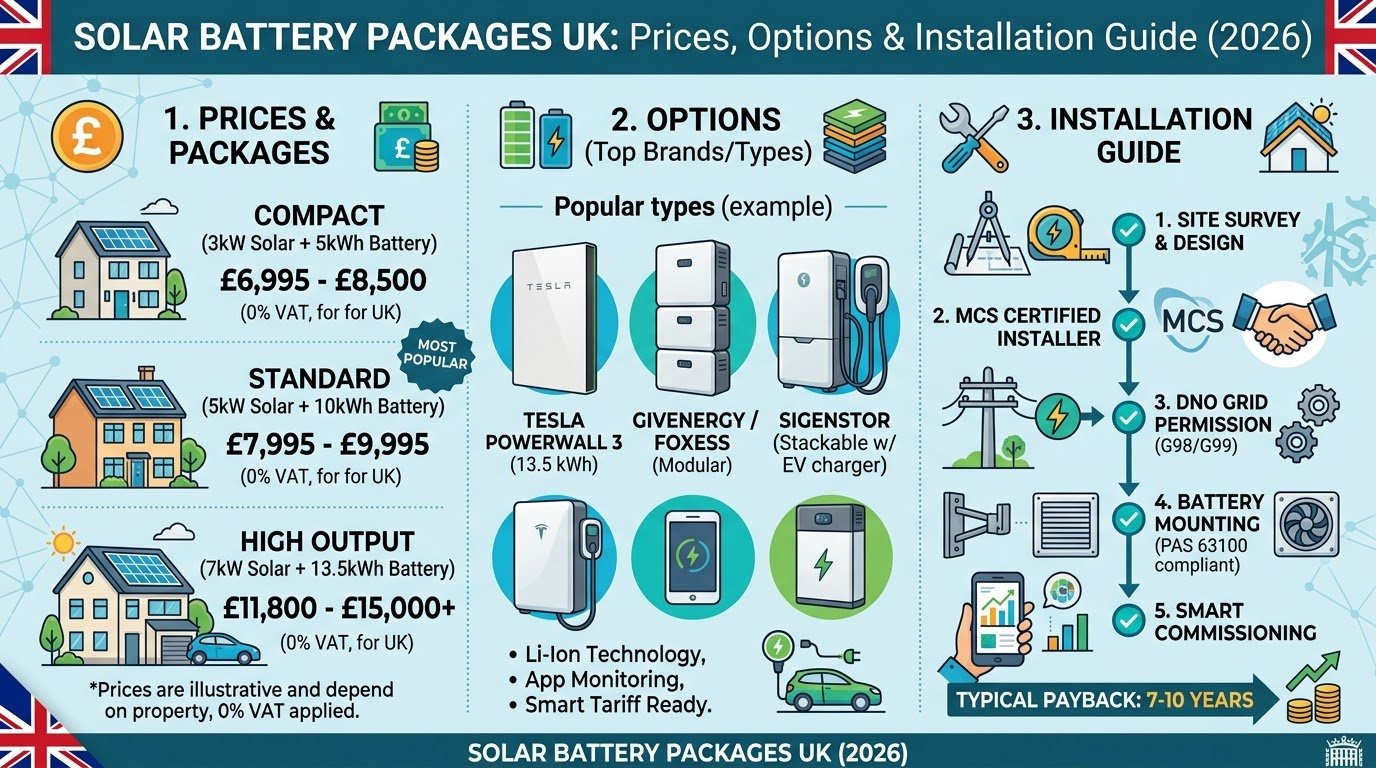
If you are looking at solar battery packages UK homeowners can buy in 2026, you have probably noticed that there are many different options. Some packages include solar panels and a battery, while others are designed for homes that already have solar panels and simply want to add battery storage.
At first, the choice can feel confusing.
Should you choose a 5kWh battery or 10kWh? Do you need a hybrid inverter? Is a complete solar panel and battery package UK installer offering better value than buying the equipment separately? And how much should you actually expect to pay?
The good news is that understanding solar battery packages does not have to be difficult.
A typical system combines solar panels, battery storage, an inverter and electrical equipment, with professional installation and certification depending on the package. The battery stores electricity generated by your solar panels so that you can use more of that energy later, rather than using all of it at the moment it is generated.
According to the Energy Saving Trust’s battery storage guidance, home batteries can store excess solar electricity for later use and can also work alongside time-of-use tariffs.
For example, imagine your solar panels generate plenty of electricity at lunchtime while everyone is out. Later, around 6pm, your family returns home, switches on the lights, starts cooking dinner and uses other appliances.
Instead of buying all that evening electricity from the grid, your battery may be able to supply some of it from energy stored earlier.
That is the basic idea behind solar battery storage.
This guide explains solar battery packages UK prices, battery sizes, package options, installation, warranties, smart tariffs, inverter choices and the questions you should ask before buying.
What Are Solar Battery Packages UK Homeowners Can Buy?
A solar battery package is a collection of equipment designed to work together as a home energy system.
Depending on the installer, supplier and package you choose, it may include:
- Solar PV panels
- Solar battery storage
- Hybrid inverter
- Roof mounting equipment
- DC and AC cabling
- Electrical protection equipment
- Monitoring equipment
- Mobile monitoring app
- Installation labour
- Testing and commissioning
- Certification
- DNO-related work where required
- Product warranties
- Installation workmanship warranty
Some companies offer complete solar panel and battery packages, while others specialise in battery systems for properties that already have solar panels.
This means there is no single type of package that suits everyone.
If you are starting from scratch, a complete solar panels and battery package may be convenient because the entire system can be designed together.
If you already have solar panels, however, you may only need a home battery storage UK solution that works with your existing equipment.
Solar Battery Packages UK Prices: How Much Do They Cost?
One of the first questions most homeowners ask is:
How much do solar battery packages cost in the UK?
There is no fixed UK-wide price because the final cost depends on the battery size, inverter, solar panel capacity, property and installation requirements.
The Energy Saving Trust currently says battery storage can range from approximately £1,500 to £10,000, depending on the type and size of battery, with an indicative cost of around £4,600 for a 5kWh battery system.
Its broader guide to energy storage gives typical battery-storage costs of around £5,000 to £8,000.
Remember that a battery-only installation is different from a complete solar-and-battery system.
A full package can include:
- Solar panels
- Battery
- Inverter
- Roof mounting
- Electrical equipment
- Labour
- Scaffolding where required
- Testing
- Certification
- System design
Therefore, when comparing solar battery packages UK prices, always ask what the advertised price actually includes.
A package costing £6,000 and another costing £7,000 cannot be compared properly if the cheaper one excludes important installation work.
Solar Panel and Battery Packages UK: What Is Usually Included?
A complete solar panel and battery package UK system normally combines solar generation and battery storage.
For example, a package might contain:
Solar panels + hybrid inverter + battery + mounting system + installation
The advantage is that the installer can design the solar panels, inverter and battery as one system.
This can also make the installation process simpler.
The Energy Saving Trust says installing battery storage at the same time as solar panels can help reduce costs because the installer is already working on the property.
However, you should still compare the equipment specifications rather than assuming every package offers the same value.
Check the:
- Solar panel wattage
- Number of panels
- Battery capacity
- Usable battery capacity
- Inverter output
- Battery warranty
- Installation warranty
- Monitoring system
- Certification
Home Battery Storage UK: How Does It Work?
The easiest way to understand home battery storage UK systems is to follow the electricity.
During the day, your solar panels generate electricity.
Your home uses some of it immediately.
If your panels generate more electricity than your home currently needs, the surplus can be sent to the battery.
The battery stores that energy.
Later, when solar generation falls, the stored electricity can be used.
The basic flow is:
Solar panels → inverter → home + battery → stored electricity → home later
For example:
Imagine your solar system generates 8kWh between 10am and 4pm.
Your home uses 4kWh during those hours.
The remaining energy may be available for storage or export, depending on your system.
Later in the evening, your household might need another 4kWh.
A battery can potentially supply some of that electricity.
This is one of the main reasons people consider solar battery storage.
The Energy Saving Trust explains that batteries can also charge from the grid during cheaper tariff periods and discharge later when electricity prices are higher.
5kWh Solar Battery vs 10kWh Battery: Which Size Is Right?
One of the biggest decisions when buying a solar battery package is battery capacity.
Battery capacity is measured in kilowatt-hours (kWh).
A 5kWh battery has a nominal capacity of 5kWh, while a 10kWh battery has approximately twice the nominal storage capacity.
But bigger does not automatically mean better.
The right battery depends on how much electricity your household uses and when it uses it.
The Energy Saving Trust says a typical home battery system might be around 10kWh, but there is no exact formula for determining the right size for every household.
A 5kWh battery may suit:
- Smaller households
- Lower electricity users
- Homes with modest evening demand
- Some smaller solar PV systems
- Homeowners looking for a smaller initial investment
A 10kWh battery may suit:
- Larger households
- Homes with higher evening electricity use
- Properties with larger solar PV systems
- Homes with an EV
- Homes using significant amounts of electricity after sunset
However, these are general examples rather than fixed rules.
The best way to size your battery is to look at your actual electricity consumption and solar generation.
Solar Battery Storage Cost UK: What Changes the Price?
The solar battery storage cost UK homeowners pay depends on several factors.
Battery Capacity
Larger batteries generally require more investment.
However, buying additional capacity only makes sense if your household can make good use of it.
Solar Panel Capacity
A package with 10 solar panels will normally cost differently from one with 16 panels.
The installer needs to consider your roof space, shading, orientation and electricity demand.
Inverter
The inverter is an important part of the system.
A hybrid inverter can manage solar generation and battery storage, depending on the system design.
Installation
Installation costs vary according to the property.
For example, the installer may need to deal with:
- Long cable runs
- Difficult access
- Additional electrical work
- Consumer-unit upgrades
- Scaffolding
- Battery location
- Existing solar equipment
This is why two homes with the same battery can receive different installation quotes.
Hybrid Inverter UK: Why Does It Matter?
When comparing solar battery packages UK, do not overlook the inverter.
The inverter converts the electricity generated by your solar panels into electricity that your home can use.
A hybrid inverter can also manage battery storage within the system.
If you are installing solar panels and battery storage at the same time, the installer can design the system around the inverter and battery from the beginning.
If you already have solar panels, however, your existing inverter may affect which battery options are suitable.
This is particularly important for retrofit installations.
Before buying a battery, ask:
“Is this battery compatible with my existing inverter?”
If the answer is unclear, get a professional assessment before placing an order.
Best Solar Battery UK: What Should You Compare?
Instead of choosing a battery based only on brand name, compare the specifications that actually affect how the system works.
Important points include:
Usable Capacity
Do not look only at the battery’s headline capacity.
Check how much energy is actually available for use.
Maximum Charge Power
This tells you how quickly the battery can accept electricity, subject to the system’s design.
Maximum Discharge Power
This affects how much power the battery can provide to your home at a given time.
Depth of Discharge
This indicates how much of the battery’s capacity can normally be used.
Warranty
Check the number of years and the conditions attached to the warranty.
Cycle Rating
Some manufacturers specify a number of charging and discharging cycles.
Compatibility
Make sure the battery works with the chosen inverter and other system components.
Monitoring
A good monitoring system can help you see solar generation, battery charging and household electricity use.
LiFePO4 Solar Battery UK: What Is It?
When researching a LiFePO4 solar battery UK shoppers may notice this term frequently.
LiFePO4 stands for lithium iron phosphate.
It is a type of lithium battery chemistry used in many modern energy-storage systems.
However, battery chemistry is only one part of the decision.
You should also compare:
- Usable capacity
- Charging power
- Discharge power
- Warranty
- Cycle life
- Depth of discharge
- Inverter compatibility
- Battery management system
- Manufacturer support
A battery with impressive specifications is not automatically the right choice if it is poorly matched to your home’s energy requirements.
AC-Coupled vs DC-Coupled Battery Storage
If you are researching solar battery installation UK options, you may see the terms AC-coupled and DC-coupled.
They describe how the battery connects to the solar and electrical system.
AC-Coupled Battery
An AC-coupled battery can be useful when adding storage to an existing solar installation.
Depending on the system, it may allow a homeowner to add battery storage without replacing the existing solar inverter.
DC-Coupled Battery
A DC-coupled system connects the battery more directly with the solar generation side.
This can be useful when solar panels and battery storage are designed together from the beginning.
The appropriate configuration depends on your equipment and installation.
Solar Battery Installation UK: Step-by-Step Guide
Once you understand the equipment, the next question is how installation works.
Step 1: Check Your Electricity Consumption
Start with your electricity bills.
Look at your:
- Annual consumption
- Daytime usage
- Evening usage
- Weekend usage
- Winter usage
- EV charging
- Electric heating
- Heat-pump consumption
This information helps determine the appropriate system size.
Step 2: Assess Your Solar Potential
If you are installing new solar panels, the installer should assess your roof.
Important factors include:
- Roof direction
- Roof angle
- Shading
- Available roof area
- Roof condition
- Structural considerations
A good design should consider both your roof and your household electricity needs.
Step 3: Decide on Battery Capacity
Now compare 5kWh, 10kWh and larger battery systems.
Do not automatically choose the largest option.
A battery should be large enough to serve your needs without paying for substantial unused capacity.
Step 4: Get Multiple Quotes
The Energy Saving Trust recommends getting at least three quotes from installers certified by MCS.
This is one of the easiest ways to compare:
- Equipment
- System design
- Installation
- Warranty
- Price
- Expected performance
A simple comparison table can help:
| Feature | Package A | Package B | Package C |
|---|---|---|---|
| Solar panel capacity | — | — | — |
| Battery capacity | — | — | — |
| Usable battery capacity | — | — | — |
| Inverter | — | — | — |
| Installation included | — | — | — |
| Certification | — | — | — |
| DNO work | — | — | — |
| Battery warranty | — | — | — |
| Workmanship warranty | — | — | — |
| Total price | — | — | — |
This allows you to compare packages on the same basis.
MCS Solar Battery Installer UK: Why Certification Matters
When choosing a solar battery installer UK homeowners should check the installer’s credentials.
The Energy Saving Trust recommends using MCS-certified installers and obtaining several quotes.
You should also ask about:
- Electrical qualifications
- Insurance
- Workmanship warranty
- Product warranties
- After-sales support
- Fault response
- Maintenance
Certification is important, but you should still compare the complete quote and installation terms.
DNO Approval for Solar Battery Installation
Another term you may encounter is DNO, which stands for Distribution Network Operator.
Depending on your system, the installer may need to notify or obtain approval from the relevant electricity network operator.
This is something your installer should explain before installation.
Ask:
“Will you handle the DNO application or notification?”
Also ask whether it is included in the quoted price.
A professional installer should be able to explain what is required for your specific system rather than leaving you to work it out yourself.
Solar Battery Packages and Smart Tariffs
One of the most interesting developments in home energy is the combination of battery storage and smart electricity tariffs.
A time-of-use tariff changes the electricity price depending on the time of day.
That means electricity may be cheaper during certain periods and more expensive during others.
A compatible battery can potentially:
Charge during cheaper periods → store electricity → supply your home later
If you have solar panels, the battery can also charge from surplus solar electricity.
So a battery may have two charging opportunities:
Solar electricity + cheaper grid electricity
The Energy Saving Trust says battery storage can be used alongside smart time-of-use tariffs and that the potential savings depend on the household, technology combination and tariff.
Therefore, do not choose a tariff simply because someone says it is “the best”.
Check the actual rates, charging periods, export terms and conditions.
Smart Export Guarantee UK: Can You Get Paid for Exporting Electricity?
If your solar panels generate more electricity than your home and battery need, you may be able to export the surplus to the grid.
The Smart Export Guarantee (SEG) is a government-backed scheme under which eligible small-scale generators can receive payments from participating electricity suppliers for electricity exported to the grid.
However, SEG rates are not all the same.
Suppliers set their own rates and contract terms, so it is important to compare the available options.
Ofgem publishes information about current SEG licensees and eligibility requirements.
Battery storage can also be used alongside a SEG installation, but the arrangement must meet the relevant requirements. Ofgem’s guidance specifically addresses the co-location of battery storage with SEG installations.
Can Solar Battery Packages Reduce Electricity Bills?
A solar battery package can potentially reduce your reliance on grid electricity, but the financial benefit varies from home to home.
Imagine two households.
House 2 uses lots of electricity during the day while its solar panel
This simple example shows why the same battery can produce different results in different homes.
The Energy Saving Trust says battery storage can provide significant savings in some situations, but the savings will not always be enough to justify the upfront cost.
Its 2026 research also shows that battery performance depends on the combination of technologies, household energy use and tariffs.
So ask your installer for a calculation based on your own electricity usage, not a generic example.
Solar Battery Warranty UK: What Should You Check?
Battery storage is a long-term purchase, so the solar battery warranty UK buyers receive deserves careful attention.
Do not look only at the number of years.
Check:
- Warranty length
- Minimum retained capacity
- Cycle limits
- Maximum throughput
- Warranty exclusions
- Replacement conditions
- Installation warranty
- Workmanship guarantee
The Energy Saving Trust currently says the typical lifespan of a battery is around 10 to 12 years, although this varies according to the battery and how it is used.
That means you should think about the battery as a long-term component rather than a quick purchase.
A longer warranty can be useful, but the detailed conditions are just as important.
Solar Battery Size Calculator: What Information Do You Need?
Before choosing a battery, you can make a basic estimate using your electricity bills.
Record:
- Annual electricity consumption
- Average daily consumption
- Typical evening consumption
- Solar PV capacity
- Approximate solar generation
- EV charging requirements
- Heat-pump usage
- Planned future electricity demand
For example, if your household uses a lot of electricity after sunset, additional battery storage may be useful.
However, battery sizing is not simply:
Annual electricity use ÷ 365 = battery size
That calculation ignores when you generate and use electricity.
The Energy Saving Trust specifically notes that there is no exact formula for determining the required battery capacity for every household.
Your installer should therefore size the system using your actual circumstances.
What Should a Solar Battery Package Include?
Before signing a contract, ask for a written breakdown.
A good quote should clearly show:
Solar Panels
Check the manufacturer, model, wattage and warranty.
Battery
Check nominal and usable capacity.
Inverter
Check the exact make and model.
Mounting System
Confirm the roof mounting equipment is included.
Electrical Equipment
Check cabling, isolators and protection equipment.
Installation
Confirm that labour is included.
Scaffolding
Ask whether scaffolding is included or charged separately.
Certification
Ask what certification is provided after installation.
DNO Work
Confirm who handles any required network notification or approval.
Monitoring
Check whether the system includes an app or online monitoring platform.
Warranty
Confirm separate warranties for the panels, inverter, battery and installation.
Solar Battery Package Installation: What Happens on Installation Day?
Once your system has been designed and approved, the installer will arrange the installation.
Depending on the project, this can involve:
- Preparing the roof
- Installing solar panel mounting equipment
- Installing solar panels
- Installing the inverter
- Positioning the battery
- Connecting electrical equipment
- Completing wiring
- Testing the system
- Configuring monitoring
- Commissioning the system
- Providing documentation
Battery systems can be installed in locations such as garages, external walls or utility areas, depending on the product and installation requirements.
Your installer should explain where your battery can safely and practically be located.
What Happens When the Solar Battery Is Full?
Suppose your solar panels are generating electricity and the battery reaches its configured maximum.
If your home does not need the remaining electricity, surplus generation may be exported to the grid if your system is configured and eligible for export.
This is where the Smart Export Guarantee can become relevant.
Ofgem explains that SEG payments are based on electricity exported and that the supplier determines the applicable rate and contract terms.
Therefore, a full battery does not necessarily mean your solar electricity is wasted.
Your system may be able to export surplus electricity, depending on the installation and export arrangement.
What Happens When the Solar Battery Is Empty?
Modern battery systems normally have a minimum state of charge.
For example, a system may stop discharging once the battery reaches a configured percentage.
At that point, your home can use electricity from the grid or available solar generation.
The Energy Saving Trust explains that battery systems may stop discharging at a set level rather than reaching true zero, helping protect the battery.
Solar Battery Packages for Existing Solar Panels
If you already have solar panels, you do not necessarily need a completely new solar system.
A solar battery retrofit UK installation may allow you to add battery storage to your existing system.
However, the installer should first check:
- Existing solar inverter
- Panel configuration
- Battery compatibility
- Available electrical capacity
- Metering
- Cable routes
- AC/DC configuration
- Existing protection equipment
This assessment is particularly important if your existing solar system is several years old.
In some cases, replacing or upgrading the inverter may be part of the most suitable solution.
Solar Battery Packages for Homes With EVs
An electric vehicle (EV) can significantly increase household electricity demand.
For example, imagine you arrive home with a partially discharged EV just as your solar panels stop generating.
Without storage, you may need to buy electricity from the grid.
With a suitable solar-and-battery setup, some solar electricity generated earlier in the day may be available for evening use.
However, EV charging can require substantial power, so your installer should consider the battery discharge power, inverter output and EV charger requirements rather than looking only at battery capacity.
The Energy Saving Trust also notes that EV bidirectional charging could eventually allow some vehicles to supply electricity back to a home or grid, although this is not yet widely available.
Solar Battery Packages for Heat Pumps
Homes with a heat pump can also have significant electricity demand.
Battery storage can potentially help shift some electricity use to cheaper periods.
The Energy Saving Trust’s 2026 research found that the financial performance of low-carbon technologies can vary significantly depending on the technology combination and tariff.
For this reason, homeowners with heat pumps should look at the complete energy system rather than purchasing a battery in isolation.
Common Solar Battery Package Mistakes to Avoid
Choosing the Cheapest Package
The lowest advertised price is not necessarily the lowest total cost.
Check whether the package includes:
Installation + scaffolding + electrical work + certification + warranties
before comparing prices.
Buying the Biggest Battery
A bigger battery is not automatically better.
Unused storage capacity still costs money.
Ignoring the Inverter
The battery and inverter need to work together.
Always check compatibility before purchasing.
Looking Only at Warranty Length
A 10-year warranty sounds attractive, but read the detailed conditions.
Check capacity retention and cycle limits.
Trusting Generic Savings Estimates
A savings figure based on another household may not represent your situation.
Ask for calculations based on:
Your electricity use + your solar generation + your tariff + your battery size
Forgetting Future Energy Needs
Your electricity consumption may change.
You might buy an EV, install a heat pump or work from home more often.
When comparing packages, ask whether the system can be expanded later.
How to Compare Solar Battery Packages UK Quotes
When three installers give you three different quotes, don’t immediately choose the lowest number.
Instead, compare them line by line.
Package A
£X
- 5kWh battery
- XkW inverter
- X solar panels
- Installation
- Warranty
Package B
£X
- 10kWh battery
- XkW inverter
- X solar panels
- Installation
- Warranty
Package C
£X
- 10kWh battery
- XkW inverter
- X solar panels
- Installation
- Warranty
Now ask:
Are the systems actually comparable?
A more expensive package may include additional equipment or a larger system.
A cheaper package may require extra work that has not been included in the advertised price.
The goal is not simply to find the lowest price.
The goal is to understand what you are paying for.
Are Solar Battery Packages UK Worth It?
Whether a solar battery package UK system is suitable depends on your home, electricity use, solar generation, tariff and budget.
A battery may be particularly useful if you:
- Generate surplus solar electricity
- Use significant electricity in the evening
- Have an EV
- Have a heat pump
- Want to increase solar self-consumption
- Have access to a suitable time-of-use tariff
- Want greater flexibility in how you use electricity
On the other hand, a battery may be less attractive if your household uses very little electricity or the proposed system is significantly oversized.
The Energy Saving Trust’s current guidance makes the same broader point: batteries can offer meaningful benefits, but the upfront cost and system efficiency need to be considered.
So the right question is not:
“Is every solar battery worth buying?”
Instead, ask:
“Does this particular battery system make sense for my home?”
Solar Battery Packages UK Buying Checklist
Before signing your contract, use this checklist.
Battery
- ✓ What is the nominal capacity?
- ✓ What is the usable capacity?
- ✓ What is the maximum charge power?
- ✓ What is the maximum discharge power?
- ✓ What is the expected lifespan?
Inverter
- ✓ What make and model is included?
- ✓ Is it a hybrid inverter?
- ✓ Is it compatible with the battery?
- ✓ Is it compatible with your existing solar panels?
Installation
- ✓ Is installation included?
- ✓ Is scaffolding included?
- ✓ Is electrical work included?
- ✓ Who handles DNO requirements?
- ✓ What certification will you receive?
Warranty
- ✓ How long is the battery warranty?
- ✓ What minimum capacity is guaranteed?
- ✓ What are the cycle limits?
- ✓ What is the installation warranty?
- ✓ Who handles warranty claims?
Energy
- ✓ What is your annual electricity consumption?
- ✓ How much solar electricity do you generate?
- ✓ How much electricity do you use in the evening?
- ✓ Do you have an EV or heat pump?
- ✓ Which time-of-use tariffs are available?
- ✓ Which SEG tariffs could you use?
Final Thoughts on Solar Battery Packages UK
A well-designed solar battery package can make a solar PV system much more flexible.
Instead of using or exporting solar electricity immediately, you can store some of it and use it later when your home needs energy.
For a household that generates surplus solar power during the day and uses more electricity in the evening, this can be particularly useful.
However, the best approach is not to choose a package simply because it has the biggest battery or the lowest advertised price.
Look at the whole system:
Battery capacity + usable capacity + solar panel size + inverter + installation + warranty + tariff + household electricity usage
Take your time and compare several quotes.
The Energy Saving Trust recommends getting at least three quotes from MCS-certified installers, giving homeowners an opportunity to compare system design, equipment and installation costs.
A good solar battery package UK system should provide more than a collection of hardware. It should be properly sized for your home, professionally installed, backed by clear warranty terms and compatible with the way you actually use electricity.
Before you buy, compare the battery, inverter, installer, warranty, usable capacity and expected energy use.
That extra research can make the difference between simply buying a battery and choosing a home energy system that genuinely fits your needs.

Gday from a happy player here. I love how straightforward everything is on this platform. The promotions run regularly and the support team genuinely goes the extra mile. My payout went through in record time last week which made my whole month. Definitely your go to for quality play. Head over to gday96casino