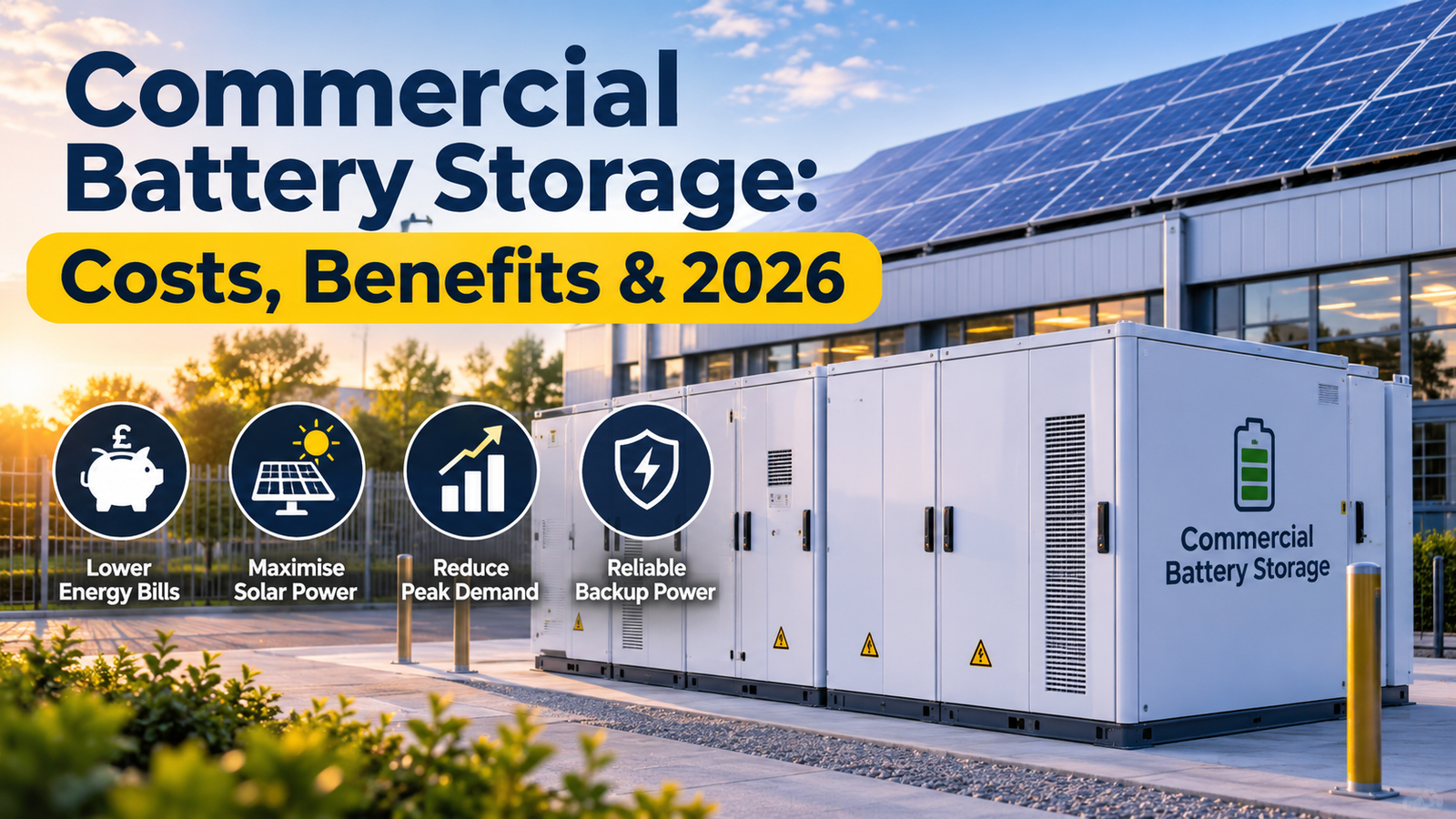
For many UK businesses, electricity is no longer just another operating expense. Energy prices, changing tariffs and high periods of demand can have a noticeable impact on monthly running costs. This is where commercial battery storage can make a real difference.
Instead of using electricity as soon as it is generated or purchased, a business can store energy in a battery and use it later when it is more valuable.
A commercial battery can also work alongside solar panels. During sunny periods, excess solar power can be stored rather than immediately exported to the grid. The stored energy can then be used when the business needs it most.
But buying a large battery simply because it sounds useful is not always a good investment. The right system depends on electricity usage, solar generation, tariffs, available space, connection capacity and the main reason for installing the battery.
This guide explains how commercial battery storage works, what it costs, the main benefits, how much businesses can save and what to consider before buying a system in 2026.
What Is Commercial Battery Storage?
Commercial battery storage is a battery energy storage system (BESS) designed for businesses and larger properties.
Unlike a typical home battery, commercial systems are usually designed around higher electricity demand and larger electrical connections. They can range from relatively small systems for offices and shops to much larger installations for factories, warehouses and industrial sites.
A typical commercial battery system can include:
- Battery cells and battery modules
- Battery management system (BMS)
- Inverter or power conversion system
- Energy management controls
- Protection equipment
- Monitoring software
- Electrical switchgear
- Enclosures or battery cabinets
The battery stores electricity and releases it when required.
For example, imagine a business that uses a lot of electricity between 4 pm and 7 pm. Instead of purchasing all of that electricity during the expensive period, the business could charge its battery earlier and discharge it during those high-demand hours.
That simple change can help reduce electricity costs.
How Does Commercial Battery Storage Work?
The basic idea is surprisingly simple.
Charge → Store → Discharge → Save
A commercial battery can be charged from several sources, depending on the system and business requirements.
1. Charging From Solar Panels
Businesses with commercial solar panels can send excess solar generation into the battery.
For example:
Solar panels → Business demand → Battery → Grid
During a sunny afternoon, the solar system might produce more electricity than the business needs. Instead of exporting all of the excess electricity, the battery can store some of it.
Later, when the sun goes down, the business can use the stored energy.
This can increase solar self-consumption and reduce reliance on grid electricity.
2. Charging From the Grid
A battery does not necessarily need solar panels.
A business can potentially charge its battery when electricity is cheaper and discharge it when electricity costs more.
This is commonly known as energy arbitrage.
For example:
Lower-cost electricity → Battery → Higher-cost period → Business
Whether this produces worthwhile savings depends on the business’s tariff, battery efficiency, system size and operating strategy.
3. Reducing Peak Demand
Another important use is peak shaving.
Some businesses have short periods when electricity demand suddenly becomes very high.
A battery can discharge during those periods to reduce the amount of electricity being drawn from the grid.
This can be particularly useful for businesses with:
- Large machinery
- Refrigeration systems
- EV charging
- Manufacturing equipment
- Commercial heating and cooling
- High-power pumps
The battery is effectively helping the business control its electricity demand.
Why Are Businesses Installing Battery Storage?
There is no single reason why a company installs a battery.
For some businesses, the biggest benefit is using more of their own solar energy. For others, it is reducing peak demand or shifting electricity consumption to cheaper periods.
Here are the main benefits.
1. Lower Electricity Bills
One of the biggest attractions of commercial battery storage is the possibility of reducing electricity costs.
Instead of purchasing electricity whenever it is needed, a business can store electricity and use it strategically.
The potential saving depends on:
- Electricity tariff
- Daily consumption
- Peak demand
- Battery size
- Battery efficiency
- Charging strategy
- Solar generation
- Export rates
This is why two businesses with identical batteries can achieve very different savings.
2. Make Better Use of Commercial Solar
A battery can make a solar PV system more useful.
Without storage, a business may generate a large amount of solar electricity during the middle of the day but have less demand at that exact time.
The unused electricity may then be exported.
With a battery, some of that excess energy can be stored and used later.
For example:
Afternoon: Solar produces more electricity than the business needs.
Battery: Stores the surplus.
Evening: Solar production falls.
Battery: Releases stored electricity.
This can increase the amount of solar power used directly by the business.
3. Reduce Peak Demand
Peak demand can be expensive for certain commercial users.
A battery can discharge when electricity demand reaches a high level, helping to smooth the site’s electricity profile.
This is particularly interesting for businesses with short but significant demand spikes.
However, the battery must be correctly sized.
A large battery with insufficient discharge power may not solve a peak-demand problem effectively.
That is why kW and kWh are both important.
4. Protection Against Power Interruptions
Some commercial battery systems can provide backup power.
This can be valuable for businesses where an unexpected power cut could cause:
- Production downtime
- Data loss
- Refrigeration problems
- Equipment shutdowns
- Lost sales
- Spoiled stock
However, not every commercial battery automatically provides backup power.
The system needs to be designed for this purpose, and the battery may need to reserve part of its capacity for backup.
5. Better Energy Management
Modern commercial battery systems can be connected to energy management software.
This allows businesses to monitor:
- Battery state of charge
- Electricity consumption
- Solar generation
- Charging and discharging
- Energy imports
- Energy exports
- Peak demand
Some systems can automatically decide when to charge and discharge based on electricity prices, solar production and site demand.
This makes the battery more than just a large box of stored electricity.
Commercial Battery Storage Cost in 2026
One of the most common questions businesses ask is:
How much does commercial battery storage cost?
There is no single price because commercial systems vary considerably in size and specification.
Published 2026 UK figures show that smaller systems can cost tens of thousands of pounds, while larger systems can reach hundreds of thousands of pounds. One current UK guide, for example, puts systems up to 100 kWh at roughly £20,000–£40,000 installed, while larger 200–500 kWh systems can reach around £80,000–£250,000+ depending on the project.
A simplified example:
| Battery Size | Indicative Installed Cost |
|---|---|
| 50 kWh | £20,000–£40,000 |
| 100 kWh | £20,000–£40,000 |
| 200 kWh | £60,000+ |
| 500 kWh | £100,000+ |
| 1 MWh | £150,000+ |
These figures are illustrative rather than fixed quotes.
The final price can be affected by the battery technology, inverter, installation, electrical upgrades, site preparation, fire protection, controls, connection requirements and warranty.
So businesses should never choose a system purely because it has the lowest price per kWh.
What Affects the Price of Commercial Battery Storage?
Several factors can make one project considerably more expensive than another.
Battery Capacity
A 100 kWh battery will normally cost less than a 500 kWh or 1 MWh system.
But larger systems can have a lower cost per kWh because some project costs are shared across the installation.
Power Rating
Do not confuse kWh with kW.
- kWh = how much energy the battery stores.
- kW = how quickly it can deliver or absorb electricity.
For example, a battery could have a large energy capacity but a relatively low power output.
If your business needs to handle a sudden high-power demand, the power rating becomes extremely important.
Installation
Installation can include much more than placing the battery on site.
Costs may include:
- Cabling
- Inverters
- Switchgear
- Protection systems
- Concrete bases
- Enclosures
- Fire safety measures
- Labour
- Monitoring equipment
- Commissioning
Grid Connection
Larger commercial systems may require additional network approval and connection work.
This can affect both the project cost and installation timeline.
Battery Management System
The control system determines how the battery operates and can have a major impact on how effectively it delivers savings.
Is Commercial Battery Storage Worth It?
The honest answer is:
It depends on the business.
Commercial battery storage can be an excellent investment for one company and a poor investment for another.
A battery is more likely to make financial sense when a business has:
- High electricity consumption
- Significant peak demand
- Suitable time-of-use tariffs
- Commercial solar
- Excess solar generation
- Expensive peak electricity periods
- A strong need for backup power
- A predictable daily load profile
On the other hand, a battery may be harder to justify if electricity consumption is very low or there is little difference between the cost of charging and discharging.
The best way to find out is to analyse actual electricity data rather than rely on a generic payback calculator.
How Long Does a Commercial Battery Last?
Battery lifespan depends on the technology, operating conditions, depth of discharge, temperature, charging cycles and manufacturer warranty.
Many modern lithium-ion systems are designed for years of commercial operation.
However, battery lifespan should not simply be described as a fixed number of years.
When comparing systems, look at:
- Warranty period
- Guaranteed capacity at the end of warranty
- Cycle limits
- Throughput warranty
- Operating temperature range
- Replacement conditions
- Expected degradation
A battery that appears cheaper initially may not be the best long-term choice if its warranty and usable capacity are weaker.
Lithium-Ion vs Other Battery Technologies
Lithium-ion batteries dominate many modern commercial storage projects because they offer a good combination of energy density, efficiency and relatively compact installation.
Within lithium-ion technology, businesses may encounter different chemistries such as LFP (lithium iron phosphate) and NMC.
LFP is increasingly popular for stationary storage because of its thermal characteristics and long cycle life.
The best technology still depends on the individual project.
For a commercial installation, safety, warranty, usable capacity, thermal management and system integration should be considered alongside price.
Commercial Battery Storage With Solar
Combining solar and battery storage can be particularly attractive for businesses.
Consider a warehouse with solar panels.
During the afternoon, the solar system produces more electricity than the warehouse requires.
Instead of exporting all of that excess electricity, the battery stores part of it.
Later, when solar production falls, the battery supplies electricity to the warehouse.
The result is a simple energy flow:
Solar → Battery → Business
This can help businesses use a greater proportion of their own renewable electricity.
Battery Storage for Different Businesses
Commercial battery storage is not only for large factories.
Warehouses
Warehouses can have substantial lighting, refrigeration, heating and EV charging loads.
Battery storage can help manage these changing demand patterns.
Manufacturing
Manufacturing businesses can have large machinery that creates short periods of high electricity demand.
Peak shaving can therefore be particularly relevant.
Offices
Offices usually have predictable daytime consumption.
Solar combined with battery storage can help improve the use of on-site renewable electricity.
Retail
Shops and supermarkets often have regular daily demand patterns and may benefit from storing solar electricity for later use.
Farms
Agricultural businesses can have different electricity demands throughout the day and across seasons.
Battery storage can work alongside solar to improve energy flexibility.
How Big a Commercial Battery Do You Need?
There is no universal battery size for every business.
A common mistake is choosing a battery based only on the size of the solar system.
Instead, the battery should be sized around the actual electricity profile of the site.
Ideally, review at least a year’s electricity consumption data.
Look at:
- Daily electricity use
- Half-hourly demand
- Highest demand periods
- Solar generation
- Solar exports
- Electricity prices
- Operating hours
- Future electricity demand
For example, a business with a 200 kW solar installation does not automatically need a 200 kWh battery.
The right size depends on how the electricity is being used.
Commercial Battery Storage: What Is the Payback Period?
Payback is one of the most important questions, but it is also one of the easiest figures to get wrong.
A supplier might advertise a particular payback period, but that number may not apply to your business.
Your actual payback depends on the difference between:
Installation cost vs annual financial benefit
Annual benefits can come from several sources:
- Peak-demand reduction
- Energy arbitrage
- Increased solar self-consumption
- Reduced grid imports
- Backup value
- Potential flexibility or grid-service revenue
A battery that combines several of these value streams may perform better than one used for only a single purpose.
However, grid-service revenue and energy-market opportunities can change, so businesses should treat them as potential benefits rather than guaranteed income.
What to Check Before Buying a Commercial Battery
Before signing a contract, ask the installer or supplier some straightforward questions.
1. What is the usable capacity?
Do not only look at the headline battery capacity.
Ask how much energy you can actually use.
2. What is the continuous power output?
This is particularly important if your business has high-power equipment.
3. What does the warranty cover?
Check both the warranty period and the guaranteed remaining capacity.
4. What happens during a power cut?
Find out whether backup power is included or whether additional equipment is required.
5. Does the system need grid approval?
Your installer should explain the relevant connection requirements for your site.
6. What are the installation costs?
Ask whether the quote includes:
- Electrical work
- Protection
- Connection costs
- Civil works
- Commissioning
- Monitoring
- Maintenance
7. How was the payback calculated?
Ask for the assumptions behind the savings estimate.
A trustworthy calculation should be based on your actual electricity consumption and tariff rather than a generic business profile.
Common Commercial Battery Storage Mistakes
Buying the Biggest Battery
Bigger does not automatically mean better.
An oversized battery can increase the upfront cost without producing enough additional savings.
Looking Only at Price Per kWh
Two systems with the same £/kWh price can have very different specifications.
Always compare usable capacity, power output, efficiency, warranty and installation scope.
Ignoring Your Electricity Data
Your electricity meter data is one of the most valuable tools when designing a battery system.
Without it, sizing becomes guesswork.
Forgetting Future Energy Demand
If your business plans to install EV chargers, new machinery, refrigeration or additional solar panels, include those plans before choosing the battery.
Assuming Solar Is Required
A commercial battery can operate without solar.
Depending on the tariff and load profile, a business may still benefit from charging and discharging electricity at different times.
Final Thoughts
Commercial battery storage is becoming an increasingly interesting option for UK businesses looking to control energy costs and make better use of renewable electricity.
But there is no one-size-fits-all solution.
The best system is not necessarily the biggest battery or the cheapest quote. It is the system that matches the business’s electricity demand, tariff, solar generation and financial goals.
For some companies, the biggest opportunity may be peak shaving. For others, it could be storing excess solar or shifting electricity consumption away from expensive periods. Businesses that rely heavily on continuous electricity may also place a higher value on backup capability.
Before investing, analyse your electricity data, compare several properly specified quotes and calculate the expected savings using realistic assumptions.
When the system is correctly sized and intelligently operated, a commercial battery can become much more than a backup device. It can become an important part of a business’s overall energy management strategy.
Key Takeaways
- Commercial battery storage allows businesses to store electricity and use it when needed.
- Batteries can work with or without solar panels.
- Peak shaving, solar self-consumption and energy arbitrage are major potential benefits.
- Commercial battery costs vary widely depending on size and installation requirements.
- kW and kWh are different, and both matter when choosing a system.
- Battery sizing should be based on real electricity consumption data.
- Do not judge a system only by its price per kWh.
- Check warranty, usable capacity, power output, installation scope and connection requirements.
- Payback varies significantly from one business to another.
- A correctly sized battery can help a business reduce energy costs and improve energy flexibility.