If you’re considering solar battery storage, one of the first questions you’ll probably ask is: what size solar battery do I need?
The answer isn’t the same for every UK home. The right battery size depends on your electricity consumption, solar panel system, daily usage pattern, available solar generation, electricity tariff and future plans such as buying an EV or installing a heat pump.
For many UK households, a battery somewhere around 5kWh to 15kWh can be suitable. However, choosing the right size isn’t simply about buying the biggest battery you can afford.
A properly sized battery should store enough of your unused solar electricity during the day to help power your home when your solar panels aren’t producing enough electricity.
Key Takeaways
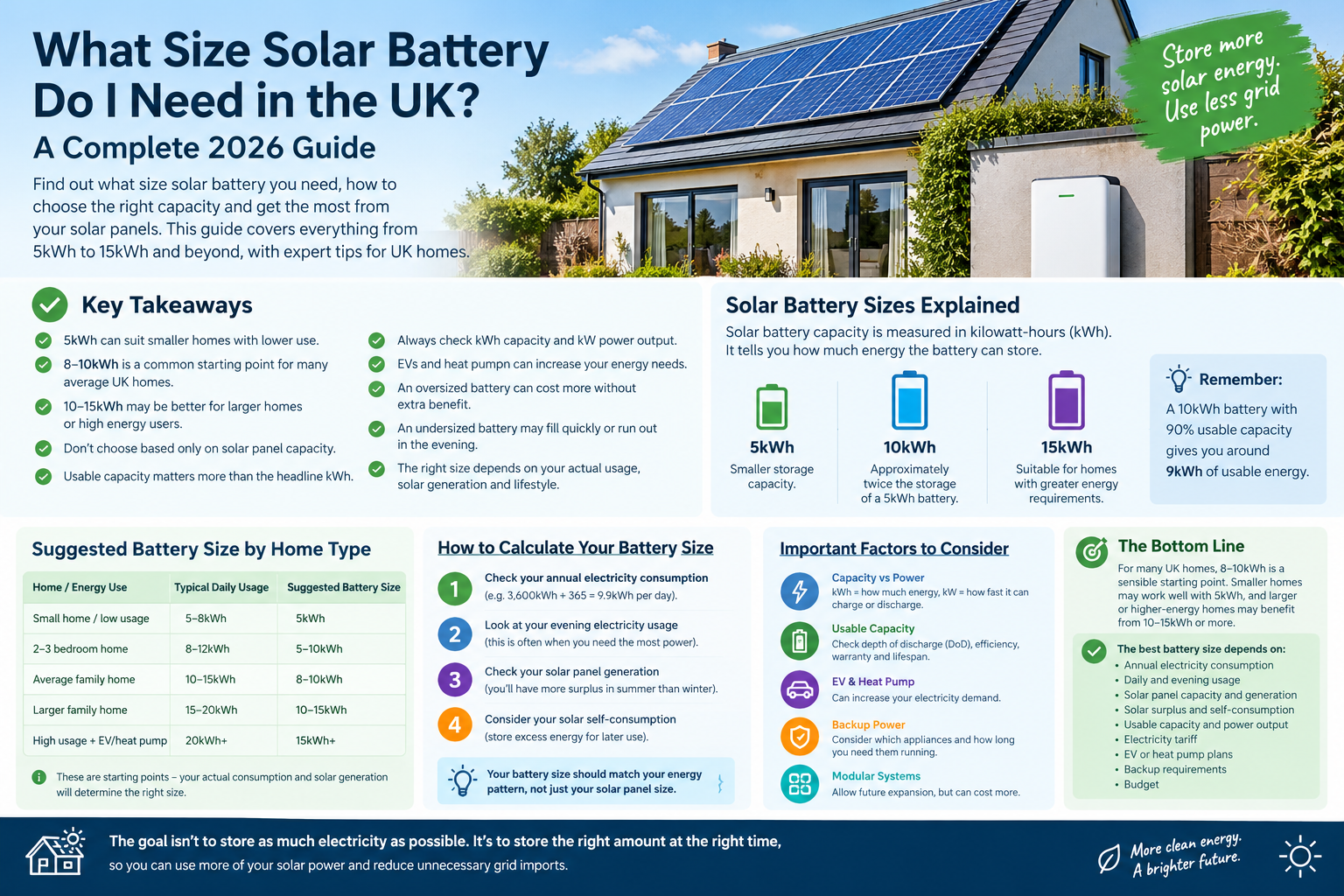
- A 5kWh battery may suit smaller homes with lower electricity consumption.
- 8–10kWh is a useful starting range for many average UK homes.
- Homes with higher electricity demand may benefit from 10–15kWh or more.
- Your battery shouldn’t be sized using solar panel capacity alone.
- Usable capacity is more important than the headline kWh figure.
- Check both kWh capacity and kW power output before choosing a battery.
- EVs and heat pumps can increase your home’s electricity requirements.
- An oversized battery can cost more without providing enough additional benefit.
- An undersized battery may fill quickly and leave more solar electricity being exported.
- The best battery size depends on your actual energy usage and solar generation.
Solar Battery Sizes Explained
Solar battery capacity is measured in kilowatt-hours (kWh).
This tells you how much energy the battery can store.
For example:
- 5kWh battery: smaller storage capacity
- 10kWh battery: approximately twice the storage of a 5kWh battery
- 15kWh battery: suitable for homes with greater energy requirements
However, the advertised capacity isn’t always the amount of energy you can use.
You also need to consider the battery’s usable capacity and Depth of Discharge (DoD).
For example, if a battery has a 10kWh nominal capacity and 90% usable capacity, you may have around 9kWh of usable energy.
That’s why comparing batteries purely by their headline capacity can be misleading.
What Size Solar Battery Do I Need for My Home?
There isn’t one battery size that’s perfect for every property.
As a rough starting point:
| Home / Energy Use | Typical Daily Usage | Possible Battery Size |
|---|---|---|
| Small home / low usage | 5–8kWh | 5kWh |
| 2–3 bedroom home | 8–12kWh | 5–10kWh |
| Average family home | 10–15kWh | 8–10kWh |
| Larger family home | 15–20kWh | 10–15kWh |
| High usage with EV/heat pump | 20kWh+ | 15kWh+ |
These figures are only starting points.
For example, if your household uses 12kWh of electricity per day, that doesn’t automatically mean you need a 12kWh battery.
Some of your electricity may be used directly from your solar panels during the daytime, meaning you only need to store the surplus for later.
Is a 5kWh Solar Battery Enough?
For some UK homes, yes.
A 5kWh solar battery can be suitable for a smaller property with relatively low electricity consumption.
It may work particularly well if you:
- Have a small household
- Use relatively little electricity
- Have limited evening demand
- Don’t own an EV
- Don’t have a heat pump
- Have a smaller solar PV system
For example, your solar panels could generate electricity during the day while you’re away at work. Instead of exporting all the unused electricity, a 5kWh battery can store some of it for use later.
The main limitation is capacity.
On a sunny day, a smaller battery can become fully charged relatively quickly. Once it reaches its usable capacity, additional solar generation may need to be exported to the grid.
Is a 10kWh Solar Battery Enough?
For many UK households, 10kWh is a sensible middle-ground option.
A 10kWh battery can provide considerably more storage than a 5kWh system without moving into the larger capacities that may be unnecessary for some homes.
It could be suitable if you:
- Have a medium-sized family home
- Have moderate-to-high electricity consumption
- Have a reasonably sized solar PV system
- Use a significant amount of electricity in the evening
- Want to increase your solar self-consumption
- Expect your electricity needs to increase in the future
However, 10kWh isn’t automatically the correct answer.
A household with low energy consumption might find it unnecessarily large, while a high-energy household could find it too small.
Would a 15kWh Solar Battery Be Too Big?
Not necessarily.
A 15kWh battery can make sense for a larger home with higher electricity consumption.
It may be worth considering if you have:
- High household electricity demand
- A large solar PV system
- An electric vehicle
- A heat pump
- High evening electricity usage
- A suitable time-of-use electricity tariff
- A need for greater backup capacity
But bigger isn’t always better.
If your household regularly uses only a small amount of electricity after sunset, paying extra for a large battery could reduce the value of your investment.
The aim should be to find the right-sized battery, rather than simply the largest one available.
How to Calculate What Size Solar Battery You Need
You can get a much better idea of your ideal battery size by looking at your actual energy data.
Step 1: Check Your Annual Electricity Consumption
Start by checking your electricity bills or your energy supplier’s account.
Look for your annual electricity consumption in kWh.
For example, suppose your household uses:
3,600kWh per year
Divide that by 365 days:
3,600 ÷ 365 = 9.86kWh per day
Your average daily electricity consumption would therefore be around 9.9kWh.
But don’t immediately assume that you need a 10kWh battery.
Your consumption is spread across different times of the day, and some of it may already be supplied directly by your solar panels.
Step 2: Check Your Evening Electricity Usage
Your evening consumption is particularly important when sizing a battery.
Solar panels generally generate most of their electricity during daylight hours. However, many households use more electricity later in the day when solar generation is falling or has stopped.
For example:
Solar generation: 10kWh
Direct daytime usage: 4kWh
Surplus solar: 6kWh
You could potentially store some of that 6kWh in your battery.
If your household then uses 5kWh between the evening and overnight period, a battery with enough usable capacity could cover much of that demand.
This is why looking at when you use electricity can be more useful than simply looking at your total daily consumption.
Step 3: Check Your Solar Panel Generation
Your solar PV system also affects battery sizing.
A home with a 3kW solar system will have a different amount of potential surplus energy compared with a home with a 6kW or 8kW system.
But you shouldn’t assume:
“I have 6kW of solar panels, so I need a 6kWh battery.”
Solar panel capacity and battery capacity are different measurements.
Solar generation also changes throughout the year.
During a bright summer day, your panels may generate considerably more electricity than your home needs. During winter, generation can be much lower.
If you already have solar panels, reviewing your actual generation and export data can help you choose a more appropriate battery size.
Step 4: Consider Your Solar Self-Consumption
One of the main reasons homeowners install batteries is to increase solar self-consumption.
Imagine your solar panels generate 8kWh during the day.
Your home directly uses 3kWh.
That leaves:
8kWh − 3kWh = 5kWh surplus
Without a battery, much of that surplus may be exported.
With a battery, some of the electricity can be stored and used later.
For example:
Daytime: Solar generates electricity → Home uses some → Battery stores surplus
Evening: Solar generation falls → Battery supplies stored electricity → Less electricity is imported from the grid
This can make better use of your solar generation.
Solar Battery Size vs Solar Panel Size
Your solar battery doesn’t need to be the same size as your solar panel system.
For example, a home with:
4kW solar PV
could potentially use a smaller or medium-sized battery depending on its electricity consumption.
A home with:
5–6kW solar PV
could potentially benefit from around 7–12kWh of storage, depending on its usage and solar surplus.
A larger system around:
6–8kW solar PV
could potentially work with 10–15kWh of storage for a higher-use household.
These are not fixed recommendations.
Your installer should consider your actual generation, electricity consumption and export pattern before choosing the final capacity.
Don’t Confuse Battery Capacity With Battery Power
This is one of the most important things to understand when comparing solar batteries.
Battery capacity = kWh
This tells you how much energy the battery can store.
Battery power = kW
This tells you how quickly the battery can charge or discharge and how much power it can provide at a particular moment.
For example, two batteries could both have around 10kWh of capacity but have different maximum power outputs.
So don’t look only at the kWh figure.
If you want to operate several high-power appliances at the same time, the battery’s kW output can be just as important as its storage capacity.
Usable Capacity and Depth of Discharge
When comparing solar batteries, always check the usable capacity.
Suppose a battery has:
10kWh nominal capacity
and a:
90% Depth of Discharge
Its approximate usable capacity would be:
10kWh × 90% = 9kWh
This means you shouldn’t automatically assume that a 10kWh battery provides 10kWh of usable energy.
Also check:
- Usable capacity
- Depth of Discharge
- Round-trip efficiency
- Charge power
- Discharge power
- Warranty
- Expected lifespan
- Expandability
These specifications can help you make a much better comparison between different battery systems.
What Size Battery Do I Need With an EV?
An electric vehicle can substantially increase household electricity consumption.
However, owning an EV doesn’t automatically mean you need a huge home battery.
EV charging can sometimes be managed separately using a suitable time-of-use electricity tariff, particularly if cheaper electricity is available overnight.
Your installer should look at your complete energy profile before recommending a larger battery.
It’s also important to think about how frequently you charge your EV and whether you intend to use solar energy for charging.
What Size Battery Do I Need With a Heat Pump?
A heat pump can also increase electricity demand.
This is particularly important during colder months when heating demand can be higher.
If you already have a heat pump—or plan to install one—tell your solar battery installer.
Otherwise, your battery could be sized according to your current electricity usage and become less suitable after your energy consumption increases.
Future energy demand should therefore be part of your battery-sizing decision.
Do You Need a Bigger Battery for Backup Power?
If your main reason for buying a battery is backup power, the calculation changes.
You need to consider:
- Which appliances you want to keep running
- How long you want them powered
- Whether you need selected circuits or whole-home backup
- Battery usable capacity
- Inverter power output
- Backup equipment
A bigger battery doesn’t automatically mean your entire home will have backup power.
The inverter and electrical installation also need to be designed to support backup operation.
If backup is important to you, tell your installer before the system is designed.
What Happens If Your Solar Battery Is Too Small?
An undersized battery can reach full charge relatively quickly on sunny days.
Once the battery is full, additional solar electricity may need to be exported rather than stored.
Later in the evening, the battery could also run out of stored energy before your household’s electricity demand falls.
This doesn’t mean a small battery is always a bad choice.
You simply need to balance:
Battery cost + solar surplus + household consumption + export payments
A smaller battery may still provide good value if your household doesn’t have a large amount of surplus solar energy.
What Happens If Your Solar Battery Is Too Large?
An oversized battery can increase your upfront cost.
Imagine paying considerably more for a 15kWh battery when your home regularly needs only 5–7kWh after solar generation ends.
Some of that additional capacity may rarely be used.
That’s why the cheapest option isn’t always the smallest battery, and the best option isn’t necessarily the largest.
The ideal system is one that provides enough capacity for your normal energy pattern without paying for storage that you rarely need.
Should You Buy a Modular Solar Battery?
A modular battery system can be useful if you expect your electricity consumption to increase in the future.
For example, you may currently have a small household but plan to:
- Buy an EV
- Install a heat pump
- Add more solar panels
- Increase electricity usage
A modular system may allow additional battery capacity to be added later.
However, future expansion isn’t always the cheapest option.
Additional installation costs, compatibility and manufacturer requirements should all be considered before assuming you’ll simply add another battery later.
What Size Solar Battery Is Best for an Average UK Home?
For many average UK homes, 8–10kWh is a sensible starting point.
But there is no universal “best” size.
Your requirements could look more like this:
5kWh: Lower electricity consumption and smaller homes
8–10kWh: Many average UK households
10–15kWh: Higher electricity consumption or larger homes
15kWh+: Particularly high energy demand and energy-intensive properties
The most important factor is your actual energy profile.
Solar Battery Sizing Example
Let’s look at two hypothetical UK homes.
Home A
- 4kW solar PV system
- 10kWh daily electricity consumption
- Most electricity used between 5pm and 11pm
- No EV
- No heat pump
- Moderate solar surplus
A 5–10kWh battery could be worth considering.
Home B
- 7kW solar PV system
- 20kWh daily electricity consumption
- EV
- Heat pump
- High evening demand
A 10–15kWh or larger battery could potentially make more sense.
The important difference isn’t simply the number of solar panels.
It’s the relationship between:
Solar generation → Direct consumption → Surplus → Battery storage → Evening demand
7 Questions to Ask Before Buying a Solar Battery
Before accepting an installer’s recommendation, ask these questions:
- What is the battery’s usable capacity?
- What is its maximum charge and discharge power?
- How much of my solar surplus will the battery actually store?
- What is my typical evening electricity consumption?
- How will the battery perform during winter?
- Can the system provide backup power during a power cut?
- Can the battery be expanded if my electricity consumption increases?
These questions can help you understand whether you’re paying for capacity you’ll actually use.
Final Verdict: What Size Solar Battery Do I Need in the UK?
So, what size solar battery do I need in the UK?
For many households, 8–10kWh is a reasonable starting point. Smaller homes may work well with a 5kWh battery, while larger or higher-energy homes may benefit from 10–15kWh or more.
However, you shouldn’t choose a battery simply because it is a popular size.
The right battery depends on:
- Your annual electricity consumption
- Daily and evening electricity usage
- Solar panel capacity
- Solar generation
- Solar surplus
- Usable battery capacity
- Battery power output
- Electricity tariff
- EV plans
- Heat pump plans
- Backup requirements
- Budget
The best approach is to use your actual electricity bills, solar generation and export data and ask an installer to compare different battery capacities.
A properly sized 10kWh battery can be a better choice than an oversized 15kWh battery that spends much of its time underused.
The goal isn’t simply to store as much electricity as possible.
It’s to store the right amount of solar energy at the right time, allowing you to use more of your own solar electricity and potentially reduce unnecessary grid imports.
FAQs
Is 5kWh enough for a solar battery?
It can be enough for a smaller home or household with relatively low electricity consumption, particularly if evening demand is modest.
Is 10kWh a good battery size for a UK home?
Yes. 8–10kWh can be a sensible starting range for many average UK households, although your actual electricity usage should determine the final size.
Is a 15kWh solar battery too big?
Not necessarily. It can be suitable for homes with high electricity consumption, larger solar systems, EVs or heat pumps. For a low-energy household, however, it may be unnecessarily expensive.
Should my battery be the same size as my solar panels?
No. Solar panel capacity and battery capacity measure different things. Your battery should be sized according to your solar generation, surplus electricity and household consumption.
What is more important: kWh or kW?
Both are important. kWh tells you how much energy the battery can store, while kW tells you how much power it can deliver or absorb at a particular time.
Can I add another battery later?
Some battery systems are modular and allow additional capacity, but this depends on the manufacturer and system design. Check compatibility and installation costs before relying on future expansion.
Do I need a bigger battery if I have an EV?
Not automatically. EV charging can sometimes be managed using a suitable time-of-use tariff. Your installer should assess your complete energy profile before recommending additional battery capacity.
Do I need a bigger battery for a heat pump?
Possibly. A heat pump can increase your home’s electricity demand, so it should be included when calculating your future battery requirements.