
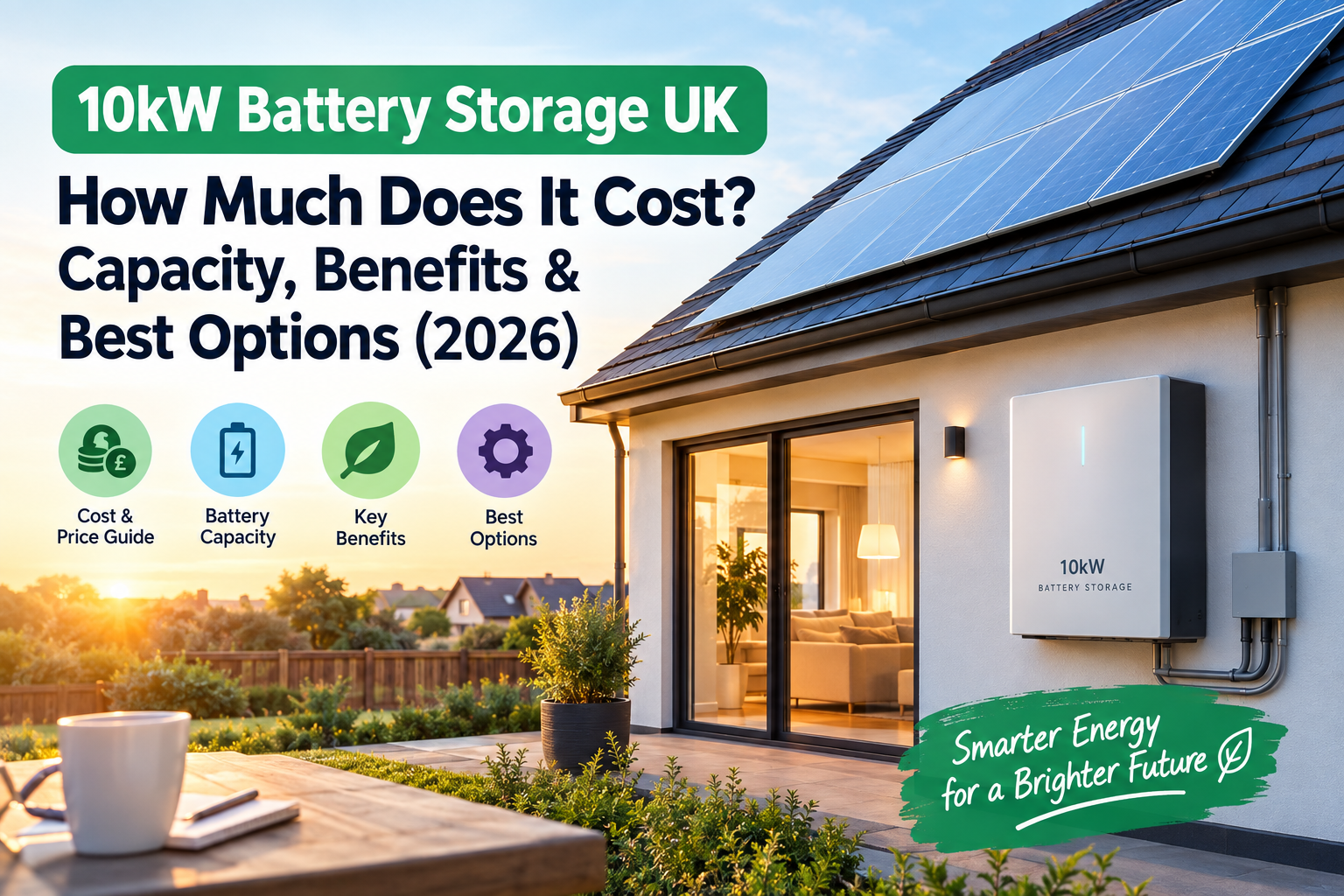
A 10kW battery storage system in the UK can help homeowners store electricity, reduce their energy bills and make better use of solar power. With electricity costs and energy independence on many households’ minds, installing a home battery is becoming an option worth considering.
Imagine your solar panels generate plenty of electricity during the day while you are at work. Your home uses only a small amount, and the remaining electricity is exported to the grid. With a suitable 10kWh solar battery, you can store some of that extra energy and use it in the evening when your solar panels are no longer producing electricity.
However, choosing the right battery is not just about storage capacity. You also need to consider the purchase price, installation costs, battery efficiency, warranty and potential savings.
So, how much does 10kW battery storage cost in the UK in 2026? Is a 10kWh battery enough for your home? Which battery features should you look for before buying?
In this guide, we explain everything you need to know about 10kW battery storage in the UK, including prices, battery capacity, installation, benefits, energy savings and how to choose a suitable system.
10kW Battery Storage: What Does It Mean?
A home battery storage system stores electricity so you can use it later. It is commonly installed alongside solar panels, although some batteries can also charge directly from the electricity grid.
Before purchasing a battery, it is important to understand the difference between kW and kWh.
- kW (kilowatt): Measures how much power a battery can deliver at a particular moment.
- kWh (kilowatt-hour): Measures how much energy a battery can store or supply over time.
For example, a 10kWh battery with a suitable power output could theoretically supply 1kW of electricity for 10 hours. However, the actual runtime depends on usable capacity, efficiency and the appliances connected.
Many homeowners search for a 10kW battery when they actually mean a 10kWh battery. These are different measurements. A battery with 10kWh of storage does not necessarily have a 10kW power output.
Throughout this article, we focus mainly on 10kWh home battery storage systems, which are commonly considered for residential solar installations.
You can learn more about this distinction in the Avepower guide to 10kWh home battery storage.
10kW Battery Storage UK: How Much Does It Cost in 2026?
The 10kWh battery storage price in the UK depends on the manufacturer, battery technology, inverter, installation requirements and additional features.
As a general guide, a professionally installed 10kWh battery system may cost approximately £5,000–£9,000 in 2026. Some standard packages are available for less, while premium systems and complicated installations can cost more.
The following table provides an approximate price guide.
| Battery storage system | Estimated price |
|---|---|
| 10kWh battery unit only | £2,000–£5,000 |
| Standard installed 10kWh system | £5,000–£7,000 |
| Premium installed battery system | £7,000–£9,500+ |
| Additional inverter or electrical upgrades | Depends on installation |
These are indicative figures, not guaranteed quotations. Actual prices depend on the equipment and work required.
What Is Included in the 10kWh Battery Installation Cost?
When comparing solar battery installation costs, check whether the price includes all the necessary equipment and labour.
A complete installation may include:
- Battery unit and battery management system
- Compatible inverter or hybrid inverter
- Mounting equipment
- Electrical cables and safety equipment
- Installation labour
- System configuration and commissioning
- Monitoring app setup
- Required electrical upgrades
Some suppliers advertise the battery price alone, while others provide a complete installation package.
For this reason, ask installers for a breakdown of their quotations. Comparing the total installed cost will help you avoid unexpected expenses.
What Factors Affect the Price of a 10kWh Battery?
Several factors can affect the total cost of a home battery.
Battery brand: Established manufacturers may charge more because of their technology, warranty, product features and customer support.
Battery chemistry: Lithium iron phosphate (LiFePO4) batteries are widely used in modern home energy storage. Their design, expected lifespan and safety features can influence the price.
Inverter requirements: If your existing solar inverter is compatible, you may not need to replace it. Otherwise, an additional inverter can increase the total cost.
Installation complexity: Long cable runs, difficult mounting locations and electrical upgrades can increase labour costs.
Backup power: A system designed to supply electricity during a power cut may require additional equipment and wiring.
Warranty: Warranty length and coverage are important when comparing battery systems. A longer warranty may provide extra reassurance, but you should also check its conditions.
10kWh Battery Capacity: How Much Electricity Can It Store?
A 10kWh battery has a nominal storage capacity of 10 kilowatt-hours. However, the amount of electricity available for everyday use depends on its usable capacity and operating limits.
For example, a battery with 10kWh of nominal capacity may provide around 9kWh of usable energy. The exact figure varies between models.
Consider a home that uses an average of 1kW of electricity. A battery with 9kWh of usable capacity could theoretically supply that load for approximately nine hours.
However, if you operate several high-power appliances simultaneously, the battery will discharge more quickly.
| Appliance | Approximate power |
|---|---|
| LED light | 5–15W |
| Wi-Fi router | 10–20W |
| Television | 80–150W |
| Laptop | 50–100W |
| Refrigerator | Varies during operation |
| Electric kettle | 2,000–3,000W |
These figures are examples. Actual consumption depends on the appliance model and how it is used.
It is also important to consider the battery’s maximum power output. A battery may have enough stored energy to run several appliances over many hours but may not be able to power them all at the same time.
Is a 10kWh Battery Enough for a UK Home?
A 10kWh home battery can be suitable for many households, particularly those with solar panels and moderate or high evening electricity consumption.
However, the ideal battery size depends on your daily electricity use, solar generation and future energy requirements.
A 10kWh battery may be suitable if you:
- Have solar panels that regularly generate surplus electricity.
- Use a significant amount of electricity in the evening.
- Want to reduce your reliance on peak-rate electricity.
- Have access to a suitable time-of-use tariff.
- Expect your household electricity consumption to increase.
For example, imagine a family that generates surplus solar electricity during the afternoon. Everyone returns home in the evening, when cooking, lighting and entertainment increase electricity consumption. A battery can store some of the daytime energy and supply it later.
However, a smaller battery may be more suitable for a household with low electricity consumption.
A larger battery is not always more economical. If you cannot regularly charge and use the extra capacity, you may pay for storage that provides little additional benefit.
How Does a 10kWh Solar Battery Work?
A solar battery storage system stores surplus electricity generated by your solar panels and makes it available when your home needs it.
The process usually works in five steps.
Step 1: Solar Panels Generate Electricity
During daylight hours, your solar panels convert sunlight into electricity. The amount generated depends on the weather, season, roof direction, shading and size of your solar system.
Step 2: Your Home Uses Solar Electricity
Your home uses the electricity generated by the panels. For example, your refrigerator, lights and other appliances may run on solar power during the day.
Step 3: Surplus Electricity Charges the Battery
When your solar panels produce more electricity than your home needs, the surplus can charge your battery.
A 10kWh battery can store a substantial amount of electricity, but it will only become fully charged if sufficient energy is available.
Step 4: The Battery Supplies Electricity
When solar generation falls in the evening or at night, your battery can supply some of the stored electricity to your home.
This allows you to use more of your own solar energy instead of purchasing as much electricity from your supplier.
Step 5: The Grid Supplies Any Additional Electricity
If the battery becomes empty or your home’s demand exceeds its power output, your home can draw additional electricity from the grid.
Many modern systems manage this process automatically. You can also use a monitoring app to check battery charging, discharging and household energy consumption.
Benefits of 10kW Battery Storage in the UK
Installing a 10kWh battery storage system can offer several benefits, especially when it is matched to your solar panels and electricity consumption.
1. Reduce Your Electricity Bills
One of the main reasons homeowners consider battery storage is the potential to reduce their electricity bills.
If you have solar panels, you can store surplus electricity during the day and use it later instead of buying as much electricity from your supplier.
For example, a household that generates excess solar energy in the afternoon could store some of it for evening use.
However, actual savings depend on your electricity tariff, solar generation, battery efficiency and household consumption. A battery will not automatically eliminate your electricity bill.
2. Make Better Use of Solar Energy
Without a battery, surplus solar electricity may be exported to the grid. You may receive payments through a suitable Smart Export Guarantee (SEG) tariff.
However, using some of that electricity yourself may offer greater financial value than exporting it, depending on your import and export rates.
You do not necessarily need solar panels to benefit from battery storage.
Some UK electricity suppliers offer time-of-use electricity tariffs, where prices change throughout the day.
With a compatible battery and tariff, you may be able to charge the battery when electricity is cheaper and use the stored energy when prices are higher.
However, your savings depend on the difference between the charging and peak prices. You should also account for battery losses and any tariff restrictions.
4. Reduce Dependence on the Electricity Grid
A battery can reduce the amount of electricity you need to buy from the grid, particularly when combined with solar panels.
It gives you more flexibility over when you use electricity and how you manage your household energy.
However, a standard battery does not necessarily provide electricity during a power cut. You need a compatible backup function and suitable installation for that.
5. Prepare for Future Electricity Needs
Your household electricity consumption may increase if you buy an electric vehicle, install a heat pump or add more electrical appliances.
Some battery systems are expandable, allowing you to increase their storage capacity later.
Before purchasing, check whether the manufacturer supports expansion and whether your inverter can handle additional battery modules.
Best 10kWh Battery Storage Options in the UK
There are several manufacturers offering residential battery storage systems. The right option depends on your budget, existing solar equipment, required capacity and installation needs.
Here are some systems worth researching when comparing 10kWh home batteries.
It may be worth comparing if you want an integrated home energy system with monitoring and energy management features.
Check the specific model’s usable capacity, inverter output, installation requirements and warranty before purchasing.
Also, confirm whether the product is suitable for your intended UK installation and whether local technical support is available.
Do not compare products on advertised capacity alone. Look at the complete system and the costs of getting it installed.
Important: These are products to research, not a ranking. Prices, availability and installation arrangements can change. Always obtain a current UK quotation and verify the manufacturer’s warranty before buying.
What Type of 10kWh Battery Should You Choose?
Understanding the different types of home batteries can help you select a suitable system.
Lithium-Ion Batteries
Lithium-ion batteries are widely used in residential energy storage. They offer relatively high energy density and are available in several designs.
They can be suitable for homeowners who want a compact battery system with good everyday performance.
However, performance, lifespan and warranty conditions vary between manufacturers.
LiFePO4 Batteries
Lithium iron phosphate (LiFePO4 or LFP) batteries are a type of lithium-ion battery.
They are widely used in modern home storage systems because of their thermal stability and long cycle life.
When comparing LFP batteries, check their usable capacity, maximum power output, warranty and compatibility with your inverter.
Wall-Mounted Batteries
Wall-mounted batteries are designed to be installed on a suitable wall. They can save floor space and may be suitable for garages or utility rooms.
Before installation, check the battery’s weight, mounting requirements, temperature limits and manufacturer’s safety instructions.
Stackable Battery Systems
Stackable batteries allow you to combine multiple battery modules to increase storage capacity.
For example, you may start with a smaller battery and add compatible modules later if your household electricity needs increase.
This provides flexibility, but expansion is only possible if the manufacturer supports it and your inverter can handle the additional capacity.
All-in-One Battery Systems
An all-in-one system combines several components, often including the battery and inverter, in one integrated package.
These systems can simplify installation and monitoring. However, check whether the system is compatible with your existing solar panels and whether its backup features meet your requirements.
How Much Money Can a 10kWh Battery Save?
The potential savings from a 10kWh battery depend on how you use it.
A household with solar panels and a suitable electricity tariff may benefit differently from a home that uses only grid electricity.
For example, imagine charging your battery overnight using a cheap electricity tariff. You can then use the stored electricity during more expensive periods.
The difference between the two rates can help reduce your electricity costs. However, charging and discharging involve energy losses, which must be included in your calculations.
Example of Potential Battery Savings
Here is a simple example showing how electricity price differences can affect savings.
| Item | Example |
|---|---|
| Cheap electricity price | 10p per kWh |
| Peak electricity price | 25p per kWh |
| Electricity charged | 10kWh |
| Assumed battery efficiency | 90% |
| Electricity available after losses | 9kWh |
| Cost of charging | £1 |
| Value of electricity replaced | £2.25 |
| Potential saving per cycle | £1.25 |
This is an illustrative calculation, not a guaranteed saving. Actual results depend on your tariff, battery efficiency, usable capacity and household electricity consumption.
If you want to estimate your own savings, use your actual electricity prices and the battery’s usable capacity. Do not assume that you will fully charge and discharge the battery every day.
How Long Does a 10kWh Battery Last?
The lifespan of a 10kWh home battery depends on its chemistry, usage, temperature and maintenance.
Many modern home battery systems come with warranties of around 10 years, although the exact terms differ between manufacturers.
Some batteries may continue working beyond their warranty period, but their storage capacity can gradually decrease.
Battery lifespan is often described in two ways:
- Calendar life: How many years the battery is expected to operate.
- Cycle life: How many charging and discharging cycles it can complete under specified conditions.
For example, a battery rated for thousands of cycles may be suitable for regular daily use. However, the manufacturer’s warranty should also explain the guaranteed remaining capacity and any usage limits.
Before buying, check the warranty carefully. A longer warranty can be useful, but the coverage conditions are just as important.
Can a 10kWh Battery Run Your Home During a Power Cut?
A 10kWh battery can provide electricity during a power cut if it has a suitable backup power function and has been installed correctly.
However, not every home battery automatically provides backup power. Some systems stop supplying electricity when the grid goes down because of safety requirements.
If backup power is important to you, ask your installer whether the system supports an emergency power supply (EPS) or another suitable backup function.
You should also decide which appliances you want to run during an outage.
For example, you may want to prioritise:
- Refrigerator
- Essential lighting
- Wi-Fi router
- Mobile phone chargers
- Selected kitchen appliances
Running an electric oven, electric shower, electric heating or several high-power appliances can drain a battery quickly. The battery’s maximum output also determines which appliances can operate together.
A backup system should be designed around your essential electricity needs rather than the assumption that your entire home will operate normally.
How Many Solar Panels Do You Need for a 10kWh Battery?
The number of solar panels needed to charge a 10kWh battery depends on your solar system’s size, panel efficiency, local weather and household electricity use.
For example, a home with a 4kW solar panel system may produce enough surplus electricity to charge a 10kWh battery on some sunny days. However, it may not generate enough surplus every day, particularly during winter.
A larger solar panel system may provide more energy for charging, but your roof space, budget and electricity consumption must also be considered.
Choosing a battery is not just about finding the lowest price. You should compare several important features to make sure the system meets your household requirements.
1. Check the Usable Battery Capacity
Start by checking how much electricity you can actually use from the battery.
A battery advertised as 10kWh may have slightly less usable capacity, depending on its design and operating limits.
Compare the usable capacity of different models rather than looking only at their advertised storage size.
2. Compare the Battery Power Output
The battery’s power output determines how much electricity it can supply at one time.
For example, a battery with a 3kW output may run several smaller appliances together, but it may not support multiple high-power appliances simultaneously.
If you want to use a kettle, washing machine and other appliances at the same time, check their combined power requirements.
3. Look at Battery Efficiency
Battery efficiency describes how much energy you can recover after charging.
For example, if you put 10kWh into a battery with 90% round-trip efficiency, you would get approximately 9kWh back under the specified test conditions.
Higher efficiency can reduce energy losses, although actual performance depends on operating conditions.
4. Check the Warranty
A home battery is a long-term investment, so warranty coverage matters.
Check the following details before purchasing:
- Warranty duration
- Guaranteed remaining capacity
- Maximum permitted energy throughput
- Conditions for warranty claims
- Availability of technical support
Also, check whether the warranty covers both the battery and any integrated inverter.
5. Check Solar Inverter Compatibility
If you already have solar panels, your battery must be compatible with your existing system.
Some batteries work with particular hybrid inverters, while others use AC coupling and may be easier to add to an existing solar installation.
Ask your installer to confirm compatibility before purchasing any equipment.
6. Consider Smart Monitoring
Many modern battery systems include a mobile app that lets you monitor charging, discharging and electricity consumption.
Some systems also support smart tariff scheduling, allowing the battery to charge when electricity is cheaper.
These features can make managing your home energy easier, particularly if you have a time-of-use tariff.
How to Install a 10kWh Battery Storage System in the UK
Installing a home battery involves electrical work and should be carried out by a suitably qualified professional.
Here is a simple step-by-step guide to the process.
Step 1: Review Your Electricity Consumption
Check your electricity bills and smart meter data to understand how much electricity you use during the day and evening.
This information can help your installer recommend an appropriate battery size.
Step 2: Check Your Existing Solar System
If you already have solar panels, find out whether your inverter is compatible with your chosen battery.
If you do not have solar panels, you can still consider a battery that charges from the grid, provided it suits your tariff and usage.
Step 3: Compare Battery Options
Compare different battery systems based on capacity, power output, efficiency, warranty, safety features and price.
Ask whether the system can be expanded in the future if your energy needs change.
Step 4: Get Installation Quotes
Depending on the battery model, it may be possible to install it in a garage, utility room or suitable outdoor location.
Your installer should check the manufacturer’s requirements, available space, temperature conditions and safety clearances.
Step 6: Installation and Commissioning
The installer will mount and connect the battery, complete the required electrical work and configure the system.
They should also explain how to monitor the battery and use any available backup or smart charging features.
Step 7: Test and Monitor the System
After installation, make sure the system operates correctly. Learn how to check battery charge levels, review energy usage and understand any warning messages.
Keep your installation documents and warranty information in a safe place.
Is 10kWh Battery Storage Worth Buying in 2026?
A 10kWh battery storage system may be worth considering if your home regularly uses electricity in the evening, has surplus solar generation or can benefit from charging at off-peak rates.
However, the financial benefits vary significantly between households.
For example, a home with a large solar panel system and high evening electricity use may have more opportunities to use stored electricity. A home with low electricity consumption and little surplus solar generation may not benefit as much.
You should compare the expected annual savings with the total installed cost and the battery’s expected working life.
A battery can reduce electricity bills, but the savings are not always enough to justify the upfront cost. Therefore, calculate your likely savings before making a purchase instead of relying on general claims about battery payback periods.
Frequently Asked Questions About 10kW Battery Storage
How much does a 10kWh battery cost in the UK in 2026?
A typical professionally installed 10kWh battery system may cost around £5,000–£9,000 in the UK in 2026. Premium products and installations that require additional electrical work may cost more.
Is a 10kWh battery enough for a family home?
A 10kWh battery can provide useful storage for many medium-sized households. However, the right size depends on daily electricity consumption, solar generation and the appliances you want to run.
Can I install a 10kWh battery without solar panels?
Yes. Some battery systems can charge directly from the electricity grid. With a suitable time-of-use tariff, you may be able to charge during cheaper periods and use the stored electricity when prices increase.
How many hours will a 10kWh battery last?
A battery with 9kWh of usable capacity could theoretically supply a 1kW load for nine hours. Actual runtime depends on the appliances connected, battery efficiency and maximum power output.
Can a 10kWh battery power an electric vehicle?
A home battery can provide some electricity for EV charging if the system is compatible. However, charging an electric vehicle can use a substantial amount of energy, so a 10kWh battery may not provide a full charge.
Does a 10kWh battery work during winter?
Yes, a battery can operate during winter. However, solar panels generally generate less electricity during shorter and cloudier winter days. You may need to charge the battery from the grid if solar generation is insufficient.
How long does a home battery last?
Many modern home batteries have warranties of around 10 years. The actual lifespan depends on the battery model, usage, temperature and operating conditions.
Can I add another battery later?
Some modular battery systems allow you to add extra storage modules. However, expansion depends on the manufacturer’s specifications and inverter compatibility. Check this before purchasing if you expect your electricity needs to increase.
Final Thoughts
A 10kWh battery storage system in the UK can help homeowners make better use of solar electricity, manage energy costs and gain more flexibility over when they use electricity.
In 2026, installed prices vary depending on the equipment and installation requirements. A typical system may cost around £5,000–£9,000, although some packages are cheaper and premium systems can cost more.
Before buying, review your household electricity consumption and estimate how much energy you can realistically store and use. If you already have solar panels, consider how much surplus electricity they generate throughout the year.
Compare complete quotations, check the battery’s usable capacity and power output, and pay close attention to the warranty and inverter compatibility.
A carefully selected battery can be a useful long-term addition to your home. The key is to choose a system that matches your actual energy needs rather than simply buying the largest battery available.


Just joined and I am already impressed. The welcome offer was straightforward with no hidden traps. Game loading times are quick and the chat support team is super helpful. It is refreshing to find a site that actually cares about player satisfaction. Will definitely keep coming back. bdadda71