If you have a caravan, motorhome or campervan, a solar panel for a leisure battery can make travelling much easier. Instead of relying completely on an electric hook-up, you can use sunlight to keep your battery charged while running everyday essentials such as lights, a water pump, USB chargers, a TV and other 12V equipment.
But there is one common mistake: buying a solar panel simply because it has a higher watt rating.
The right solar panel depends on several things, including your leisure battery size, daily electricity usage, type of battery, available roof space and how often you travel off-grid.
For example, a 60W panel might be enough for light weekend use, while a larger motorhome with a fridge, TV and other appliances may benefit from 100W, 150W or even 200W+ of solar capacity.
In this guide, we’ll explain how solar panels charge leisure batteries, what size panel you may need, which type is best and how to build a reliable solar charging setup.
Key Takeaways
- A solar panel can keep a 12V leisure battery charged while you’re off-grid.
- The right panel size depends more on your daily electricity consumption than simply the battery’s Ah rating.
- Around 60W can suit light use, while 100W–150W is a common range for more regular motorhome or caravan use.
- Larger setups may need 200W or more, particularly when running a fridge and several electrical devices.
- A solar charge controller is normally needed to manage charging safely.
- Rigid, flexible and folding panels each have different advantages.
- UK winter sunlight can be considerably weaker than summer sunlight, so don’t size your system using summer figures alone.
- Good-quality cables, suitable fuses and correct installation are important for a safe system.
What Is a Solar Panel for a Leisure Battery?
A solar panel for a leisure battery is designed to convert sunlight into electrical energy that can be stored in your vehicle’s auxiliary battery.
Most caravans, campervans and motorhomes use a 12V leisure battery to power equipment when the vehicle isn’t connected to mains electricity.
The basic system looks like this:
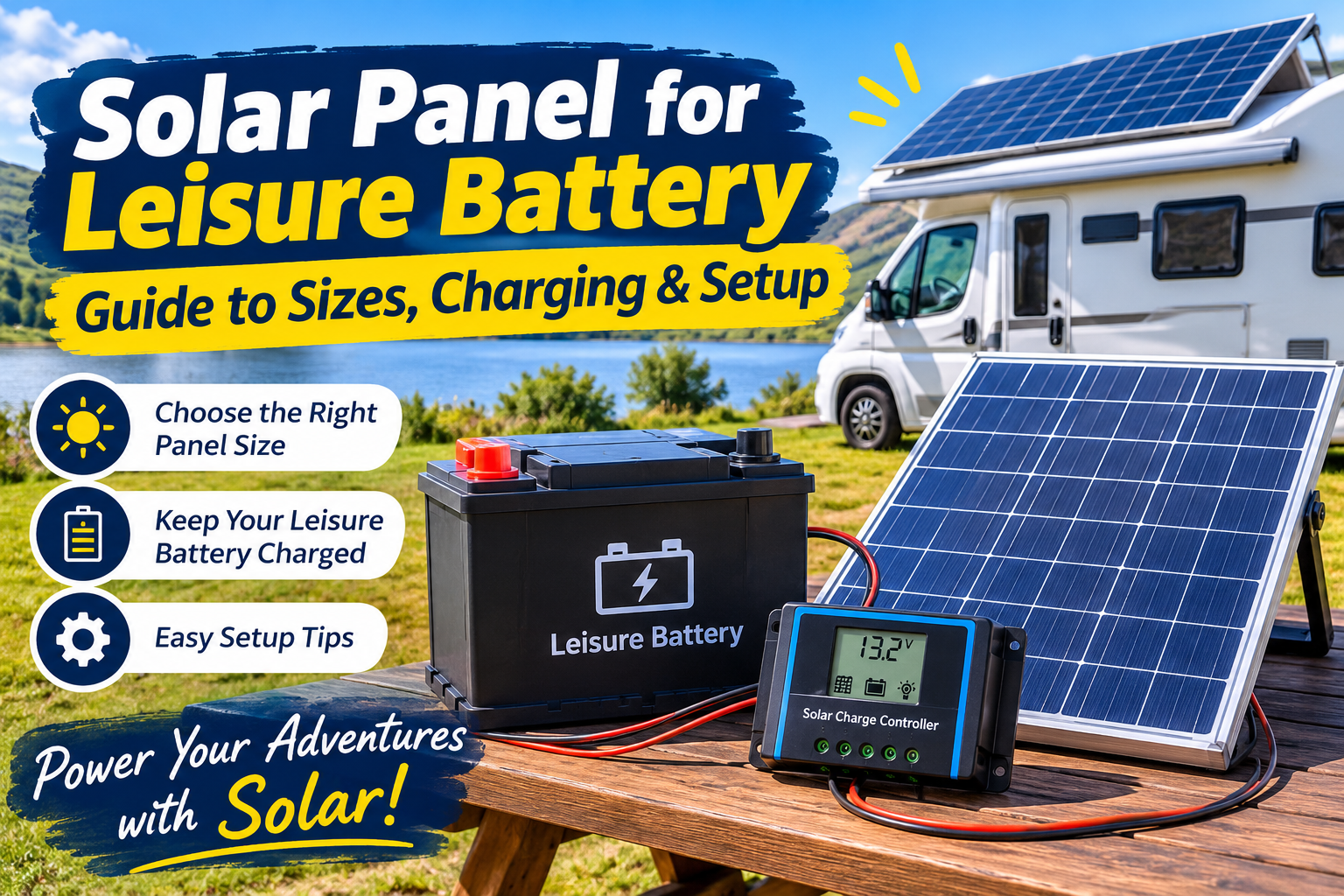
Solar panel → Charge controller → Leisure battery → 12V appliances
During daylight, the solar panel produces DC electricity. The charge controller manages that electricity before it reaches the battery.
The battery then stores the energy so you can use it later, including when the sun has gone down.
This makes solar particularly useful when you’re camping away from an electric hook-up.
How Does Solar Charging Work?
The process is quite simple.
1. The panel captures sunlight
Solar cells inside the panel convert sunlight into DC electricity.
The amount produced changes throughout the day depending on sunlight, panel orientation, shading, weather and the time of year.
2. The charge controller manages the power
The electricity normally passes through a solar charge controller before reaching the battery.
Its job is to control the charging process and help prevent problems such as overcharging.
For smaller leisure-vehicle systems, PWM controllers are commonly used. MPPT controllers can extract more usable energy from a solar array and are particularly useful when you have a larger installation.
3. The leisure battery stores the energy
The electricity is stored in the leisure battery.
You can then use that stored energy for your vehicle’s electrical equipment.
4. Your appliances use the stored power
Lights, water pumps, USB chargers, TVs and other 12V equipment can draw energy from the battery.
If you want to run normal household appliances through a 230V socket, you will generally need an inverter, which introduces additional energy losses.
What Size Solar Panel Do I Need for a Leisure Battery?
This is probably the biggest question people have when buying a leisure solar system.
There isn’t one solar panel size that is right for every caravan or motorhome.
The best approach is to look at how much electricity you use each day.
As a general starting point:
| Solar Panel Size | Typical Use |
|---|---|
| 40W–60W | Battery maintenance and light use |
| 80W–100W | Weekend trips and moderate 12V use |
| 120W–150W | Regular off-grid use |
| 200W+ | Higher energy demand and longer off-grid stays |
These are starting points rather than strict rules. Your actual requirements can change considerably depending on the season and your appliances.
Camplify, for example, suggests around 60W for light off-grid use, 100W–150W for many weekend trips and 200W+ for heavier requirements such as supporting a fridge and larger battery capacity.
Is a 60W Solar Panel Enough?
A 60W panel can be perfectly suitable if your electricity requirements are fairly low.
It may work well for:
- LED lights
- Phone charging
- USB devices
- Water pump
- Small TV
- Basic battery maintenance
However, don’t expect a 60W panel to comfortably replace the energy used by several high-power appliances every day.
If your motorhome has a fridge, TV, heating controls and several other electrical loads, you may need more solar capacity.
Is a 100W Solar Panel Enough?
For many leisure vehicles, 100W is a useful middle ground.
It can provide substantially more charging capacity than a small 40W–60W panel without requiring as much roof space as a large system.
A 100W panel can be suitable for moderate use involving:
- Lighting
- Water pump
- Phone and tablet charging
- TV
- Small 12V appliances
- General battery top-up
Actual output will depend heavily on sunlight and installation conditions.
What About 150W or 200W?
If you’re regularly camping off-grid, a 150W or 200W system can make more sense.
The extra capacity becomes useful when your daily electricity consumption is higher.
For example, you may have:
- A larger leisure battery
- A 12V fridge
- Several phones and devices
- A TV
- More lighting
- Heating controls
- Other electrical equipment
The important point is that a bigger battery does not automatically mean you need a huge solar panel. Your daily energy consumption is still one of the most important factors.
How to Calculate Your Solar Panel Requirements
You can estimate your requirements using a simple calculation.
First, work out how much energy your appliances consume.
For example:
- LED lights: 20W × 4 hours = 80Wh
- TV: 40W × 3 hours = 120Wh
- Water pump: 30W × 0.5 hours = 15Wh
- USB charging: 20W × 2 hours = 40Wh
Total:
80 + 120 + 15 + 40 = 255Wh per day
To convert this into approximate amp-hours for a 12V system:
255Wh ÷ 12V = 21.25Ah
So you’re using roughly 21Ah per day.
You then need a solar system capable of replacing that energy while also allowing for real-world losses and changing sunlight conditions.
The Camping and Caravanning Club uses the same basic relationship between watts, amp-hours, voltage and energy when explaining leisure-vehicle solar sizing.
Solar Panel Wattage vs Leisure Battery Size
It’s easy to assume that a 100Ah battery needs a 100W solar panel.
That’s not necessarily true.
A battery’s Ah rating tells you how much electrical charge it can store, while the solar panel’s wattage describes its power rating.
For example, you could have:
100Ah leisure battery + 100W solar panel
or:
200Ah leisure battery + 100W solar panel
Both can work, but the second setup has a larger storage capacity and may require longer to fully recharge from solar alone.
Your ideal combination depends on how much energy you consume and how quickly you need the battery to recover.
How Much Solar Power Can You Actually Get?
A 100W solar panel doesn’t produce 100W continuously from sunrise to sunset.
This is a very important point.
The panel’s wattage is measured under Standard Test Conditions (STC). Real-world production changes depending on:
- Sunlight intensity
- Cloud cover
- Panel angle
- Shading
- Temperature
- Time of year
- Roof orientation
- Dirt and debris
The Camping and Caravanning Club notes that UK summer conditions can provide the equivalent of several hours of strong sunlight, while winter output can be dramatically lower.
So, when sizing your system, don’t calculate your expected daily energy simply as:
Panel wattage × 24 hours
That would give a completely unrealistic result.
Summer vs Winter Solar Charging
UK weather makes seasonal performance particularly important.
During summer, longer days and stronger sunlight can give your panel much better production.
During winter:
- Days are shorter
- The sun sits lower in the sky
- Cloud cover can reduce output
- Your heating and lighting use may increase
The same panel can therefore produce dramatically different amounts of energy depending on the season.
For example, a 100W panel may produce several times more useful energy on a good summer day than it does during a dark winter day.
This is why people who want reliable off-grid power throughout the year may choose a larger solar array and a larger leisure battery.
Types of Solar Panels for Leisure Batteries
There are three main options worth considering.
1. Rigid Solar Panels
Rigid panels have a traditional framed construction and are normally mounted permanently on the roof.
Advantages:
- Durable
- Good long-term option
- Suitable for permanent installations
- Generally good value per watt
Disadvantages:
- Heavier
- Requires permanent mounting
- Can be more noticeable on the roof
If you use your motorhome regularly, a rigid panel can be a practical long-term choice.
2. Flexible Solar Panels
Flexible panels are lighter and can be useful where weight or roof shape is an issue.
They can work well on some curved surfaces where a conventional framed panel would be difficult to install.
Advantages:
- Lightweight
- Low-profile
- Flexible mounting options
- Useful for weight-sensitive vehicles
Disadvantages:
- Can cost more
- Installation needs careful consideration
- Heat management and mounting quality matter
3. Folding or Portable Solar Panels
Folding panels are useful if you don’t want a permanent roof installation.
You can position the panel in a sunny area while keeping the caravan or motorhome somewhere else.
This can be especially useful if your vehicle is parked in shade.
Camplify highlights this advantage: portable folding panels can be repositioned to find better sunlight, although they also need to be stored and secured when not being used.
Do You Need a Solar Charge Controller?
In most leisure-battery solar installations, yes.
A charge controller sits between the solar panel and battery and regulates the charging process.
Without appropriate charging control, you risk damaging the battery through improper charging.
There are two common types:
PWM Solar Controller
PWM controllers are relatively simple and can be a sensible option for smaller solar systems.
They are usually cheaper and can work well for basic leisure-vehicle setups.
MPPT Solar Controller
MPPT controllers are more advanced.
They can extract more usable energy from the solar panel under suitable conditions and are particularly attractive for larger systems.
If you’re installing a larger solar array or want to maximise available solar energy, MPPT is worth considering.
How to Connect a Solar Panel to a Leisure Battery
A typical setup looks like:
Solar panel → Solar cables → Charge controller → Fuse → Leisure battery
The exact installation depends on your vehicle and equipment.
You’ll need to consider:
- Correct cable size
- Fuse protection
- Cable length
- Panel voltage
- Charge controller rating
- Battery chemistry
- Correct polarity
- Mounting method
Cable size matters because long or undersized cables can increase voltage drop and reduce efficiency.
The Camping and Caravanning Club recommends paying attention to cable length and thickness in 12V systems because voltage drop can reduce charging efficiency. It also recommends suitable fuse protection close to the battery.
Can Solar Panels Charge a Leisure Battery While Driving?
Yes, a solar panel can continue producing electricity while you’re driving if the system is installed and connected correctly.
However, solar isn’t the only way to charge a leisure battery.
Many motorhomes and campervans also use:
- Vehicle alternator charging
- Mains charging
- Solar charging
- DC-DC chargers
Using multiple charging methods can make your electrical system more flexible, particularly when travelling during periods of poor sunlight.
Can a Solar Panel Charge a Leisure Battery Overnight?
No.
Solar panels require light to generate electricity, so they don’t normally charge your leisure battery at night.
Instead, the battery supplies your appliances after the sun goes down.
This is one reason battery capacity matters.
If you use a lot of electricity in the evening, you need enough stored energy to get through the night until solar production starts again.
Can Solar Keep a Leisure Battery Charged in Winter?
It can help, but don’t expect the same performance as summer.
A small solar panel may be enough to maintain a battery when the vehicle is stored and electrical consumption is minimal.
But if you’re actively using the motorhome during winter, your electricity demand can be much higher while solar production is lower.
That combination can quickly create an energy deficit.
If winter off-grid use is important to you, consider:
More solar + larger battery + efficient appliances
rather than relying on a small panel.
Solar Panel for Leisure Battery When the Vehicle Is in Storage
Solar can also be useful when your caravan or motorhome is parked for long periods.
A suitable solar system can help maintain the leisure battery and compensate for small background loads.
However, the system still needs appropriate regulation and should be correctly sized for the battery and expected conditions.
Check your battery manufacturer’s charging requirements before leaving a system connected for long periods.
What Size Solar Panel Is Best for You?
Here’s a simple starting guide:
Occasional weekend camper
60W–100W
Good for basic lighting, phones, USB devices and light 12V use.
Regular off-grid camper
100W–150W
A good starting range if you regularly use lights, a TV, water pump and other small appliances.
Heavy off-grid use
150W–200W+
Better suited to higher daily consumption and longer stays away from hook-up.
Large motorhome with high electricity demand
200W+
Consider a larger solar array if you’re running a fridge and several other appliances and want to remain off-grid for longer.
Remember that these are starting points rather than universal recommendations. Your actual daily energy use should determine the final system size.
Common Mistakes to Avoid
Buying the biggest panel you can fit
More wattage isn’t automatically better.
Your battery, charge controller, cables and daily energy consumption all need to work together.
Ignoring winter performance
A system that works perfectly during a sunny summer trip may struggle during a cloudy winter.
Forgetting shading
Even partial shading from roof equipment, trees or other objects can reduce solar production.
Using undersized cables
Long cable runs and thin cables can cause voltage drop.
Installing without suitable protection
Fuses and appropriate isolation/protection are important parts of a safe 12V system.
Choosing a panel before checking the battery
Always check the battery type, voltage and capacity before choosing the solar charging equipment.
Final Thoughts
A solar panel for a leisure battery can be one of the most useful upgrades for a caravan, campervan or motorhome.
The key is not simply choosing the highest-wattage panel. Instead, think about how much electricity you actually use, how large your leisure battery is and how often you want to camp without an electric hook-up.
For light use, a 60W–100W panel may be enough. For more regular off-grid trips, 100W–150W can provide a useful balance, while heavier users may benefit from 200W or more.
Also remember that UK solar production changes significantly throughout the year. A well-designed system should account for real-world sunlight, battery capacity, charge-controller requirements, shading and cable losses.
If you’re unsure, calculate your daily energy consumption first and then choose the panel, controller and battery as one complete system rather than buying each component separately.
That approach will give you a much better chance of having reliable power when you’re parked away from the mains.
Frequently Asked Questions
What is the best solar panel size for a 100Ah leisure battery?
There isn’t one universal size. A 100W panel can be a reasonable starting point for moderate use, but your daily electricity consumption and seasonal conditions should determine the final size.
Is 100W solar enough for a caravan?
For light to moderate use, 100W can be enough. If you’re running a fridge, TV and several other appliances for extended off-grid periods, you may need more capacity.
Can I connect a solar panel directly to my leisure battery?
It is generally better to use an appropriate solar charge controller between the panel and battery so charging can be properly regulated.
Is 200W solar enough for a motorhome?
It can be a good option for higher energy use, but whether it is enough depends on your appliances, daily consumption, battery capacity and available sunlight.
Can solar panels overcharge a leisure battery?
Yes, if the charging system isn’t properly regulated. That’s why an appropriate charge controller is normally an important part of the setup.
Do solar panels work on cloudy days?
Yes. Solar panels can still generate electricity in cloudy conditions, but their output is usually lower than under strong direct sunlight.
Are flexible solar panels better than rigid panels?
Not necessarily. Flexible panels are lighter and can be useful where weight or roof shape matters. Rigid panels are often preferred for permanent installations because of their durability and conventional mounting design.
How long does it take to charge a leisure battery with solar?
It depends on the battery’s state of charge, battery capacity, panel wattage, sunlight, controller efficiency and your electrical usage. A 100W panel won’t deliver its full rated output continuously throughout the day.
Can I run a fridge from a leisure battery and solar panel?
Yes, depending on the fridge type, battery capacity and solar system size. A fridge can consume a significant amount of energy, so it should be included when calculating your daily energy requirements.