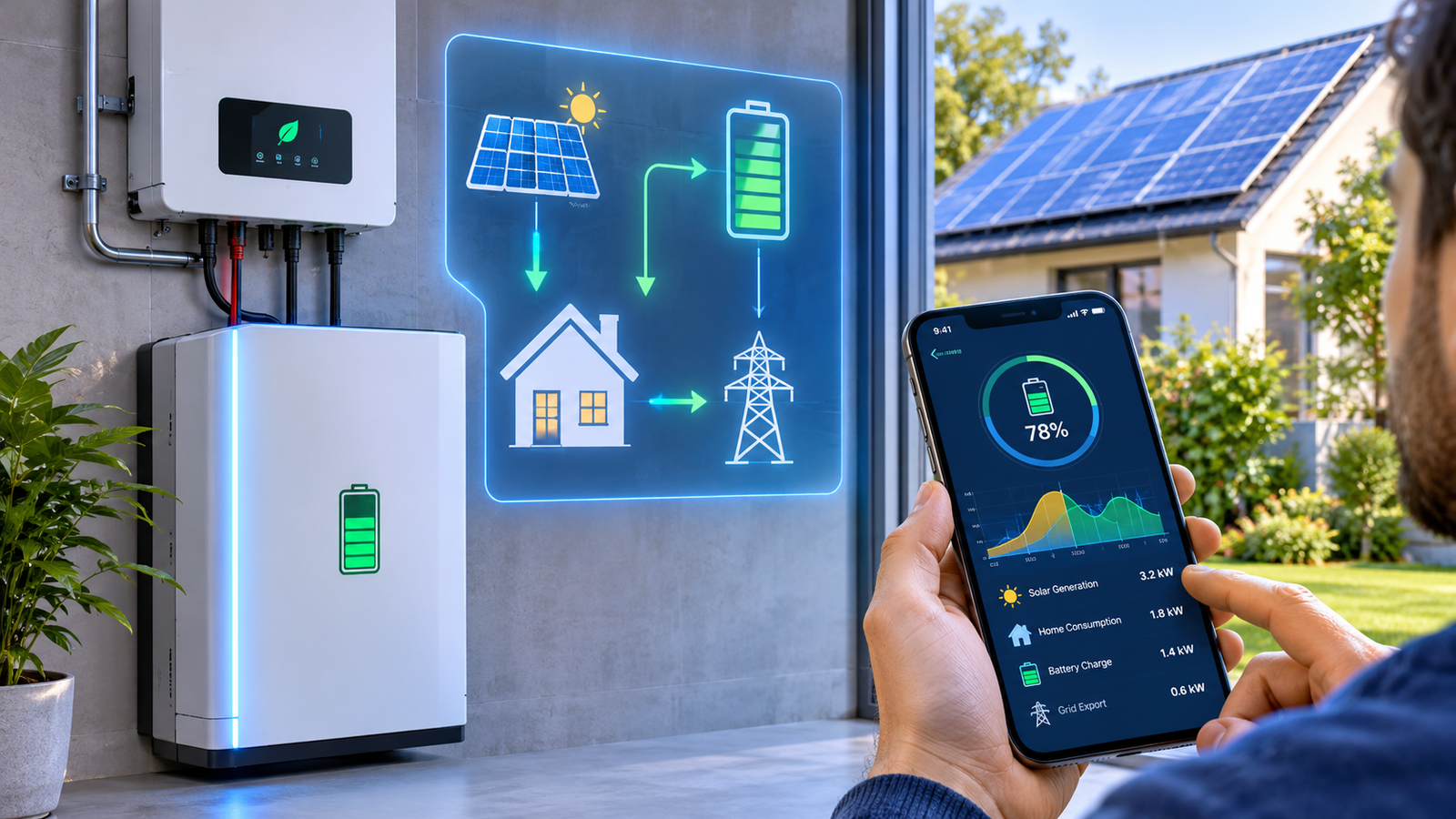
Solar batteries have become much more advanced than simple energy storage devices. Modern smart solar batteries can monitor battery health, communicate with an inverter, track energy use and automatically adjust when to charge or discharge.
But what actually makes a solar battery “smart”?
A smart solar battery combines battery cells with an intelligent Battery Management System (BMS), sensors, communication technology and software. Instead of simply storing electricity, it can continuously monitor the battery and help manage how that stored energy is used.
For homeowners and businesses, this can mean better energy management, improved monitoring, greater use of solar power and potentially lower electricity costs.
In this guide, we explain what smart solar batteries are, how they work, their main benefits, costs, limitations and what to look for before buying one.
What Are Smart Solar Batteries?
Smart solar batteries are energy storage systems that use intelligent controls and monitoring technology to manage stored electricity more efficiently.
A conventional battery mainly stores and releases energy. A smart battery goes further by monitoring information such as:
- Battery state of charge (SOC)
- Battery temperature
- Voltage
- Current
- State of health (SOH)
- Charging and discharging activity
- Energy consumption
- Fault conditions
- Communication with the inverter
The battery’s Battery Management System (BMS) acts as an important control layer between the battery cells and the wider solar energy system.
Modern BMS technology can monitor voltage, current and temperature while also estimating battery conditions such as state of charge and state of health.
In simple terms
Think of a smart solar battery as a battery with a brain.
The battery stores energy, while the BMS and connected software help determine:
How much energy is available → when it should charge → when it should discharge → how the battery should be protected.
That intelligence is what separates many smart battery systems from basic storage solutions.
How Do Smart Solar Batteries Work?
The basic principle is similar to other solar battery systems, but smart batteries add another layer of monitoring and control.
Step 1: Solar panels generate electricity
During daylight hours, solar panels generate electricity from sunlight.
Some of that electricity can immediately power appliances in the property.
If solar production is higher than the property’s current demand, the surplus can be directed towards the battery.
Step 2: The battery stores excess energy
The smart battery stores the available surplus electricity for later use.
For example, your solar panels may produce plenty of energy during the afternoon when your electricity demand is relatively low.
Instead of wasting that surplus or exporting it, the system can store some of it for later.
Step 3: The BMS monitors the battery
This is where the smart part becomes important.
The BMS continuously monitors important battery parameters, including voltage, current and temperature.
It can also calculate information such as state of charge (SOC) and state of health (SOH).
Advanced systems can use this information to determine appropriate charging and discharging limits.
Step 4: The inverter and battery communicate
A smart solar battery normally works alongside an inverter.
The battery can communicate information to the inverter or energy management system through communication protocols such as CAN or RS485, depending on the equipment.
This communication allows the wider system to understand the battery’s condition and operating limits.
Step 5: Stored energy is used when needed
When solar generation falls, such as in the evening, the system can use stored battery energy.
Instead of relying entirely on electricity from the grid, your home can use energy that was stored earlier.
Step 6: The system keeps adjusting
This is one of the biggest advantages of smart battery technology.
The system can monitor changing conditions and adjust charging or discharging according to its configuration.
Some systems can also integrate with energy tariffs, household demand and other energy-management features.
What Makes a Solar Battery Smart?
Not every solar battery advertised as “smart” has exactly the same features.
When comparing products, look for the technology behind the marketing term.
1. Intelligent Battery Management System
The BMS is one of the most important components.
A good BMS monitors individual battery conditions and helps protect the cells from problems such as:
- Overcharging
- Over-discharging
- Excessive current
- Abnormal temperatures
- Cell imbalance
- Other operating faults
Advanced BMS designs can also communicate battery information to other system components.
A smart BMS can therefore do much more than simply switch the battery off when something goes wrong. It can measure, calculate and communicate battery conditions in real time.
2. Real-Time Monitoring
Smart batteries can provide information about how the battery is performing.
Depending on the manufacturer and system, you may be able to see:
- Current battery percentage
- Charging power
- Discharging power
- Solar generation
- Household consumption
- Battery temperature
- Historical energy data
- Fault notifications
This can make it much easier to understand how your solar storage system is performing.
3. Intelligent Charging and Discharging
A smart battery can be configured to charge and discharge according to system conditions.
For example, it may charge from excess solar generation during the day and discharge later when solar production falls.
Where supported, the system can also be configured around time-based electricity tariffs.
4. Battery Health Monitoring
Smart systems can monitor battery performance over time.
Some advanced systems provide information relating to state of health, cycle activity and battery faults.
This can help identify unusual behaviour before it becomes a bigger problem.
5. Remote Access
Many modern systems offer an app or online monitoring platform.
This allows users to check their battery remotely rather than relying entirely on the physical display on the battery or inverter.
Smart Solar Batteries vs Regular Solar Batteries
The main difference isn’t necessarily the battery chemistry.
The biggest difference is the level of monitoring, communication and control.
| Feature | Regular Solar Battery | Smart Solar Battery |
|---|---|---|
| Energy storage | Yes | Yes |
| Basic protection | Yes | Yes |
| Battery monitoring | Basic | Advanced |
| Intelligent BMS | Limited/varies | Usually |
| Real-time data | Limited | Usually available |
| Remote monitoring | May be unavailable | Common |
| Inverter communication | Varies | Usually stronger |
| Energy optimisation | Limited | Advanced |
| Fault diagnostics | Basic | More detailed |
| Automation | Limited | More capable |
| Price | Usually lower | Usually higher |
This does not mean a regular battery is a bad choice.
If you simply need dependable energy storage and do not need detailed monitoring or advanced automation, paying extra for smart features may not always make financial sense.
Key Benefits of Smart Solar Batteries
1. Better Use of Solar Energy
One of the biggest reasons to install a solar battery is to use more of the electricity your solar panels generate.
Instead of exporting excess energy immediately, you can store it and use it later.
Smart control can help make this process more efficient.
2. Improved Energy Monitoring
A smart battery gives you greater visibility into your energy system.
Instead of wondering where your electricity is going, you can often see:
Solar generation → household consumption → battery charging → battery discharging → grid import/export
This information can help you understand your property’s energy habits.
3. Better Battery Protection
The BMS monitors important operating conditions and can take protective action when limits are reached.
This is particularly important for lithium-based batteries, where temperature, voltage and current need to remain within appropriate operating ranges.
A properly designed BMS helps improve safety and manage battery operation.
4. Potentially Lower Electricity Costs
A smart battery can help reduce grid electricity consumption by allowing you to use stored energy when your solar panels are not producing enough.
If your electricity tariff changes throughout the day, smart control can become even more useful.
However, savings depend on factors such as:
- Electricity prices
- Solar generation
- Battery capacity
- Household consumption
- Battery efficiency
- Export rates
- Installation cost
- Battery degradation
A smart battery does not automatically guarantee lower bills.
5. Better Understanding of Battery Health
Smart monitoring can give users more information about battery performance.
Instead of treating the battery as a black box, you can potentially monitor its condition and identify unusual behaviour.
This can be especially useful for systems expected to operate for many years.
6. Convenient Remote Monitoring
If your battery includes an app, you can often check system performance from your phone.
For example, you might be able to see whether your battery is:
Charging → Fully charged → Discharging → Idle → Reporting a fault
This can make everyday management much easier.
Do Smart Solar Batteries Save More Money?
This is an important question.
The answer is sometimes, but not automatically.
The smart features themselves do not create free energy.
Instead, they can help you use the energy you already generate or purchase electricity at more favourable times, depending on the system and tariff.
For example:
Imagine your solar panels generate a large amount of electricity during the afternoon.
Your household demand is low, so instead of using all that energy immediately, the battery stores the surplus.
Later in the evening, your solar panels produce little or no electricity.
The battery can then discharge to supply your home.
This increases the amount of solar electricity you use yourself.
The financial benefit depends on the difference between the value of the electricity stored and the cost of importing electricity later.
Smart Solar Battery Cost in 2026
There is no single price for a smart solar battery.
The total cost can vary significantly depending on the battery’s:
- Capacity
- Chemistry
- Power rating
- Brand
- BMS
- Inverter compatibility
- Warranty
- Installation requirements
- Monitoring features
- Backup capability
Some products are sold as battery-only units, while complete installations can include the battery, inverter, protection equipment, labour and commissioning.
For example, one current smart solar battery product listing from Quantum Renewables shows a £399 product price, but that should not be treated as a typical installed-system price because battery specifications, installation and system configuration can vary considerably.
What you should compare instead of just the price
Don’t ask only:
“How much does the battery cost?”
Also ask:
“How much will the complete system cost per usable kWh?”
A cheaper battery is not necessarily better value if it has lower usable capacity, weaker warranty terms or limited compatibility.
What Size Smart Solar Battery Do You Need?
Choosing the right capacity is just as important as choosing smart features.
Common residential battery capacities can range from relatively small systems to large modular installations.
Your ideal size depends on:
- Daily electricity consumption
- Solar panel capacity
- Solar generation profile
- Evening electricity usage
- Existing inverter
- Desired backup capacity
- Electricity tariff
- Budget
- Future energy demand
Simple example
If your home regularly has a large amount of unused solar energy during the day and significant electricity demand in the evening, a larger battery may make sense.
But installing the biggest battery possible isn’t automatically the best option.
A battery that regularly sits partially unused may provide poorer value than a correctly sized system.
What Battery Chemistry Is Best for Smart Solar Storage?
Smart features and battery chemistry are separate considerations.
A battery can be intelligent while using different cell chemistries.
For modern home energy storage, lithium iron phosphate (LiFePO4) is widely used because of its combination of safety characteristics, cycle performance and suitability for stationary storage.
However, the best option depends on the specific product.
When comparing smart batteries, look at:
- Chemistry
- Usable capacity
- Round-trip efficiency
- Maximum charge power
- Maximum discharge power
- Cycle warranty
- Calendar warranty
- Operating temperature
- Installation requirements
- Inverter compatibility
Can Smart Solar Batteries Work With Existing Solar Panels?
Potentially, yes.
But compatibility needs to be checked before purchasing.
A battery system needs to work correctly with the existing electrical architecture, inverter and control system.
Depending on the setup, you may need:
- A compatible hybrid inverter
- An AC-coupled battery
- A DC-coupled battery
- Additional control equipment
- Electrical protection
- Professional configuration
Never assume that any battery will work with any inverter simply because both are labelled “solar”.
Smart Solar Batteries With Time-of-Use Tariffs
Smart batteries can become particularly interesting when electricity prices vary during the day.
A system may be configured to:
Charge when electricity is cheaper → store energy → discharge when electricity is more expensive.
If solar generation is also available, the system can potentially combine solar charging with tariff-based energy management.
However, the economics depend on the actual tariff and battery efficiency.
You should calculate the expected saving rather than assuming every time-of-use tariff will make a battery worthwhile.
Smart Solar Batteries for Homes With EVs
Electric vehicles can significantly increase household electricity consumption.
A smart solar battery can help manage energy between:
Solar panels + home + battery + EV + grid
For example, surplus solar generation could potentially be stored in the battery rather than immediately imported from the grid later.
However, EV charging can require substantial power, so the battery’s discharge rate and inverter capacity are important.
A large battery with a low power output may not behave the way you expect when several high-power appliances are running.
Are Smart Solar Batteries Worth It?
For many homeowners, smart solar batteries can be worthwhile, but the answer depends on how the system will actually be used.
They may be worth considering if you:
- Generate a lot of excess solar energy
- Use significant electricity in the evening
- Want detailed energy monitoring
- Have a time-of-use electricity tariff
- Want automated energy management
- Have an EV
- Want better visibility of battery health
- Expect your energy needs to increase
They may be less attractive if you:
- Have very little surplus solar energy
- Use most solar electricity immediately
- Have low electricity consumption
- Rarely use the battery
- Have a very high installation cost
- Don’t need advanced monitoring
The important point is that smart features should support a useful energy strategy rather than being purchased simply because they sound impressive.
What to Look for When Buying Smart Solar Batteries
Before buying, use this checklist.
1. Usable Capacity
Don’t look only at the advertised nominal capacity.
Check how much energy you can actually use.
2. Power Output
Capacity tells you how much energy the battery stores.
Power tells you how quickly it can deliver that energy.
Both matter.
3. Battery Management System
Ask what the BMS actually monitors.
A good BMS should provide appropriate protection and monitoring rather than simply being a marketing label.
4. Inverter Compatibility
Check whether the battery is officially compatible with your inverter.
5. Monitoring Platform
Look at the app or web dashboard before buying.
Can you see:
- SOC?
- Solar generation?
- Consumption?
- Charging?
- Discharging?
- Faults?
- Historical data?
6. Warranty
Check both the warranty period and its conditions.
Look for information about:
- Cycle limits
- Throughput
- Capacity retention
- Installation requirements
- Approved installers
7. Safety Features
Check the manufacturer’s specifications for:
- Over-voltage protection
- Over-current protection
- Temperature monitoring
- Short-circuit protection
- Thermal management
8. Scalability
If your electricity consumption could increase in the future, consider whether additional battery modules can be added.
9. Backup Power
Don’t assume every solar battery provides backup power during a grid outage.
Check whether backup functionality is supported and what additional equipment is required.
10. Total Installed Cost
Always compare the complete system price rather than just the battery unit.
Smart Solar Batteries: Pros and Cons
Pros
- Better energy monitoring
- Intelligent battery management
- More detailed diagnostics
- Improved control
- Potentially better solar self-consumption
- Remote monitoring
- Compatibility with advanced energy-management strategies
- Useful for homes with EVs or changing energy demand
Cons
- Usually more expensive than basic systems
- More complicated installation
- Requires compatible equipment
- Smart features may not be useful for every household
- Internet/app features can vary between manufacturers
- Higher upfront cost can increase the payback period
Smart Solar Batteries vs Traditional Batteries: Which Should You Choose?
If your priority is simply storing solar electricity, a conventional battery may be enough.
But if you want greater visibility, automation and control, a smart solar battery can be the better long-term option.
For example:
Basic requirement:
Store solar energy and use it at night → a standard battery may be sufficient.
Advanced requirement:
Monitor battery health, optimise charging, manage time-of-use electricity and analyse household consumption → a smart battery is more attractive.
The right choice depends on your energy usage rather than the number of features on the product brochure.
Frequently Asked Questions
What is a smart solar battery?
A smart solar battery is an energy storage system equipped with intelligent monitoring and control technology, usually including a Battery Management System (BMS). It can monitor battery conditions and communicate with other components of the solar system.
How does a smart solar battery work?
It stores surplus electricity and releases it when required. Its BMS monitors conditions such as voltage, current and temperature while connected control systems can manage charging, discharging and monitoring.
Are smart solar batteries better than normal batteries?
They can be, particularly if you want advanced monitoring, automation and energy optimisation. However, a conventional battery can still be the better-value choice for users who only need basic energy storage.
Do smart batteries reduce electricity bills?
They can help reduce electricity costs by increasing solar self-consumption or shifting stored energy to more expensive periods. Actual savings depend on your energy use, tariff, solar generation, battery capacity and installation cost.
Can a smart solar battery charge from the grid?
Some systems can, depending on the battery, inverter and system configuration. This can be useful with certain time-of-use tariffs, but it should be configured according to the manufacturer’s specifications and local installation requirements.
How long do smart solar batteries last?
Battery lifespan depends on chemistry, operating temperature, depth of discharge, cycling, charging conditions and product quality. Always check the manufacturer’s warranty and expected cycle or throughput specifications rather than relying on one universal lifespan figure.
Do smart solar batteries work during a power cut?
Not automatically.
Backup power depends on the battery system, inverter and installation configuration. Some systems provide backup functionality while others are designed primarily for energy storage and grid-connected operation.
Can I add a smart battery to my existing solar panels?
Often yes, but compatibility must be checked. Your existing inverter, electrical system and battery architecture all need to be considered.
Final Verdict
Smart solar batteries are more than simple energy storage devices.
Their biggest advantage is the combination of battery storage, intelligent BMS technology, monitoring and energy management.
For a homeowner, this can mean greater visibility into energy use and better control over when stored electricity is charged and discharged. For larger or more complex systems, smart monitoring and communication can become even more valuable.
But don’t choose a battery simply because it has the word “smart” on the box.
Before buying, compare its usable capacity, power output, BMS, inverter compatibility, warranty, monitoring system, backup capability and total installed cost.
The smartest battery is not necessarily the one with the most features. It is the one whose features actually match your electricity usage and solar system.
Key takeaway: If you have excess solar generation, meaningful evening electricity demand and want better control over your energy system, a smart solar battery can be a valuable upgrade. If your requirements are simple, a less expensive battery may provide better overall value.