
If you are thinking about installing a solar battery, solar battery efficiency is one of the most important specifications to understand.
A battery can store the electricity produced by your solar panels and make it available later, but you will never get exactly the same amount of electricity back. Some energy is lost during charging, storage and discharging.
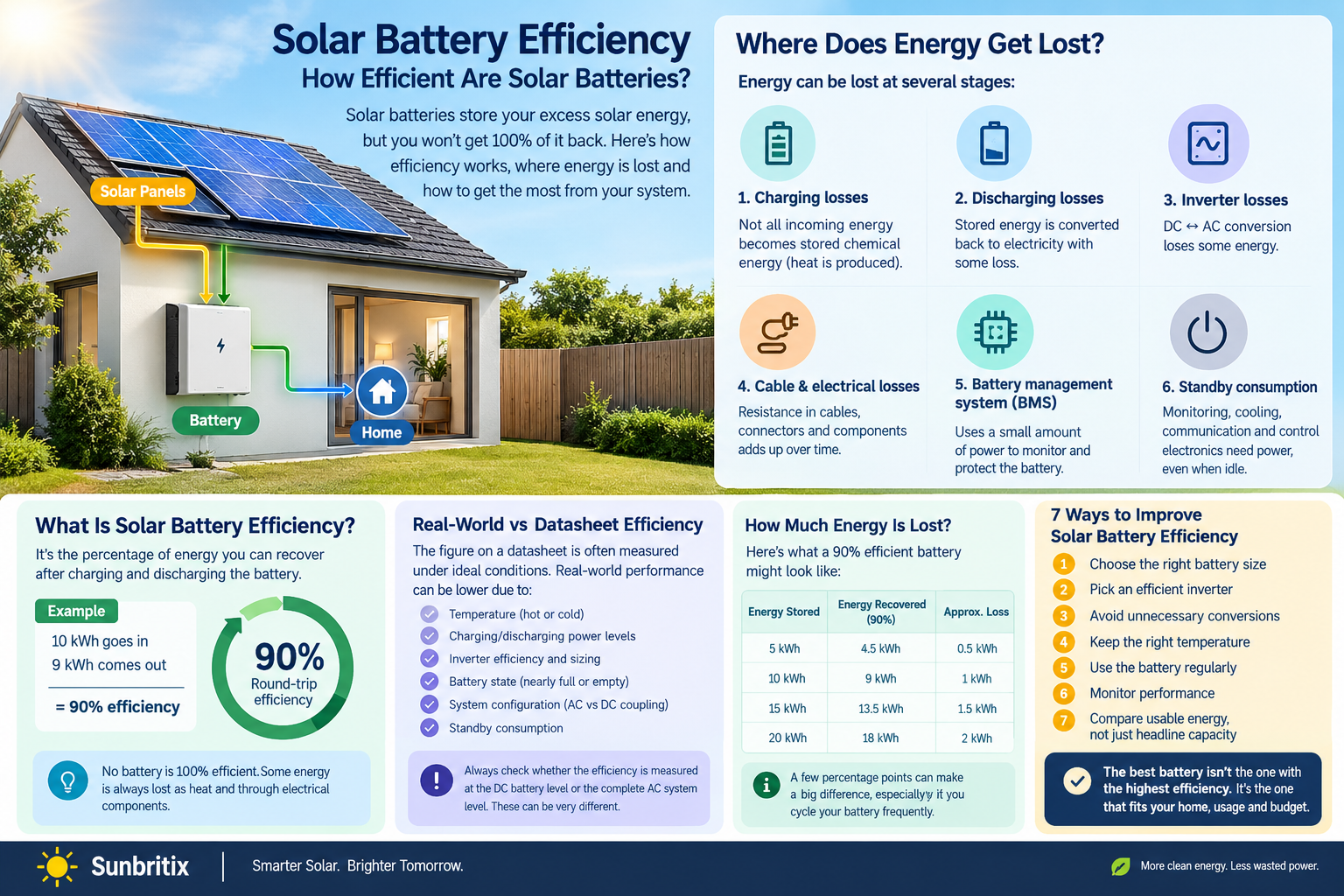
For example, if 10 kWh of electricity goes into a battery and 9 kWh comes back out, the round-trip efficiency is 90%.
But there is an important point that many people miss: the efficiency shown on a battery datasheet may not represent the efficiency of the complete solar battery system in everyday use.
In this guide, we explain how efficient solar batteries really are, where energy losses occur, how to calculate efficiency, what affects performance and what to look for when comparing batteries.
Key Takeaways
- Solar battery efficiency measures how much energy you can recover after charging and discharging a battery.
- Round-trip efficiency is one of the most useful figures when comparing battery storage systems.
- Modern lithium-ion batteries can have high round-trip efficiency, but actual whole-system performance can be lower.
- Energy can be lost through the battery cells, inverter, cables, battery management system and standby consumption.
- Temperature, charging power, discharge power and battery usage can all affect efficiency.
- A higher efficiency rating is useful, but it should not be the only factor when choosing a solar battery.
- A slightly less efficient battery can sometimes provide better overall value if it has the right capacity, power rating, warranty and price.
What Is Solar Battery Efficiency?
Solar battery efficiency is the percentage of electrical energy that can be recovered after energy has been stored in the battery.
A simple example makes this easier to understand.
Suppose your solar panels send 10 kWh of electricity to your battery.
After charging, storing and discharging, you receive 9 kWh back for use in your home.
The calculation is:
9 kWh ÷ 10 kWh × 100 = 90% efficiency
The remaining 1 kWh has been lost during the energy conversion and storage process.
These losses are normal. No electrical storage system can operate at 100% efficiency because energy is lost as heat and through electrical components during conversion.
What Is Round-Trip Efficiency?
When people compare solar batteries, you will often see the term round-trip efficiency.
Round-trip efficiency measures how much energy comes back out compared with the amount of energy that went into the battery.
The basic formula is:
Round-trip efficiency = Energy discharged ÷ Energy charged × 100
For example:
- Energy sent to battery: 10 kWh
- Energy recovered: 9.2 kWh
- Energy lost: 0.8 kWh
- Round-trip efficiency: 92%
This is a much more useful figure than simply looking at the battery’s charging efficiency or discharging efficiency separately.
However, you should always check how a manufacturer defines its efficiency figure. Some specifications are measured at the battery/DC level, while others include more of the system. Different measurement methods can therefore make direct comparisons misleading.
How Efficient Are Solar Batteries?
There is no single efficiency figure that applies to every solar battery.
Battery chemistry, inverter design, operating conditions and system configuration all make a difference.
For lithium-ion batteries, published round-trip efficiency figures are commonly in the high-80% to mid-90% range, depending on the technology and how the system is measured. One technical comparison lists lithium-ion systems at around 89–96%, while older lead-acid technology is generally lower.
But don’t assume that a battery advertised as 95% efficient will always deliver 95% of the solar energy to your appliances.
The complete system can have additional losses.
That’s why there can be a significant difference between:
Battery cell efficiency → Battery system efficiency → Whole solar-plus-battery efficiency
Where Does Solar Battery Energy Get Lost?
Energy can be lost at several stages.
1. Battery charging losses
When electricity enters the battery, not all of it becomes stored chemical energy.
Some energy is converted into heat because of electrical resistance and the internal characteristics of the cells.
2. Battery discharge losses
The reverse process also produces losses.
When stored chemical energy is converted back into electrical energy, some energy is lost.
3. Inverter losses
Most homes use AC electricity, while batteries store electricity as DC.
An inverter may therefore need to convert:
DC → AC
or:
AC → DC
Every conversion introduces some energy loss.
4. Cable and electrical losses
Cables, connectors and other electrical components also have resistance.
The losses may be relatively small, but across thousands of charging and discharging cycles they can become meaningful.
5. Battery management system
The battery management system, or BMS, monitors things such as voltage, temperature and cell conditions.
It requires a small amount of electricity to operate.
6. Standby consumption
A battery system can consume electricity even when it is not actively charging or discharging.
Monitoring equipment, communication systems, displays, cooling and control electronics can all require power.
This is one reason why measuring efficiency over a longer period can provide a more realistic picture than looking at a single charging cycle.
Why Real-World Efficiency Can Be Lower Than the Datasheet
This is one of the most important things to understand before buying a battery.
Manufacturers normally publish performance figures under particular test conditions.
Your home will not operate under those exact conditions every day.
For example, efficiency can change when:
- The battery is charging at very low power
- The battery is discharging at very low power
- The battery is operating at high power
- Temperatures are very high or very low
- The battery is nearly full
- The battery is nearly empty
- The inverter is operating away from its optimum range
- Standby consumption becomes significant compared with household demand
Research and field assessments also show that real-world PV-plus-battery performance depends on factors beyond battery chemistry, including inverter behaviour, control strategy, temperature, operating profile and system design.
Does Battery Temperature Affect Efficiency?
Yes.
Temperature can influence battery performance and efficiency.
A battery operating outside its preferred temperature range may experience reduced performance, while thermal management can also consume additional energy.
This is particularly important when comparing systems installed in different environments.
A battery in a well-designed, temperature-controlled installation may perform differently from the same battery operating in much harsher conditions.
Therefore, don’t judge a battery only by its headline efficiency percentage.
Does Charging Speed Affect Solar Battery Efficiency?
It can.
The amount of power flowing through the battery and inverter can affect efficiency.
For example, a system operating at a very low power level may have fixed losses that become relatively significant.
Imagine a battery system consuming 30 W for its electronics.
If the battery is processing 5,000 W, that consumption is relatively small.
But if the battery is only processing 300 W, the same 30 W represents a much larger proportion of the energy being used.
This is one reason why real-world efficiency can vary throughout the day.
AC-Coupled vs DC-Coupled Battery Systems
The way a battery is connected to a solar system can also affect energy losses.
AC-Coupled System
In an AC-coupled setup, electricity may go through multiple conversion stages.
For example:
Solar panels → Solar inverter → AC → Battery inverter → Battery
When the stored electricity is later used:
Battery → Battery inverter → AC → Home
Every conversion introduces potential losses.
DC-Coupled System
A DC-coupled system can reduce some conversion stages because solar electricity and battery storage can be connected on the DC side.
A simpler path can potentially mean fewer conversion losses.
However, the best system is not automatically the one with the highest theoretical efficiency.
System design, inverter sizing, installation conditions, battery capacity and how the household uses electricity all matter.
A Simple Solar Battery Efficiency Example
Let’s say your solar panels generate 12 kWh during the day.
Your home immediately uses 4 kWh.
That leaves:
12 kWh − 4 kWh = 8 kWh
available for battery charging.
Suppose the battery system has a round-trip efficiency of 90%.
The approximate energy you can recover later would be:
8 kWh × 90% = 7.2 kWh
So:
8 kWh stored → approximately 7.2 kWh recovered
Around 0.8 kWh is lost during the complete cycle.
This is why battery capacity and battery efficiency should be considered together.
How Much Energy Does a 90% Efficient Battery Lose?
Let’s make the numbers easier.
| Energy Stored | 90% Efficiency | Energy Recovered | Approx. Loss |
|---|---|---|---|
| 5 kWh | 90% | 4.5 kWh | 0.5 kWh |
| 10 kWh | 90% | 9 kWh | 1 kWh |
| 15 kWh | 90% | 13.5 kWh | 1.5 kWh |
| 20 kWh | 90% | 18 kWh | 2 kWh |
This demonstrates why even a few percentage points of efficiency can matter when a battery is cycled frequently.
How Do You Calculate Solar Battery Efficiency?
If you have your own battery monitoring data, you can calculate efficiency yourself.
Use:
Efficiency (%) = Energy discharged ÷ Energy charged × 100
For example:
You charge the battery with:
4,000 kWh
Over the same measurement period, you recover:
3,600 kWh
Therefore:
3,600 ÷ 4,000 × 100 = 90%
Your measured round-trip efficiency is approximately 90%.
For a useful real-world assessment, it is better to look at longer-term monitoring rather than relying on a single day. Household demand, weather, charging patterns and operating conditions can change considerably from day to day. Sonnen, for example, recommends looking at annual values when assessing actual system efficiency because usage patterns vary throughout the year.
What Is a Good Solar Battery Efficiency?
For most homeowners, a high round-trip efficiency is desirable.
Modern lithium-ion systems can offer strong efficiency, with some published figures reaching the 90%+ range depending on the measurement method and system configuration.
But there is no magic number that automatically makes a battery the best choice.
When comparing batteries, look at:
- Round-trip efficiency
- Usable battery capacity
- Battery power output
- Depth of discharge
- Warranty
- Expected cycle life
- Battery chemistry
- Inverter efficiency
- Installation requirements
- Monitoring features
- Price
- Manufacturer support
A battery with 96% efficiency is not necessarily a better purchase than one rated at 92% if the first system costs substantially more or doesn’t suit your household’s electricity demand.
Does Higher Efficiency Always Mean More Savings?
Not necessarily.
This is a common misunderstanding.
Imagine Battery A has a slightly higher efficiency but is too small for your household.
Battery B has slightly lower efficiency but enough usable capacity to store more of your excess solar electricity.
If Battery B allows you to use significantly more of your own solar power in the evening, it could provide better overall value.
The same applies to inverter sizing.
A system designed only around maximum efficiency may not always capture the maximum amount of available solar energy. Sonnen’s analysis illustrates this trade-off: inverter sizing and the amount of solar energy captured can sometimes matter alongside efficiency itself.
Solar Battery Efficiency vs Battery Capacity
These two specifications are often confused.
Battery capacity tells you how much energy the battery can store.
Efficiency tells you how much of that stored energy you can recover.
For example:
A battery might have:
10 kWh usable capacity
and:
90% round-trip efficiency
Capacity answers:
How much energy can I store?
Efficiency answers:
How much energy can I get back after storing it?
You need both figures to understand the real performance of a battery.
Solar Battery Efficiency vs Depth of Discharge
Depth of discharge, or DoD, is another specification that should not be confused with efficiency.
If a battery has a 10 kWh capacity and a 90% usable depth of discharge, approximately 9 kWh may be available for normal use, depending on how the manufacturer defines its specifications.
Efficiency then determines how much energy is lost during the charging and discharging process.
So:
Capacity = storage size
Depth of discharge = usable portion
Efficiency = energy retained through the storage cycle
Together, these give you a much better understanding of battery performance.
Which Battery Chemistry Is Most Efficient?
Lithium-ion batteries are widely used in modern residential energy storage because they offer a strong combination of efficiency, energy density, cycle performance and usable capacity.
Within lithium-ion technology, lithium iron phosphate (LFP or LiFePO4) is also widely used in stationary energy storage.
However, efficiency should not be considered in isolation.
Battery safety, warranty, cycle life, usable capacity and thermal management can be equally important when choosing a system.
Different battery technologies have different performance characteristics, so published specifications should always be compared on a like-for-like basis.
7 Ways to Improve Solar Battery Efficiency
You cannot eliminate battery losses completely, but good system design can help minimise unnecessary losses.
1. Choose the right battery size
An oversized battery may spend more time operating at low power or at partial utilisation.
An undersized battery may regularly reach full charge and waste excess solar generation.
The right size depends on your solar generation and household electricity demand.
2. Choose an efficient inverter
The inverter is a major part of the energy conversion process.
Look at the inverter’s efficiency specifications as well as the battery’s advertised efficiency.
3. Avoid unnecessary conversion stages
Where appropriate, a well-designed DC-coupled system may reduce some conversion steps.
However, the overall design should always be assessed rather than assuming DC coupling is automatically better.
4. Keep the battery within its recommended temperature range
Extreme temperatures can affect battery performance.
Follow the manufacturer’s installation and operating requirements.
5. Use the battery regularly
A battery is designed around a particular operating profile.
How frequently it charges and discharges affects its overall economics and performance.
6. Monitor battery performance
Modern systems often provide apps or monitoring platforms.
Check:
- Solar generation
- Battery charging
- Battery discharge
- Household consumption
- Grid imports
- Grid exports
This can help identify unusual losses or performance changes.
7. Compare usable energy, not just headline capacity
A battery advertised as 10 kWh does not necessarily mean you can use the full 10 kWh in every situation.
Always check the usable capacity alongside efficiency.
What Should You Look for on a Solar Battery Datasheet?
When comparing two batteries, don’t immediately look at the highest efficiency percentage.
Check the complete specification.
| Specification | Why It Matters |
|---|---|
| Usable capacity | Shows how much energy is actually available |
| Round-trip efficiency | Shows how much energy survives the storage cycle |
| Continuous power | Determines how much load the battery can supply |
| Peak power | Important for short high-power demands |
| Depth of discharge | Shows how much of the battery can normally be used |
| Cycle life | Helps indicate long-term durability |
| Warranty | Provides protection over the expected operating period |
| Battery chemistry | Affects safety, performance and lifespan |
| Inverter efficiency | Influences whole-system energy losses |
| Operating temperature | Can affect real-world performance |
Is a 95% Efficient Solar Battery Worth It?
It can be, but don’t automatically pay a premium just because the number is higher.
Consider two batteries:
Battery A
- 95% efficiency
- Higher price
- Smaller usable capacity
Battery B
- 92% efficiency
- Lower price
- Larger usable capacity
But if Battery B stores substantially more of your excess solar and has a lower purchase cost, it could deliver better overall value.
This is why the right question is not:
Which battery has the highest efficiency?
Instead, ask:
Which battery gives me the best combination of usable energy, efficiency, power, lifespan and cost?
Solar Battery Efficiency: The Bottom Line
Solar battery efficiency matters because every storage cycle involves some energy loss.
A battery with high round-trip efficiency can return more of the electricity you put into it, helping you make better use of surplus solar generation.
However, the number printed on a datasheet is only part of the story.
Real-world performance also depends on the inverter, battery management system, temperature, charging and discharging power, standby consumption, system configuration and household usage.
For this reason, don’t choose a solar battery based on efficiency alone.
Look at the complete system.
A slightly lower efficiency rating can still be a sensible choice if the battery has the right usable capacity, power output, warranty, lifespan and price for your home.
The best solar battery is not necessarily the one with the biggest capacity or the highest efficiency percentage. It is the one that loses as little energy as possible while matching the way your household actually produces and uses electricity.
Frequently Asked Questions
Are solar batteries 100% efficient?
No. Some energy is inevitably lost during charging, storage and discharging. Additional losses can occur through inverters, cables, electronics and standby consumption.
What is a good efficiency for a solar battery?
A high round-trip efficiency is generally desirable. Modern lithium-ion systems can achieve high efficiency, but the exact figure depends on the battery, inverter, measurement method and operating conditions.
Does solar battery efficiency decrease over time?
Battery performance can change as the battery ages. Degradation can affect capacity and overall system performance, although the exact effect depends on the battery technology, operating conditions and usage.
Is 90% battery efficiency good?
Yes. A 90% round-trip efficiency means that approximately 90% of the energy entering the complete measured cycle is recovered, while around 10% is lost.
How much energy does a 90% efficient battery lose?
If 10 kWh enters the battery system and its measured round-trip efficiency is 90%, approximately 9 kWh would be recovered, leaving about 1 kWh of loss.
Does battery efficiency affect electricity savings?
Yes. Higher efficiency means less stored energy is lost, which can help increase the amount of solar electricity available for later use. However, battery size, electricity prices, solar generation and usage patterns also have a major effect on savings.
Is lithium-ion more efficient than lead-acid?
Generally, lithium-ion batteries have higher round-trip efficiency than traditional lead-acid systems. Published technical comparisons show lithium-ion around 89–96% versus roughly 80–87% for lead-acid, although actual performance depends on the specific system and measurement conditions.
Should I choose a solar battery based only on efficiency?
No. Compare efficiency together with usable capacity, power output, warranty, cycle life, battery chemistry, inverter performance and total installed cost.
Final tip: When comparing solar batteries, always ask whether the quoted efficiency is measured at the DC battery level or the complete AC system level. That small detail can make two seemingly similar efficiency figures much less comparable than they first appear.