
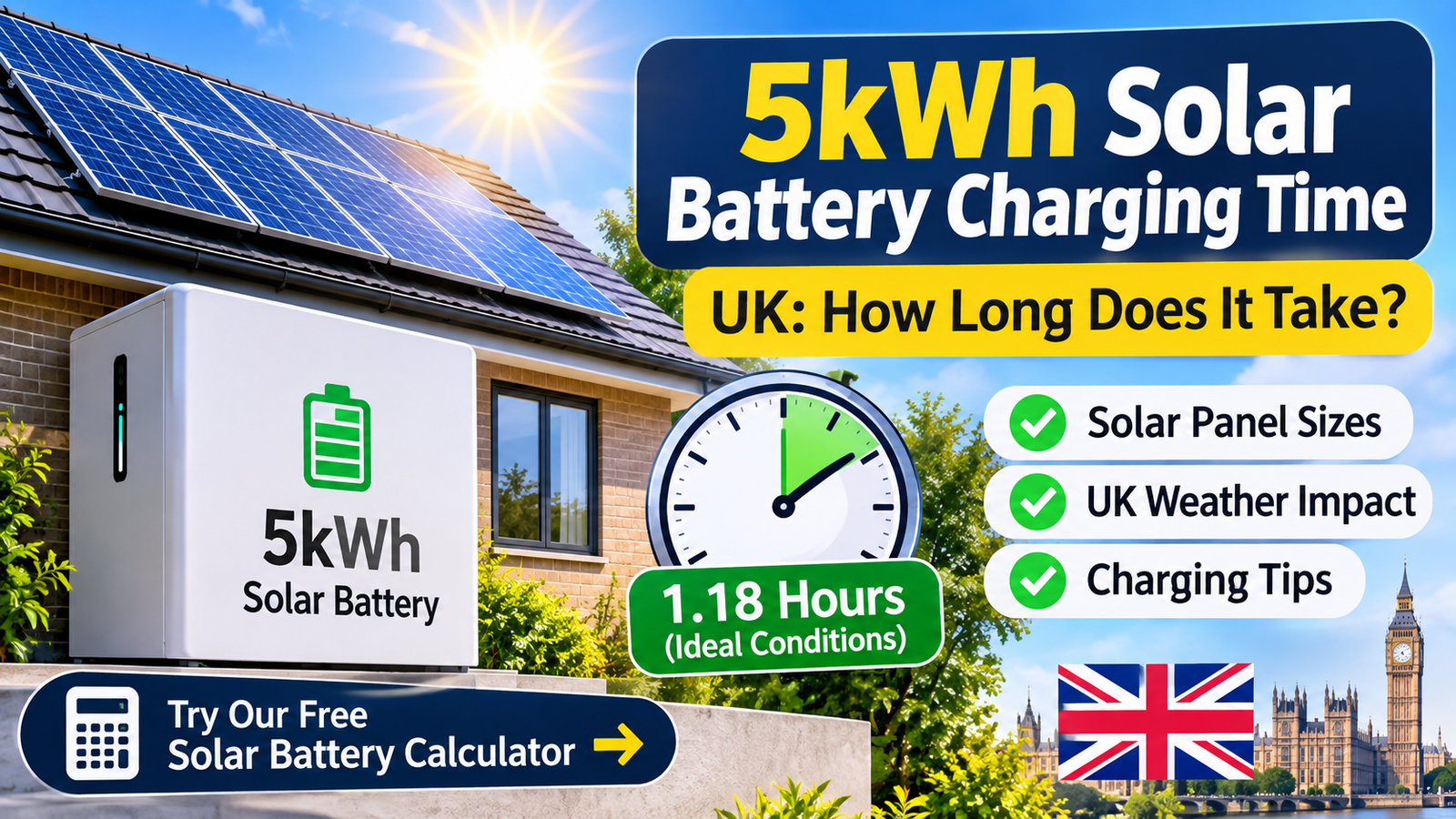
If you are thinking about installing a 5kWh solar battery, one important question is: how long does it take to charge a 5kWh solar battery in the UK?
The answer depends on several factors, including your solar panel system size, available sunlight, battery charge level, inverter capacity and how much electricity your home is using.
Under ideal conditions, a 5kWh battery that needs 4kWh of energy could take approximately 1.18 hours of equivalent full-power charging from a 4kW solar array operating at 85% assumed efficiency. However, this does not mean the battery will always become full in 1 hour and 11 minutes of real daylight.
In practice, UK weather, household electricity consumption and equipment limits can make charging take considerably longer.
In this guide, we explain typical charging calculations, solar panel requirements, seasonal differences and practical ways to estimate your battery charging time. You can also use our free calculators to check your own requirements.
Key Takeaways
- A 5kWh battery does not always need 5kWh of electricity to become fully charged. The amount required depends on its current charge level.
- A larger solar panel system can generally provide more charging power, but actual output changes throughout the day.
- Household electricity use can reduce the surplus solar power available to charge your battery.
- Inverter and battery charging limits can restrict the charging speed.
- UK winter conditions can increase charging time because of shorter days and lower solar generation.
- Our solar battery charging calculator can help estimate charging time using your own figures.
How Long Does It Take to Charge a 5kWh Solar Battery?
A 5kWh battery can theoretically be charged relatively quickly when enough solar power is available. However, the actual time depends on how much energy the battery needs and how much power your system can deliver to it.
For example, imagine your battery has a capacity of 5kWh and its current charge level is 20%. You want to charge it to 100%.
The battery needs another 80% of its capacity.
Energy required = 5kWh × 80% = 4kWh
If your solar system can deliver an effective charging power of 3.4kW, the simplified charging calculation is:
Charging time = 4kWh ÷ 3.4kW = 1.18 hours
This is an idealised estimate based on constant effective charging power. It represents equivalent full-power charging time, not a promise that the battery will charge completely within 1 hour and 11 minutes of ordinary daylight.
Real solar generation rises and falls with sunlight, while the battery, inverter and household may also limit the power available.
5kWh Solar Battery Charging Time by Solar Panel Size
Your solar panel system size is one of the main factors affecting how quickly a battery can charge.
A larger solar array can generate more electricity in suitable conditions. However, the power reaching your battery may be lower because of system losses, household consumption and equipment limits.
The following table gives a simplified example.
Example assumptions:
- Battery capacity: 5kWh
- Starting charge: 20%
- Target charge: 100%
- Energy required: 4kWh
- Assumed charging efficiency: 85%
- No household load or equipment power limit included
| Solar panel system | Assumed effective power | Idealised charging time |
|---|---|---|
| 1kW | 0.85kW | 4.71 hours |
| 2kW | 1.70kW | 2.35 hours |
| 3kW | 2.55kW | 1.57 hours |
| 4kW | 3.40kW | 1.18 hours |
These figures are mathematical estimates, not typical guaranteed charging times.
For example, a 4kW solar array does not continuously produce 4kW throughout the day. Its output depends on sunlight, roof direction, shading, temperature and weather. If your home is using electricity at the same time, less power may be available for battery charging.
How to Calculate 5kWh Solar Battery Charging Time
You can estimate charging time using a simple formula.
Step 1: Calculate the Energy Required
First, find out how much energy your battery needs.
Energy required (kWh) = Battery capacity × (Target charge − Current charge) ÷ 100
For example:
- Battery capacity: 5kWh
- Current charge: 20%
- Target charge: 100%
Energy required:
5 × (100 − 20) ÷ 100 = 4kWh
This means the battery needs approximately 4kWh of additional stored energy.
Step 2: Calculate Effective Charging Power
For a simplified estimate, multiply your solar panel system power by an assumed charging efficiency.
Effective charging power = Solar panel power × Charging efficiency
For example:
- Solar panel system: 4kW
- Assumed efficiency: 85%
4 × 0.85 = 3.4kW
This simplified calculation does not account for household electricity use or inverter and battery charging limits.
Step 3: Estimate Charging Time
Now divide the energy required by the effective charging power.
Charging time = Energy required ÷ Effective charging power
4 ÷ 3.4 = 1.18 hours
This is an equivalent full-power estimate. Your real charging session may take longer because solar output is not constant.
Use Our Free Solar Battery Charging Time Calculator UK
You do not need to calculate everything manually. Our free calculator can help you estimate how long your solar battery may take to charge.
Enter your battery capacity, current charge level, target charge, solar panel power, peak sunlight hours and estimated charging efficiency.
Try our Solar Battery Charging Time Calculator UK to get an estimate based on your own system.
The calculator provides:
- Estimated peak-power charging time
- Estimated charging days based on peak sunlight hours
- Energy required to reach your target charge
- Effective solar charging power
- Percentage increase in battery charge
Remember that this is an indicative estimate. It does not separately subtract household electricity consumption or automatically apply your inverter’s and battery’s maximum charging limits.
What Factors Affect 5kWh Solar Battery Charging Time?
Several factors can change how quickly your 5kWh battery charges. Understanding them will help you make a more realistic estimate.
1. Solar Panel System Size
The size of your solar panel system affects how much electricity can be generated.
For example, a 4kW solar array can generally generate more power than a 2kW array under similar conditions. This may allow the battery to charge faster.
However, panel capacity is not the same as the power available to the battery. Some electricity may be used by your home, and the system may experience conversion losses.
2. Weather Conditions in the UK
UK weather can have a noticeable impact on solar battery charging.
On a bright summer day, solar panels may generate substantial electricity. On a cloudy or rainy day, generation can fall, reducing the power available to charge your battery.
This means the same 5kWh battery and solar panel system can have very different charging times on different days.
3. Peak Sunlight Hours
Peak sunlight hours are not the same as the total number of daylight hours.
For example, a day with 12 hours of daylight does not mean your solar panels produce their maximum rated power for 12 hours.
Peak sunlight hours represent the equivalent number of hours at full solar output. Your calculator uses this figure to estimate how many sunny days may be needed.
4. Current Battery Charge Level
Your battery’s starting charge level makes a big difference.
Consider these examples:
| Starting charge | Target charge | Energy needed |
|---|---|---|
| 20% | 100% | 4kWh |
| 40% | 100% | 3kWh |
| 50% | 100% | 2.5kWh |
| 80% | 100% | 1kWh |
A battery starting at 80% needs much less energy than one starting at 20%.
This is why you should enter your actual starting charge level when using a charging time calculator.
5. Inverter Charging Capacity
Your inverter plays an important role in battery charging speed.
Even if your solar panels can generate plenty of electricity, the inverter may limit how much power can be sent to the battery.
For example, if your solar system produces 4kW but your battery charging limit is 2.5kW, the battery cannot necessarily charge at the full 4kW rate.
You should check the maximum charging power in your inverter and battery specifications.
6. Household Electricity Consumption
Your home may use electricity while your solar panels are generating it.
For example, your solar system might generate 3kW, while your home uses 1kW. In a simplified example, only around 2kW remains before other system losses and charging limits.
This is why a battery may charge more slowly when appliances are running during the day.
If you want a realistic estimate, consider your typical daytime electricity use rather than looking only at your solar panel rating.
7. Battery Charging Restrictions
Every battery has a maximum charging power specified by its manufacturer.
Temperature, battery management settings and the battery’s state of charge can also affect charging behaviour.
Some systems reduce charging power as the battery approaches full charge. This means the final part of charging may take longer than a simple calculation suggests.
Always check the technical specifications for your particular battery.
How Long Does a 5kWh Solar Battery Take to Charge in Summer?
Summer is generally a favourable season for solar generation in the UK.
Longer daylight hours and stronger sunlight can provide more opportunities to generate electricity and charge your battery.
For example, if your home has a suitable solar panel system and relatively low daytime electricity consumption, a 5kWh battery may receive a substantial amount of charge during a good summer day.
However, actual performance still depends on:
- Solar panel direction and angle
- Roof shading
- Cloud cover
- Battery starting charge
- Household electricity demand
- Inverter and battery charging limits
Do not assume that every summer day will produce the same amount of electricity. A cloudy summer day can generate less solar power than a clear day.
How Long Does a 5kWh Solar Battery Take to Charge in Winter?
Winter charging can be more challenging in the UK.
There are fewer daylight hours, the sun is lower in the sky and cloudy weather can reduce solar generation. As a result, your solar panels may produce less electricity for battery charging.
A 5kWh battery that charges substantially during a good summer day may take longer to charge in winter.
In some circumstances, your solar panels may not generate enough surplus electricity to fully charge the battery in one day.
Your winter charging performance will depend on your location, roof orientation, panel size, weather and household demand.
If you regularly need a full battery during winter, you may want to explore whether your compatible system supports grid charging or charging through an appropriate electricity tariff.
Can Household Electricity Use Slow Down Battery Charging?
Yes. Household electricity consumption can significantly affect how much solar energy is left for battery charging.
Imagine your solar panels are generating 3kW.
At the same time:
- Your kettle uses electricity.
- Your washing machine is running.
- Your refrigerator and other appliances are operating.
Your home uses some of the generated electricity before the remaining surplus can charge the battery.
The amount available for charging will therefore be lower than the total solar generation.
This is why two homes with the same solar panel system and battery capacity may experience different charging times.
Can You Charge a 5kWh Solar Battery from the Grid?
Some home battery systems can charge from the electricity grid as well as solar panels.
This can be useful during winter or on days when solar generation is low. Depending on your system and electricity tariff, you may be able to charge the battery during cheaper periods and use the stored energy later.
However, not every battery installation supports every type of grid charging. Compatibility, inverter settings and manufacturer requirements matter.
Before changing your settings, check your battery documentation or speak to your installer.
How to Charge a 5kWh Solar Battery Faster
You cannot control the weather, but there are practical ways to make better use of the solar energy your system generates.
1. Use Suitable Solar Panel Capacity
Your solar panel system should be appropriate for your household electricity use and battery.
A larger array may provide more charging power, but the system must be compatible with your inverter and battery.
2. Run Appliances at Suitable Times
Where practical, use electricity during periods of good solar generation.
For example, running a washing machine or dishwasher during the day may help you use solar electricity directly. However, remember that using more electricity at home can also leave less surplus for battery charging.
3. Reduce Unnecessary Daytime Consumption
Switching off appliances that are not needed can leave more solar electricity available for charging your battery.
4. Check Your Inverter Settings
Your inverter may have charging limits or operating settings that affect battery performance.
Check the manufacturer’s instructions and ask a qualified installer before changing technical settings.
5. Keep Solar Panels Clear of Avoidable Shading
Shading from trees, buildings or other obstacles can reduce solar generation.
If shading is a regular problem, ask a solar professional whether your panel layout or system design could be improved.
6. Monitor Your Battery Performance
Use your inverter or battery monitoring app to check:
- Solar generation
- Household electricity consumption
- Battery charge level
- Battery charging power
- Grid electricity use
Monitoring these figures can help you understand why your battery charges faster on some days than others.
Is a 5kWh Solar Battery Enough for a UK Home?
A 5kWh battery may be suitable for some households, but it is not the right size for everyone.
The best battery capacity depends on how much electricity your home uses, when you use it and how much backup energy you want.
For example, a household with relatively low evening electricity consumption may find a 5kWh battery useful. A larger household with electric heating, an electric vehicle or high evening demand may need more storage.
It is important to consider usable battery capacity too. A battery’s advertised capacity and the amount of energy available for everyday use may not be identical.
Calculate the Right Battery Size for Your Home
Before choosing a battery, estimate how much energy your household needs.
Our free tool can help you make an initial estimate using your daily electricity consumption, desired usage coverage, backup hours and usable battery capacity.
Use our Solar Battery Size Calculator UK to estimate the battery capacity that may suit your home.
This calculator is a starting point, not a final installation recommendation. Your actual requirements also depend on appliance power demand, inverter compatibility and household usage patterns.
5kWh Battery Charging Time vs Battery Runtime
Charging time and runtime are two different things.
Charging time means how long it takes to put energy into a battery.
Runtime means how long the battery can supply electricity to your appliances.
For example, a fully charged 5kWh battery might theoretically supply:
- 1kW of load for around 5 hours
- 500W of load for around 10 hours
- 250W of load for around 20 hours
These are simplified energy calculations. Actual runtime will be lower or different depending on usable capacity, inverter losses, appliance demand and battery settings.
A battery’s charging speed does not tell you how long it will power your home. Both capacity and power output matter.
Frequently Asked Questions
1. How long does it take to charge a 5kWh solar battery?
It depends on the energy required, available solar power, household consumption and equipment limits. Under ideal conditions, adding 4kWh at an effective 3.4kW charging rate takes approximately 1.18 hours of equivalent full-power charging. Real charging sessions can take longer.
2. How many solar panels do I need to charge a 5kWh battery?
It depends on the wattage of each panel, your total solar array size, sunlight and household electricity use. You should calculate the system’s expected generation rather than choosing panels based only on battery capacity.
3. Can a 5kWh battery charge in one day?
Yes, it can be possible when there is sufficient solar generation and surplus electricity. However, cloudy weather, household demand and equipment limits may prevent a full charge in one day.
4. Does a 5kWh battery need 5kWh of electricity to charge?
Not necessarily. The amount of energy needed depends on its starting charge. For example, a 5kWh battery at 20% needs approximately 4kWh to reach 100%, before allowing for charging losses.
5. Does UK winter weather affect solar battery charging?
Yes. Shorter days, lower sun angles and cloudy weather can reduce solar generation. This can increase the time needed to charge a battery and may mean that solar generation is insufficient for a full charge on some days.
6. Can I charge my 5kWh battery overnight?
Some compatible battery systems support grid charging. Whether you can do this depends on your battery, inverter, settings and electricity tariff. Check your system’s specifications before relying on overnight charging.
7. Does a bigger solar panel system always charge a battery faster?
Not always. A larger system can generate more electricity, but the inverter and battery may have maximum charging limits. Household consumption and solar conditions also affect the power available.
8. Why does my solar battery charge slowly near 100%?
Some battery systems reduce charging power as the battery approaches its target charge. Battery management settings, temperature and manufacturer limits can also affect the final charging stage.
9. Is a 5kWh battery enough for a house?
It may be enough for a household with moderate electricity use, but homes with higher evening demand may need more storage. Check your actual consumption before choosing a battery.
10. How can I estimate my solar battery charging time?
You can calculate the energy required from the battery’s capacity and current charge level, then divide it by the effective charging power available. For a quick estimate, use our free Solar Battery Charging Time Calculator UK.
Final Thoughts
A 5kWh solar battery can charge relatively quickly when enough solar electricity is available. However, there is no single charging time that applies to every UK home.
Your solar panel capacity, current battery charge, weather, household electricity use, inverter and battery charging limits all affect the result.
The best approach is to calculate your energy requirement and then consider how much surplus solar power your system can realistically deliver.
To get started, try our Solar Battery Charging Time Calculator UK. If you are still deciding which battery capacity is right for your household, use our Solar Battery Size Calculator UK.
These tools can help you make a more informed decision before choosing a solar battery system for your home.