Solar lights are a simple way to illuminate gardens, paths, driveways and outdoor spaces without connecting every light to mains electricity. But while the solar panel gets most of the attention, the battery in solar lights is equally important.
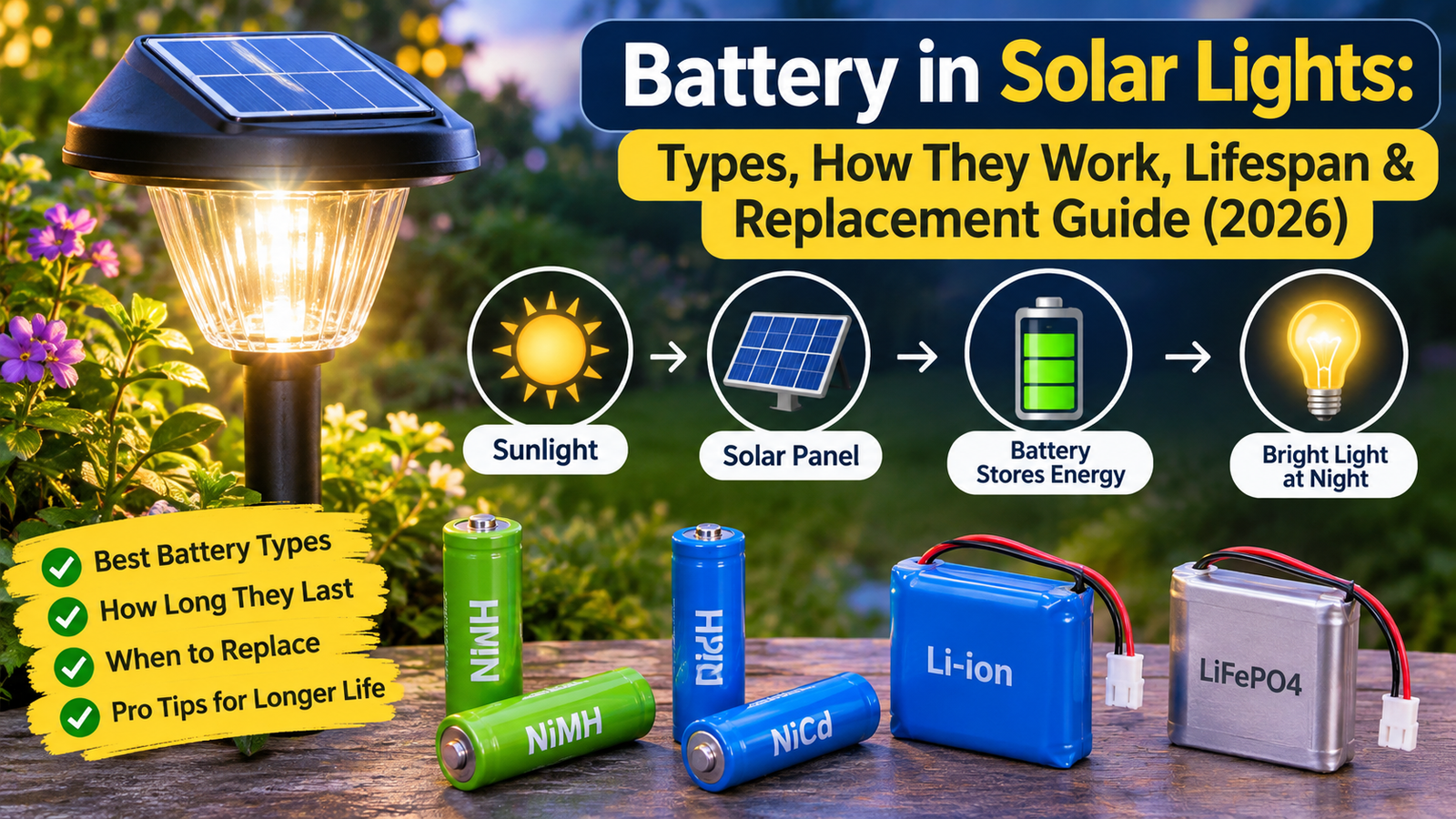
During the day, the solar panel collects sunlight and converts it into electrical energy. The battery stores that energy, and after sunset, the stored power is used to run the LED light.
When a solar light becomes dim, switches off too early or stops working altogether, the battery is often one of the first things worth checking.
This guide explains what battery in solar lights does, which battery types are commonly used, how long they last, how to choose the right replacement and how to make them last longer.
Key Takeaways
- Solar lights normally use rechargeable batteries, not ordinary disposable batteries.
- NiMH batteries are widely used in traditional garden and pathway solar lights.
- NiCd batteries can still be found in older solar lights.
- Li-ion and LiFePO4 batteries are used in some newer solar lighting systems.
- The correct voltage, physical size and battery chemistry matter when replacing a battery.
- A higher mAh rating does not automatically mean a battery is the best choice.
- Solar-light batteries eventually lose capacity because of repeated charging and discharging.
- Cleaning the solar panel and using the correct battery can help improve performance.
What Is the Battery in Solar Lights Used For?
The battery inside a solar light acts as an energy storage device.
A typical solar light has several important components:
- Solar panel
- Rechargeable battery
- LED light
- Charge controller or charging circuit
- Light sensor
- Switch or control system
The solar panel produces electricity during daylight hours. Instead of using all that electricity immediately, the system sends it to the rechargeable battery.
After it gets dark, the solar panel stops producing useful power and the stored energy is released to the LED.
So, in simple terms:
Sunlight → Solar panel → Battery charging → Stored energy → LED light
The battery is therefore what allows a small solar light to continue working after sunset.
How Does a Battery in Solar Lights Work?
The process is fairly straightforward.
During the Day
The solar panel receives sunlight and produces electrical energy. A charging circuit controls how that energy reaches the battery.
During Charging
The rechargeable battery stores the electrical energy chemically. How much it can store depends partly on its capacity, normally expressed in mAh for small batteries.
After Sunset
A light sensor detects that the surrounding area has become dark. The control circuit then switches the LED on.
During the Night
The battery gradually releases its stored energy to power the LED.
The Next Morning
Once sunlight returns, the charging process begins again.
This cycle repeats almost every day, which is why the number of charge cycles and the battery’s quality can have a major effect on its useful life.
What Type of Battery Is Used in Solar Lights?
There isn’t one universal battery for every solar light.
The appropriate type depends on the design of the light, voltage requirements, available space, charging circuit and intended use.
Common rechargeable battery chemistries include:
- NiMH (Nickel-Metal Hydride)
- NiCd (Nickel-Cadmium)
- Lithium-ion (Li-ion)
- LiFePO4 (Lithium Iron Phosphate)
Let’s look at each one.
1. NiMH Batteries
NiMH batteries are among the most common choices for small traditional solar garden lights.
They are available in familiar sizes such as AA and AAA and are relatively easy to replace.
Advantages
- Widely available
- Relatively affordable
- Rechargeable
- Suitable for many small solar lights
- Available in different capacities
Disadvantages
- Capacity can decline over time
- Performance can be affected by temperature
- Not every NiMH battery is suitable for every solar light
For a conventional garden light designed for a rechargeable AA NiMH cell, replacing the old battery with a compatible NiMH battery can be a straightforward solution.
2. NiCd Batteries
Nickel-Cadmium (NiCd) batteries have historically been used in solar lights and other rechargeable applications.
They can tolerate repeated charging and discharging, but they are now less attractive than newer alternatives because of their environmental concerns and battery characteristics.
Older solar lights may still contain NiCd batteries, so you should check the existing battery before purchasing a replacement.
Important: Don’t automatically replace a NiCd battery with another chemistry simply because the new battery has the same physical size. The solar light’s charging circuit must be compatible with the replacement chemistry.
3. Lithium-Ion Batteries
Lithium-ion batteries offer high energy density and can provide a lot of energy relative to their size.
They are used in various modern portable and solar-powered products.
However, Li-ion isn’t automatically a drop-in replacement for NiMH or NiCd.
A lithium battery can have a different voltage and charging requirement, so you should only use one when the solar light is designed for that chemistry.
Li-ion batteries are particularly useful where manufacturers need compact energy storage and higher performance.
4. LiFePO4 Batteries
LiFePO4, or lithium iron phosphate, is another lithium battery chemistry.
It is known for good cycle life and strong thermal characteristics, which makes it attractive for certain outdoor lighting systems.
However, there’s an important point:
Don’t assume a LiFePO4 battery can replace a NiMH battery just because both are rechargeable.
Their voltage and charging requirements can be different.
If your solar light was designed for LiFePO4, it can be an excellent option. If it wasn’t, use the battery chemistry specified by the manufacturer.
Battery Types Compared
| Battery Type | Main Advantage | Potential Drawback | Common Use |
|---|---|---|---|
| NiMH | Affordable and widely available | Capacity declines with age | Garden/pathway lights |
| NiCd | Durable and established technology | Older chemistry with environmental concerns | Older solar lights |
| Li-ion | High energy density | Requires compatible charging system | Modern/portable lights |
| LiFePO4 | Long cycle life and good thermal stability | Can cost more | Higher-performance systems |
The important lesson is that the best battery depends on the solar light, not simply on which battery chemistry sounds most advanced.
What Does mAh Mean on a Solar Light Battery?
One of the most confusing battery specifications is mAh, or milliamp-hours.
For example, you might see batteries labelled:
- 600mAh
- 800mAh
- 1,000mAh
- 1,200mAh
- 1,500mAh
- 2,000mAh
- 2,800mAh
In simple terms, capacity indicates how much electrical charge a battery can store.
A higher mAh rating can potentially provide longer runtime, but it doesn’t mean you should always buy the highest number available.
The solar panel and charging circuit also need to be capable of charging the battery properly.
For example, putting a very high-capacity battery into a small solar light doesn’t automatically turn it into a better light. If the panel produces too little energy, the battery may not receive enough charge during the day.
So think about the whole system:
Solar panel + charging circuit + battery + LED
rather than looking at mAh alone.
Does a Higher mAh Battery Make Solar Lights Brighter?
Not necessarily.
Battery capacity mainly affects how much energy can be stored and potentially how long the light can operate.
Brightness is influenced by other components, including:
- LED power
- LED efficiency
- Battery voltage
- Light’s electronics
- Available stored energy
- Design of the solar panel
A larger battery may help a light run for longer, but it won’t necessarily make the LED brighter.
What Voltage Battery Do Solar Lights Use?
Solar lights can use different battery voltages depending on their design.
Small garden lights commonly use low-voltage rechargeable cells, while larger or more sophisticated lighting systems may use different configurations.
The replacement battery should match the voltage specified by the manufacturer or the original battery.
For example, don’t replace a battery simply because it fits physically.
A battery can have the correct shape but the wrong voltage or chemistry.
That can result in:
- Poor performance
- Charging problems
- Reduced battery life
- Damage to the electronics
- Potential safety problems
Always check the original battery label or manufacturer’s instructions before replacing it.
What Size Battery Do Solar Lights Use?
Small solar lights commonly use familiar battery sizes such as AA or AAA, although other sizes and proprietary battery packs are also used.
Before buying a replacement, check:
Battery size + voltage + chemistry + capacity
All four can matter.
A battery that fits the compartment isn’t necessarily electrically compatible.
How Long Do Solar Light Batteries Last?
The lifespan of a solar-light battery varies considerably.
It depends on:
- Battery chemistry
- Battery quality
- Number of charging cycles
- Temperature
- Depth of discharge
- Solar exposure
- Charging circuit
- How frequently the light operates
- Storage conditions
Instead of expecting every battery to last exactly a certain number of years, it’s better to monitor its performance.
A battery approaching the end of its useful life may show symptoms such as:
- Light becoming noticeably dimmer
- Shorter operating time
- Light switching off earlier
- Battery failing to hold its charge
- Light working poorly even after a sunny day
Some manufacturers publish expected cycle counts, but real-world lifespan can vary.
Why Do Solar Light Batteries Stop Working?
There are several possible reasons.
1. Battery Age
Rechargeable batteries gradually lose their ability to hold energy.
After many charging and discharging cycles, the battery may no longer provide enough power for the entire night.
2. Insufficient Sunlight
A battery can appear to be faulty when the real problem is inadequate charging.
Shade from:
- Trees
- Walls
- Buildings
- Fences
- Overhanging roofs
can reduce solar charging.
3. Dirty Solar Panel
Dust, dirt and other debris can reduce the amount of sunlight reaching the panel.
Cleaning the panel can therefore improve charging performance.
4. Cold or Excessive Heat
Temperature affects battery performance and ageing.
Outdoor batteries are exposed to changing weather conditions throughout the year, so environmental conditions matter when selecting a replacement.
5. Corrosion or Water Damage
If water enters the battery compartment, electrical contacts can corrode.
That can create resistance and prevent the battery from charging properly.
How to Know When to Replace a Solar Light Battery
Replacing the battery is worth considering when the light:
- Works for only a short time
- Becomes dim soon after sunset
- Doesn’t stay on overnight
- Stops charging properly
- Works again temporarily after replacing the battery
- Has an old or visibly damaged rechargeable cell
However, don’t immediately blame the battery.
First check whether the solar panel is receiving enough direct sunlight and whether the panel and contacts are clean.
If the light still performs poorly after these checks, the battery becomes a more likely cause.
How to Replace the Battery in Solar Lights
Replacing a battery is often straightforward.
Step 1: Turn the Light Off
If the light has an ON/OFF switch, turn it off before opening the battery compartment.
Step 2: Find the Battery Compartment
Depending on the design, it may be underneath the solar panel, inside the light body or behind a small cover.
Step 3: Remove the Old Battery
Take a photo of the battery position before removing it.
This helps you remember the correct orientation.
Step 4: Check the Label
Look at:
- Voltage
- Chemistry
- Capacity
- Battery size
Step 5: Buy a Compatible Replacement
Choose a battery that meets the manufacturer’s requirements.
Step 6: Install the New Battery
Insert it with the correct positive and negative orientation.
Step 7: Close the Compartment
Make sure the cover is properly secured, especially for outdoor lights.
Step 8: Test the Light
Place the solar light somewhere it receives good sunlight and allow the new battery to charge according to the manufacturer’s instructions.
Can You Put Any Rechargeable Battery in a Solar Light?
No.
This is one of the biggest mistakes people make.
A solar light isn’t designed to work with every rechargeable battery.
You need to consider:
Chemistry → Voltage → Size → Capacity → Charging compatibility
For example, replacing an original NiMH cell with a lithium battery simply because both batteries physically fit can create a charging mismatch.
If you’re unsure, use the same battery chemistry and specification as the original battery or follow the solar light manufacturer’s instructions.
How to Make Solar Light Batteries Last Longer
You can improve battery performance by looking after the entire solar-light system.
Keep the Solar Panel Clean
Clean dust and dirt from the panel regularly with a soft, damp cloth.
A cleaner panel can capture more sunlight.
Give the Panel Enough Sunlight
Place the light where its panel receives plenty of direct sunlight.
Avoid locations where the panel remains shaded for much of the day.
Don’t Mix Old and New Batteries
If a light uses multiple rechargeable cells, avoid mixing batteries with significantly different ages or capacities unless the manufacturer specifically allows it.
Use the Correct Battery Chemistry
Don’t experiment with different battery chemistries simply to increase capacity.
The charging system needs to be compatible with the battery.
Protect the Battery Compartment
Check seals and covers periodically, particularly after heavy rain.
Moisture can damage electrical contacts and battery connections.
Clean Corroded Contacts Carefully
If you notice corrosion around the battery contacts, clean and inspect the connection before installing a new battery.
If the contacts are badly damaged, replacing the entire light may be more practical.
Solar Light Battery vs Ordinary Battery
This distinction is important.
Solar lights normally need rechargeable batteries.
Ordinary single-use alkaline batteries are designed for disposal after their stored energy is used.
Solar lights, on the other hand, repeatedly charge their battery during the day and discharge it at night.
Using a non-rechargeable battery in a system designed to recharge the battery can be unsafe and may damage the product.
Always follow the battery specification provided with your solar light.
Are Lithium Batteries Better Than NiMH for Solar Lights?
Not automatically.
Lithium-based batteries can provide advantages such as high energy density and, depending on the chemistry and application, longer cycle life.
But NiMH remains a practical choice for many traditional solar garden lights because it is widely available and commonly supported by those designs.
The better question isn’t:
Which battery is the most advanced?
Instead ask:
Which battery is designed to work correctly with my solar light?
That approach will usually lead to a better result.
What Is the Best Battery in Solar Lights?
For a traditional small garden or pathway solar light, a compatible NiMH rechargeable battery is often a sensible replacement when the original system was designed for NiMH.
For a modern light specifically designed around lithium technology, Li-ion or LiFePO4 may be the better option.
So there is no single “best battery in solar lights” for every product.
The best choice is the one that matches:
- The manufacturer’s specification
- Battery chemistry
- Voltage
- Physical size
- Capacity
- Charging system
- Outdoor operating conditions
Frequently Asked Questions
Can I replace a solar light battery myself?
In many small solar lights, yes. The battery compartment is usually designed to allow replacement. Always switch the light off first and follow the manufacturer’s instructions.
How many mAh is best for solar lights?
There isn’t one universal number. Choose a capacity that is compatible with the solar panel and charging circuit. A larger mAh rating isn’t automatically better.
Why do my solar lights only last a few hours?
Possible causes include an ageing battery, insufficient sunlight, a dirty solar panel, cold weather, damaged connections or a faulty charging circuit.
Can I use rechargeable AA batteries in solar lights?
If your solar light is specifically designed for an AA rechargeable battery, yes—but check the required chemistry, voltage and capacity first.
Should I use NiMH or lithium batteries?
Use the chemistry specified by the manufacturer. Lithium batteries shouldn’t be used as automatic replacements for NiMH batteries.
How long should solar lights stay on at night?
Runtime depends on battery capacity, solar charging, LED power, weather and the design of the light. A healthy system should normally provide several hours of illumination after receiving sufficient sunlight.
Do solar light batteries need sunlight?
No. The battery itself does not need sunlight. The solar panel needs sunlight to generate the electricity that charges the battery.
Why are my solar lights dim even after replacing the battery?
Check the solar panel, sunlight exposure, wiring and LED. If the panel isn’t receiving enough sunlight or the charging circuit has a problem, a new battery won’t necessarily solve the issue.
Final Verdict
The battery in solar lights is the hidden component that determines how much stored energy is available after sunset. A good solar panel cannot compensate for an unsuitable, worn-out or incompatible battery.
For the best results, don’t choose a replacement simply by looking at its mAh rating. Check the battery chemistry, voltage, physical size and compatibility with the solar light’s charging system.
For many traditional garden and pathway lights, NiMH remains a practical rechargeable option. Newer systems may use lithium-ion or LiFePO4 technology, but these should only be used when the light is designed to support them.
Finally, remember that battery performance depends on more than the battery itself. Clean the solar panel, provide sufficient sunlight, protect the battery compartment and replace ageing cells when their runtime noticeably declines.
That combination will help your solar lights stay brighter and work more reliably for longer.