Solar batteries are designed to store electricity for years, but they do not keep exactly the same capacity forever. Every lithium-ion battery gradually loses some of its ability to store energy. This process is known as solar battery degradation.
For a homeowner, the important question is not whether degradation happens — it does — but how quickly your battery loses capacity and when that loss becomes significant.
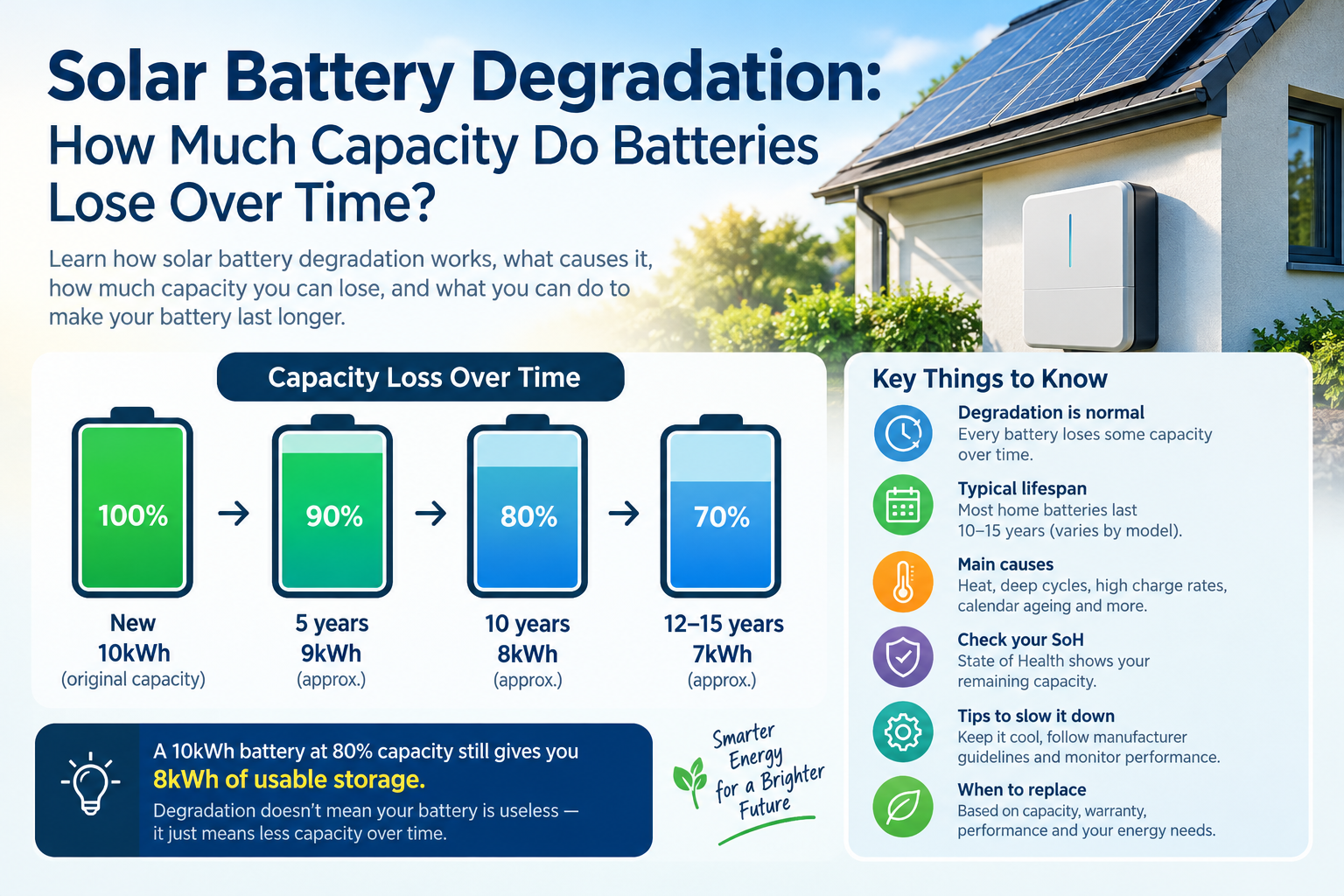
A modern home battery may still be useful after many years even though its maximum capacity has fallen. For example, a 10kWh battery operating at 80% of its original capacity would still have around 8kWh of usable storage.
In this guide, we explain how solar battery degradation works, typical capacity loss, what causes it, how to calculate remaining capacity, and what you can do to slow it down.
Key Takeaways
- Solar battery degradation is normal and happens gradually over time.
- Lithium-ion home batteries commonly provide around 10–15 years of useful service, depending on chemistry, usage and manufacturer specifications.
- Many battery warranties specify a minimum retained capacity, often around 70–80% at a particular time or cycle limit.
- Heat, frequent cycling, high charging rates and prolonged extreme states of charge can accelerate degradation.
- A battery showing lower performance does not always mean it is failing.
- State of Health (SoH) is one of the most useful indicators of battery condition.
- A 10kWh battery at 80% capacity has approximately 8kWh of remaining storage capacity.
- Replacement should be based on battery condition, warranty, energy usage and economics, rather than age alone.
What Is Solar Battery Degradation?
Solar battery degradation is the gradual loss of a battery’s ability to store and deliver the same amount of energy it could when it was new.
Imagine you install a 10kWh home battery.
When new:
10kWh = 100% original capacity
After several years, it might retain 90%:
10kWh × 90% = 9kWh
Later, if it reaches 80%:
10kWh × 80% = 8kWh
The battery has not necessarily “stopped working”. It simply cannot store as much energy as it did when it was new.
This distinction is important because degradation and battery failure are not the same thing.
How Fast Do Solar Batteries Degrade?
There is no single degradation rate that applies to every solar battery.
The actual rate depends on:
- Battery chemistry
- Number of charge and discharge cycles
- Depth of discharge
- Operating temperature
- Charging and discharge power
- State of charge
- Battery Management System
- Installation environment
- Manufacturer and battery model
Some broad estimates suggest around 1–3% capacity loss per year, but real-world performance can vary considerably between models and operating conditions.
This is why you should avoid assuming that every battery will lose exactly the same percentage every year.
A Simple Example
Suppose a 10kWh battery loses capacity gradually:
| Battery Age | Example Remaining Capacity |
|---|---|
| New | 10kWh |
| 5 years | 9–9.5kWh |
| 10 years | 7–9kWh |
| 12–15 years | Depends heavily on model and usage |
These are illustrative examples, not guaranteed degradation figures. Your battery’s manufacturer warranty and monitoring data are more useful than a generic estimate.
Solar Battery Capacity Loss Explained
One of the easiest ways to understand degradation is to look at retained capacity.
Suppose you have a 10kWh solar battery.
If its remaining capacity is:
- 100% = 10kWh
- 90% = 9kWh
- 80% = 8kWh
- 70% = 7kWh
- 60% = 6kWh
So if your battery’s warranty guarantees 70% capacity after a specified period, that does not necessarily mean the battery has failed at that point.
It means the manufacturer is guaranteeing that it should retain at least the stated percentage under the warranty’s conditions.
Many battery warranties use a minimum retained-capacity figure together with a time period, cycle count or energy-throughput limit.
Why Do Solar Batteries Degrade?
There isn’t one single reason.
Battery degradation is the result of several physical and chemical processes occurring inside the cells.
1. Charge and Discharge Cycles
Every time a battery charges and discharges, its internal materials experience a small amount of wear.
One complete cycle generally means using an amount of energy equivalent to the battery’s full usable capacity, although manufacturers may define cycles differently.
The more heavily a battery is cycled, the greater the cumulative wear can become.
However, modern home batteries are specifically designed for regular cycling, so daily use does not automatically mean you are damaging your battery.
2. High Temperature
Heat is one of the biggest factors that can accelerate battery ageing.
A battery operating in a very hot environment can degrade faster because higher temperatures accelerate unwanted chemical reactions inside the cells.
This is particularly relevant to batteries installed in:
- Poorly ventilated spaces
- Very hot lofts
- Uninsulated areas
- Enclosures exposed to excessive heat
The goal is not to keep your battery artificially cold. Instead, it should be installed and operated within the temperature range specified by the manufacturer.
Does Cold Weather Damage Solar Batteries?
Cold temperatures can affect battery performance, but temporary cold-weather performance loss should not automatically be confused with permanent degradation.
When a battery becomes cold, its chemical reactions slow down. This can temporarily reduce the amount of energy it can deliver.
Once the battery returns to a suitable operating temperature, some of that lost performance can return.
This is different from permanent capacity degradation.
A Battery Management System (BMS) can also limit charging or discharging under unsuitable conditions to protect the battery.
3. Depth of Discharge
Depth of discharge (DoD) describes how much of a battery’s available capacity is used.
For example, using 8kWh from a 10kWh usable battery represents an 80% depth of discharge.
Repeatedly pushing a battery through very deep cycles can contribute to greater wear than operating it within a more moderate range.
However, modern home batteries are built to be cycled and their warranties are designed around specified operating conditions.
Do not manually change your battery’s settings simply to reduce degradation without checking the manufacturer’s recommendations.
4. Charging and Discharging Speed
Very high charging or discharge rates can put additional stress on battery cells.
This is why battery systems have maximum charge and discharge power specifications.
A properly configured home battery should operate within the manufacturer’s limits.
If your battery regularly operates at very high power, it is worth checking the manufacturer’s specifications rather than assuming that faster is always better.
5. Calendar Ageing
Battery degradation can happen even when a battery is not being heavily cycled.
This is called calendar ageing.
In simple terms, the battery’s chemistry continues to change with time.
Therefore:
A battery can lose some capacity simply because it is getting older, even if it has not been used heavily.
This is one reason battery lifespan depends on both time and usage.
What Is Battery State of Health (SoH)?
If your solar battery monitoring app shows State of Health (SoH), this is one of the most useful numbers to watch.
SoH generally represents the battery’s current usable capacity compared with its original capacity.
For example:
100% SoH
The battery is operating close to its original capacity.
90% SoH
The battery has lost approximately 10% of its original capacity.
80% SoH
The battery has approximately 80% of its original capacity remaining.
70% SoH
The battery has approximately 70% of its original capacity remaining.
Some battery systems display SoH directly through their monitoring software.
How to Calculate Solar Battery Capacity After Degradation
You can use a simple calculation:
Remaining capacity = Original capacity × SoH percentage
Example 1: 10kWh Battery at 90%
10 × 0.90 = 9kWh
Example 2: 10kWh Battery at 80%
10 × 0.80 = 8kWh
Example 3: 13.5kWh Battery at 70%
13.5 × 0.70 = 9.45kWh
This is useful when comparing an older battery’s current performance with its original specification.
What Does Battery Degradation Mean for Your Energy Bills?
This is where degradation becomes important for homeowners.
Suppose you originally installed a 10kWh battery.
When new, it might store enough energy to cover much of your evening electricity use.
After years of degradation, suppose it can only store 7kWh.
You now have approximately 3kWh less storage capacity than before.
That could mean:
- More electricity purchased from the grid
- Less solar energy stored during the day
- Greater reliance on peak electricity prices
- Potentially lower savings from time-of-use tariffs
A degraded battery does not automatically become uneconomical, but its reduced capacity can gradually reduce the financial benefit it provides.
Solar Battery Degradation vs Solar Panel Degradation
Battery degradation is often confused with solar panel degradation.
They are very different.
Modern solar panels can continue producing electricity for 25–30 years or longer, while home batteries commonly have a shorter useful life.
| Component | Typical Useful Lifespan |
|---|---|
| Solar panels | 25–30+ years |
| Lithium-ion home battery | Around 10–15 years |
| Solar inverter | Often around 10–15 years |
This means a homeowner may replace the battery before replacing the solar panels.
In fact, a battery may need to be replaced more than once during the lifetime of a solar PV system.
Which Battery Chemistry Degrades More Slowly?
Battery chemistry matters.
Most modern residential systems use lithium-based batteries.
Two important chemistries you may encounter are:
LFP — Lithium Iron Phosphate
LFP batteries are increasingly common in home energy storage.
Advantages can include:
- Good cycle life
- Strong thermal stability
- Long service life
- Suitability for frequent cycling
NMC — Nickel Manganese Cobalt
NMC batteries have also been used extensively in energy storage and electric vehicles.
The exact degradation performance depends on the battery design, manufacturer, operating conditions and warranty.
Do not choose a battery based on chemistry alone.
The warranty, usable capacity, cycle rating, efficiency, operating temperature range, monitoring system and installer support all matter.
How Can You Slow Solar Battery Degradation?
You cannot completely stop battery degradation.
But you can avoid conditions that unnecessarily accelerate it.
1. Keep the Battery Within Its Recommended Temperature Range
Avoid exposing the battery to unnecessary heat.
Follow the manufacturer’s installation requirements and ventilation recommendations.
2. Avoid Unnecessary Extreme Settings
Do not repeatedly force the battery to operate outside the manufacturer’s recommended state-of-charge range.
3. Use the Battery as Designed
Daily cycling is normal for a home energy storage system.
You don’t need to avoid using your battery simply because cycling contributes to degradation.
The battery exists to store and use energy.
4. Keep the System Updated
Where supported by the manufacturer, keep the battery management system and related software/firmware up to date.
Updates can improve monitoring, control and system operation.
5. Monitor Battery Performance
Check your solar battery app regularly.
Look for:
- State of Health
- Available capacity
- Charge/discharge behaviour
- Error messages
- Unusual temperature readings
- Sudden changes in performance
A gradual decline is expected.
A sudden and significant drop deserves investigation.
How Do You Know If Your Solar Battery Is Degrading Too Quickly?
A lower battery level does not always mean degradation.
For example, your battery may appear to run out faster because:
- Your household is using more electricity.
- You added an EV charger.
- Winter solar generation is lower.
- Your battery is starting the evening with less charge.
- Your tariff settings changed.
- Your inverter has a problem.
- The battery’s usable capacity has genuinely declined.
This is why you should compare similar conditions before concluding that the battery is degrading.
A battery that previously supplied 8kWh under similar conditions but now consistently supplies substantially less may deserve further investigation.
When Should You Replace a Solar Battery?
Age alone should not determine replacement.
A 10-year-old battery that is still performing well may continue to provide useful service.
On the other hand, a younger battery with unusually rapid capacity loss or a serious fault may need professional attention.
Consider replacement when:
The Battery Has Reached the End of Its Warranty
This is a good point to review its condition and future economics.
Capacity Has Fallen Significantly
If the battery no longer stores enough energy to meet your household’s needs, replacement may make financial sense.
Your Electricity Consumption Has Changed
If you bought a 5kWh battery years ago but now have an EV, heat pump or larger household demand, the problem may be battery sizing, not degradation.
The Battery Develops a Fault
Persistent errors, charging problems or abnormal behaviour should be assessed by a qualified professional.
A Newer Battery Offers Substantially Better Value
Technology changes.
A modern replacement could potentially offer:
- Higher usable capacity
- Better efficiency
- Better monitoring
- Improved tariff integration
- Longer warranty
- Better compatibility with your current energy system
Can You Still Use a Solar Battery After It Has Degraded?
Yes.
A battery does not normally become useless the moment it reaches a particular age.
For example, if a 10kWh battery has 70% retained capacity, it may still have around 7kWh of capacity.
Whether that is sufficient depends on your household consumption and energy goals.
This is why 70% capacity should not automatically be treated as “battery failure.”
It is better to ask:
Is the battery still providing enough usable storage to justify keeping it?
Solar Battery Warranty and Degradation
When comparing batteries, don’t look only at the number of years in the warranty.
Check exactly what the manufacturer guarantees.
A battery warranty may include:
- Product warranty period
- Minimum retained capacity
- Maximum cycle count
- Energy throughput
- Installation requirements
- Operating temperature requirements
- Conditions that can invalidate the warranty
For example, a warranty might specify a certain number of years or a certain number of cycles, depending on which condition is reached first.
Always read the warranty for the specific battery model you’re considering.
Solar Battery Degradation Example
Let’s take a simple household example.
Sarah installs a 10kWh solar battery.
Year 1
Approximate original capacity:
10kWh
Later Years
Suppose monitoring shows that the battery retains:
85% capacity
Calculation:
10 × 0.85 = 8.5kWh
Sarah has lost approximately:
1.5kWh of capacity
The battery is still storing a substantial amount of energy.
Now imagine it eventually reaches:
70%
10 × 0.70 = 7kWh
At that point, Sarah needs to decide whether 7kWh is still enough for her household’s evening consumption.
If it is, she may continue using the battery.
If not, replacing or expanding the system could be worth considering.
Solar Battery Degradation: What Homeowners Should Remember
The most important point is simple:
Solar battery degradation is normal.
Every rechargeable battery gradually loses some capacity. The goal isn’t to prevent degradation completely — that isn’t realistic.
The goal is to:
- Choose a good-quality battery.
- Follow the manufacturer’s installation requirements.
- Keep the battery within its recommended operating conditions.
- Avoid unnecessary overheating.
- Monitor its State of Health.
- Understand the warranty.
- Compare actual performance with expected performance.
- Replace the battery when its reduced capacity no longer makes financial or practical sense.
A battery that has lost some capacity can still be perfectly useful.