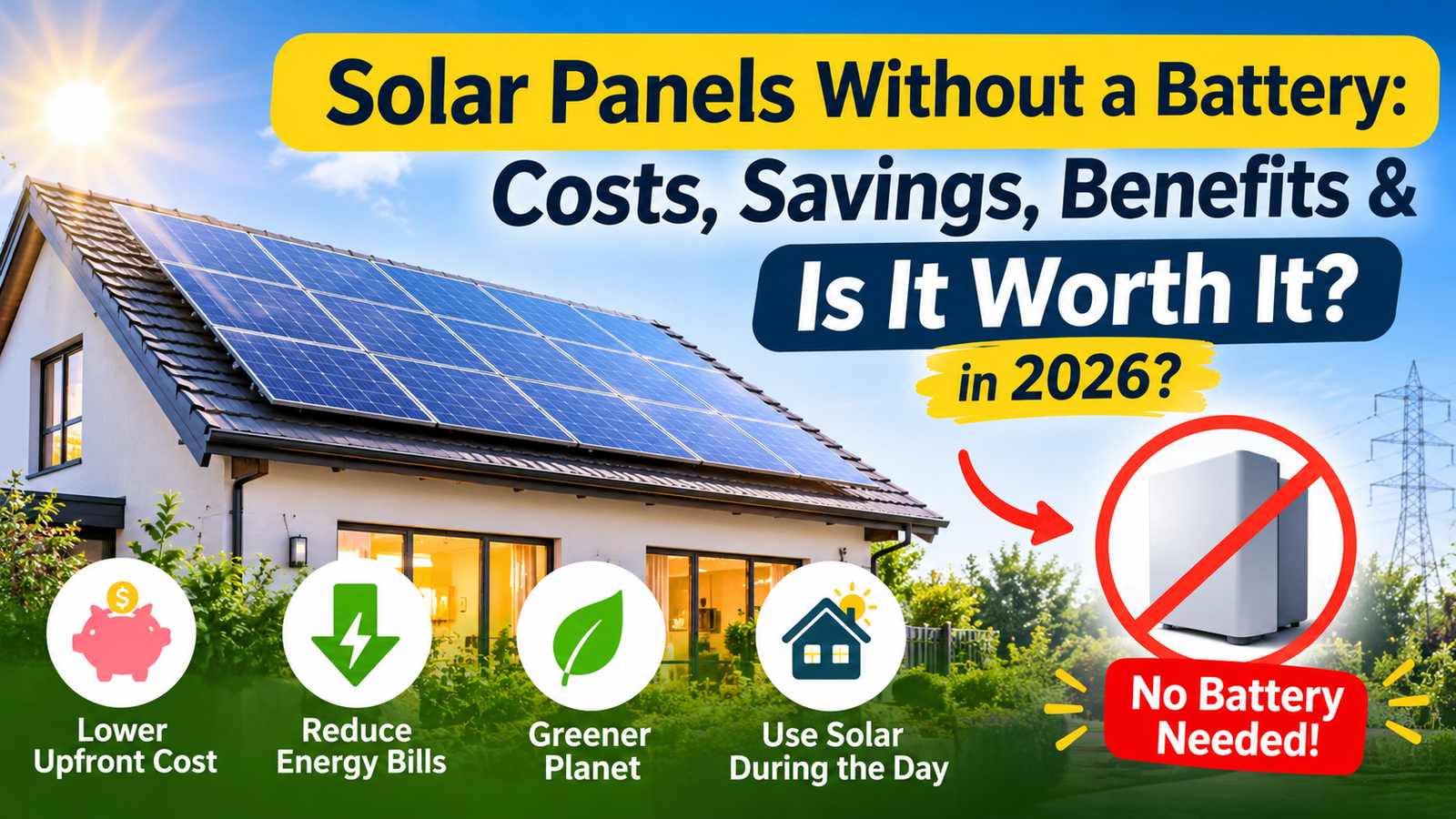
Solar panels and batteries are often advertised as a complete package, but do you really need a battery with solar panels?
The simple answer is no. You can install solar panels without battery storage and still generate electricity, reduce your reliance on the grid and potentially earn money by exporting unused solar energy.
The main difference is what happens to your surplus electricity. Without a battery, electricity that your home does not use immediately can be exported to the grid. With a battery, that surplus can be stored and used later, such as in the evening when your solar panels are no longer producing electricity.
So, are solar panels without a battery still worth it?
For many households, yes. They can offer a lower upfront cost and a simpler system. However, whether solar without a battery is the best financial choice depends heavily on when you use electricity, how much solar energy your home can consume during the day and the export tariff available to you.
This guide explains how solar panels without battery storage work, their costs, potential savings, benefits, disadvantages and when adding a battery could make sense.
Key Takeaways
- Solar panels do not need a battery to generate electricity.
- A battery-free solar system can power appliances while the panels are producing electricity.
- Unused solar electricity can usually be exported to the grid if the system meets the relevant requirements.
- Solar without a battery normally has a lower upfront cost than solar with storage.
- Homes that use lots of electricity during daylight hours can be particularly well suited to solar-only systems.
- The biggest disadvantage is that excess daytime solar cannot be saved for use at night.
- You can often design a solar installation so that a battery can be added later, subject to system compatibility.
- The best option depends on your electricity usage, solar generation, tariffs and budget.
Can You Have Solar Panels Without a Battery?
Yes, absolutely.
A battery is not required for solar panels to generate electricity. A typical grid-connected solar PV system can operate with solar panels, an inverter and the necessary electrical equipment without any battery storage.
During daylight hours, the panels generate electricity. Your home uses that electricity first. If the panels are producing more electricity than your property needs at that moment, the surplus can be exported to the electricity grid.
When solar production is lower than your household demand, electricity can be imported from the grid.
This means your home can operate with a simple pattern:
Solar generation → Home uses electricity → Surplus exported to grid → Grid supplies electricity when solar is insufficient
A battery changes this arrangement by adding another option:
Solar generation → Home uses electricity → Surplus charges battery → Battery supplies home later
This basic difference is important when deciding whether you actually need battery storage.
How Do Solar Panels Without Battery Storage Work?
The process is relatively straightforward.
1. Solar panels generate electricity
Solar panels contain photovoltaic cells that convert sunlight into DC electricity.
The amount of electricity generated changes throughout the day depending on factors such as sunlight, weather, roof orientation, shading and system size.
2. The inverter converts the electricity
Most household appliances use AC electricity, while solar panels generate DC electricity.
The inverter converts the DC electricity into AC electricity that can be used around your home.
The inverter is therefore an essential part of a grid-connected solar system, even when there is no battery.
3. Your home uses the electricity first
If your solar panels are generating 2kW while your home is using 1.5kW, approximately 1.5kW can be used directly by your household.
The remaining generation may be available for export.
This is called self-consumption because you are using your own solar electricity instead of buying the equivalent electricity from the grid.
4. Surplus electricity can be exported
When solar generation is higher than your household’s immediate demand, the excess electricity can be sent to the grid.
Eligible UK households can potentially receive payments through the Smart Export Guarantee (SEG), although rates, eligibility and supplier requirements vary.
5. You use grid electricity when solar isn’t enough
Solar generation falls when the sun goes down and can also be lower during cloudy or winter conditions.
If your home needs more electricity than the panels are producing, the grid supplies the difference.
At night, a solar-only home normally relies on grid electricity because there is no battery storing daytime generation.
What Happens to Excess Solar Energy Without a Battery?
This is one of the biggest differences between solar-only and solar-plus-battery systems.
Imagine your panels generate 4kWh between 12pm and 1pm, but your home only needs 2kWh during that hour.
The remaining 2kWh cannot simply be stored inside the solar panels.
Without a battery, that surplus can be exported to the grid, assuming your system is set up for export.
With a battery, the surplus could instead be stored and potentially used later in the evening.
This is why your daily electricity usage pattern matters so much.
If you are using lots of electricity during the daytime, you may already be consuming a large proportion of your solar generation directly.
If your home is empty during the day and most electricity is used after 6pm, a battery may provide more value because it can shift daytime generation into the evening.
Solar Panels Without Battery: Costs
One of the biggest attractions of a battery-free solar installation is the lower initial cost.
You are paying for the solar PV system without the additional cost of battery storage.
As an example, current UK cost data cited by Sunsave puts solar PV at around £1,622 per kWp, meaning a 4.9kWp installation could be around £8,000 before considering the exact circumstances of the property and installation. Actual quotes can vary considerably depending on roof type, location, system specification, labour and other installation requirements.
Battery costs are additional and can vary according to capacity, brand, inverter arrangement and installation requirements.
That means choosing solar without a battery can make it easier to get started if your main priority is reducing the initial investment.
What affects the cost of solar without a battery?
Your final price can depend on:
- Number and type of solar panels
- Total system capacity
- Roof size and design
- Roof orientation and pitch
- Scaffolding requirements
- Inverter type
- Electrical work
- Installation location
- Monitoring equipment
- DNO requirements
- Installer experience and certification
- Whether future battery compatibility is included in the design
For this reason, avoid choosing an installer based purely on the cheapest headline price.
A slightly more expensive system may provide better equipment, installation quality and upgrade flexibility.
Can Solar Panels Without a Battery Save Money?
Yes.
Solar panels can reduce the amount of electricity you need to buy from the grid even without battery storage.
The key is self-consumption.
Every unit of solar electricity that you use directly can reduce the amount of electricity you would otherwise purchase from your supplier.
For example, if your panels are generating electricity while your washing machine, dishwasher, computer or other appliances are operating, that solar power can be consumed directly.
The more solar electricity you can use at the time it is generated, the less you need to export.
This is particularly important because the value of electricity used in your home can differ from the amount you receive for exported electricity.
Sunsave’s 2026 analysis highlights this difference and shows how a solar-only system can still provide substantial long-term savings, although adding storage can increase the amount of solar electricity used within the home.
How to Increase Savings Without a Solar Battery
If you decide to install solar panels without a battery, you can take several practical steps to increase your self-consumption.
1. Run appliances during daylight hours
Try to use high-energy appliances when your panels are producing the most electricity.
For example:
- Washing machine
- Dishwasher
- Tumble dryer
- Electric oven
- Immersion heater
- Pool equipment
- Other flexible electrical loads
You don’t need to run everything at exactly the same time. The goal is simply to move flexible electricity use towards periods of stronger solar generation.
2. Charge an EV during the day
If you own an electric vehicle, daytime charging can be an excellent way to consume more solar electricity directly.
Instead of exporting a large amount of solar energy during the middle of the day, your EV can use some of that generation.
3. Use timers and smart controls
Timers can help automatically operate certain appliances during daylight hours.
Some smart energy systems can also monitor solar production and household demand, allowing you to make better use of available generation.
4. Monitor your solar production
Your inverter or monitoring system may provide information about:
- Current solar generation
- Daily generation
- Electricity consumption
- Grid imports
- Grid exports
Checking this information can help you identify when your solar panels generate the most electricity.
Solar Panels Without Battery: Main Benefits
There are several reasons why homeowners may choose solar without storage.
Lower upfront cost
The most obvious benefit is that you do not have to pay for battery storage at the beginning.
This can make solar more accessible if your budget is limited.
Simpler installation
A solar-only system has fewer major components than a solar-and-battery installation.
There is no battery capacity to size, battery location to plan or battery charging strategy to configure.
Potentially faster return on initial investment
Because the initial system cost can be lower, you may recover your original solar investment sooner than if you add an expensive battery from day one.
However, this does not automatically mean solar-only will produce the highest total lifetime savings.
A battery may allow more solar electricity to be used within the home and can open additional tariff options.
You can still export surplus electricity
Not using a battery does not mean your excess electricity has no value.
Eligible systems can export surplus generation to the grid and potentially receive SEG payments.
Less equipment to maintain
Without a battery, there is one less major component in the system.
The solar panels and inverter still need appropriate monitoring and maintenance, but there is no battery storage unit to manage.
You can potentially add a battery later
Installing solar first does not necessarily mean you can never install a battery.
A future retrofit may be possible, depending on your inverter, electrical setup, available space and battery compatibility.
If you think you may want a battery later, tell your installer before the original system is designed.
What Are the Disadvantages of Solar Without a Battery?
Solar-only systems are not perfect.
The biggest weakness is simple:
Solar panels produce most of their electricity during the day, while many households use a significant amount of electricity in the evening.
Without storage, you cannot move your own excess solar generation from midday to 8pm.
1. You may export more electricity
If nobody is home during the day, a large percentage of your solar generation may be exported.
You then need to buy electricity from the grid later when your panels are producing little or nothing.
2. No stored solar power at night
Solar panels stop generating electricity after sunset.
Without a battery, your home cannot use stored daytime solar electricity.
You will normally rely on the grid during nighttime hours.
3. Lower self-consumption
A battery can increase the proportion of solar electricity that is used by the household.
Without storage, your self-consumption depends heavily on your lifestyle.
Someone working from home may use much more solar directly than someone who leaves home at 8am and returns at 6pm.
4. No automatic battery backup
A normal grid-connected solar system generally shuts down during a grid outage for safety reasons.
Solar panels alone should not be treated as an emergency backup system.
A battery can provide backup power only when the battery system and electrical installation have been specifically designed to support backup operation.
5. Fewer battery-related tariff opportunities
Some time-of-use and battery-focused energy tariffs are designed around storage.
Without a battery, you may not be able to take advantage of certain battery-specific tariff arrangements.
The availability and terms of these tariffs can change, so always check the current supplier conditions before making a financial decision.
Solar Panels Without Battery vs Solar Panels With Battery
| Feature | Solar Without Battery | Solar With Battery |
|---|---|---|
| Lower upfront cost | ✅ | ❌ |
| Generate solar electricity | ✅ | ✅ |
| Use solar during daytime | ✅ | ✅ |
| Export surplus | ✅ | ✅ |
| Store surplus solar | ❌ | ✅ |
| Use stored solar at night | ❌ | ✅ |
| Backup power | Usually ❌ | Possible with suitable system |
| Installation complexity | Lower | Higher |
| Battery maintenance | Not required | Required |
| Potential for higher self-consumption | Lower | Higher |
| Best for daytime electricity users | ✅ | ✅ |
| Best for heavy evening users | Less suitable | Often more suitable |
There is no universal winner.
The right system depends on how much electricity you generate, when you use electricity and how much you are willing to spend upfront.
Who Should Consider Solar Without a Battery?
Solar-only can be particularly attractive if:
You are home during the day
Working from home or spending more time at home during daylight hours can increase direct solar consumption.
You can shift electricity usage
If you can run appliances or charge an EV while the sun is shining, you can use more of your own electricity.
You have a limited budget
If adding a battery would make the entire solar project too expensive, starting with panels alone can be a sensible approach.
You want to keep the system simple
Some homeowners prefer fewer components and a straightforward solar PV installation.
You may add storage later
Starting with solar and installing a compatible battery later can be an option, although you should discuss future expansion with your installer before the initial system is designed.
JPEC Green Energy similarly highlights daytime usage, working from home and flexible appliance use as situations where solar without a battery can make sense.
Who May Benefit More From a Battery?
A battery becomes more attractive when your electricity consumption does not match your solar generation.
For example, imagine this daily pattern:
Solar generation: High from 10am–3pm
Household usage: Low from 9am–4pm
Household usage: High from 5pm–10pm
This creates a timing problem.
You produce plenty of solar electricity when you don’t need much electricity.
Then, when you need lots of electricity, the sun has already gone down.
A battery can help bridge this gap.
Battery storage may be worth considering if:
- You use most electricity in the evening.
- Your home is empty during the day.
- You regularly export a large amount of solar energy.
- You want to increase self-consumption.
- You own or plan to buy an EV.
- You are interested in certain time-of-use tariffs.
- You want battery backup during suitable grid outages.
- You want to make greater use of your solar generation.
Can You Add a Battery Later?
In many situations, yes.
A homeowner can install solar panels initially and investigate battery storage later.
However, future compatibility should be considered from the beginning.
Your installer may need to consider:
- Existing inverter type
- Hybrid inverter compatibility
- Battery location
- Cable routes
- Consumer unit
- Electrical capacity
- Protection equipment
- DNO requirements
- Future EV charging
- Future heat-pump installation
The exact retrofit method depends on the existing solar installation.
Some systems can be expanded relatively easily, while others may require additional equipment or changes to the inverter arrangement.
EcoFlow’s 2026 guide also notes that AC-coupled storage can be one retrofit approach for existing solar installations, but compatibility and the wider electrical setup should be assessed by a qualified installer.
How to Decide: Solar Only or Solar + Battery?
Before choosing, ask yourself five questions.
Question 1: When do you use electricity?
If most of your consumption happens between 9am and 4pm, solar-only may work well.
If most usage happens after sunset, storage becomes more attractive.
Question 2: How much solar electricity will you consume directly?
A professional installer can estimate your expected generation and household consumption.
The higher your self-consumption, the more valuable a battery-free system can be.
Question 3: How much surplus will you export?
If your system regularly produces more electricity than you can use, a battery could potentially allow you to use more of that generation later.
Question 4: What is your budget?
Don’t choose a battery simply because everyone else has one.
A battery adds cost. You need to compare the additional investment against the extra savings and other benefits it could provide.
Question 5: Do you want backup power?
If backup during a power cut is important to you, you need to consider a battery system specifically designed for backup operation.
Solar panels alone normally cannot provide that function when the grid is down.
Is It Worth Getting Solar Panels Without a Battery?
Yes, solar panels without a battery can still be worth it.
The important point is that “worth it” depends on your circumstances.
A solar-only system can provide a lower-cost way to generate renewable electricity and reduce grid purchases. It can be especially appealing when a household uses plenty of electricity during daylight hours.
However, a battery can improve the usefulness of solar generation for households that consume most of their electricity in the evening.
So the decision should not simply be:
Solar = good / no battery = bad
Instead, think about the relationship between generation, consumption, export payments and system cost.
For some homeowners, solar-only will provide the best balance between upfront cost and savings.
For others, paying more for battery storage may make sense because they can use much more of their solar electricity after sunset.
Current 2026 comparisons from UK solar sources show that solar-only systems can still deliver meaningful savings, while battery systems can increase self-consumption and potentially improve overall returns depending on tariffs and usage patterns.
Final Verdict
Solar panels without battery storage are still a viable option in 2026.
You don’t need a battery for solar panels to work. Your panels can generate electricity during daylight, your home can use that electricity directly, and surplus generation can potentially be exported to the grid.
The biggest limitation is timing.
Without a battery, you cannot save your unused midday solar electricity for the evening. This can be a major disadvantage if your household uses most of its electricity after sunset.
On the other hand, solar without a battery can offer:
- Lower upfront cost
- A simpler installation
- Reduced grid electricity use
- Potential export income
- Less equipment to maintain
- The possibility of adding storage later
The best choice is therefore based on your electricity habits rather than simply whether batteries are popular.
If you work from home, use appliances during the day, charge an EV while the sun is shining or have a limited installation budget, solar panels without a battery could be an excellent starting point.
If your electricity usage is heavily concentrated in the evening and you regularly export large amounts of solar power, a battery may provide additional value.
Before making a decision, compare the expected solar generation, daytime consumption, export tariff, battery cost and potential long-term savings rather than focusing only on the initial installation price.
Frequently Asked Questions
Can solar panels work without a battery?
Yes. Solar panels can generate electricity and power household appliances without battery storage. Surplus electricity can potentially be exported to the grid.
Do solar panels without a battery work at night?
No. Solar panels need sunlight to generate electricity. Without a battery, your home normally uses electricity from the grid after solar generation stops.
Is solar without a battery cheaper?
Usually, yes. Removing the battery reduces the upfront equipment and installation cost, although the final price depends on the complete system.
Can I sell excess solar electricity without a battery?
Yes, eligible solar installations can potentially export surplus electricity and receive SEG payments. The exact tariff and eligibility requirements depend on the supplier and system.
Can I add a battery to solar panels later?
Often, yes, but it depends on your existing inverter, electrical installation and battery compatibility. If you may want storage later, plan for that possibility when installing solar.
Is solar without a battery better than solar with a battery?
Neither option is automatically better. Solar-only can be attractive because of its lower upfront cost, while solar plus battery can provide greater self-consumption and evening use of solar electricity.
What is the biggest disadvantage of solar panels without a battery?
The main disadvantage is that excess electricity generated during the day cannot be stored for use at night. This can increase your reliance on grid electricity during evening hours.
Should I install a battery at the same time as solar panels?
It depends on your budget, electricity consumption pattern, export tariff and future plans. A battery is more attractive when you have substantial daytime surplus and high evening electricity demand.