
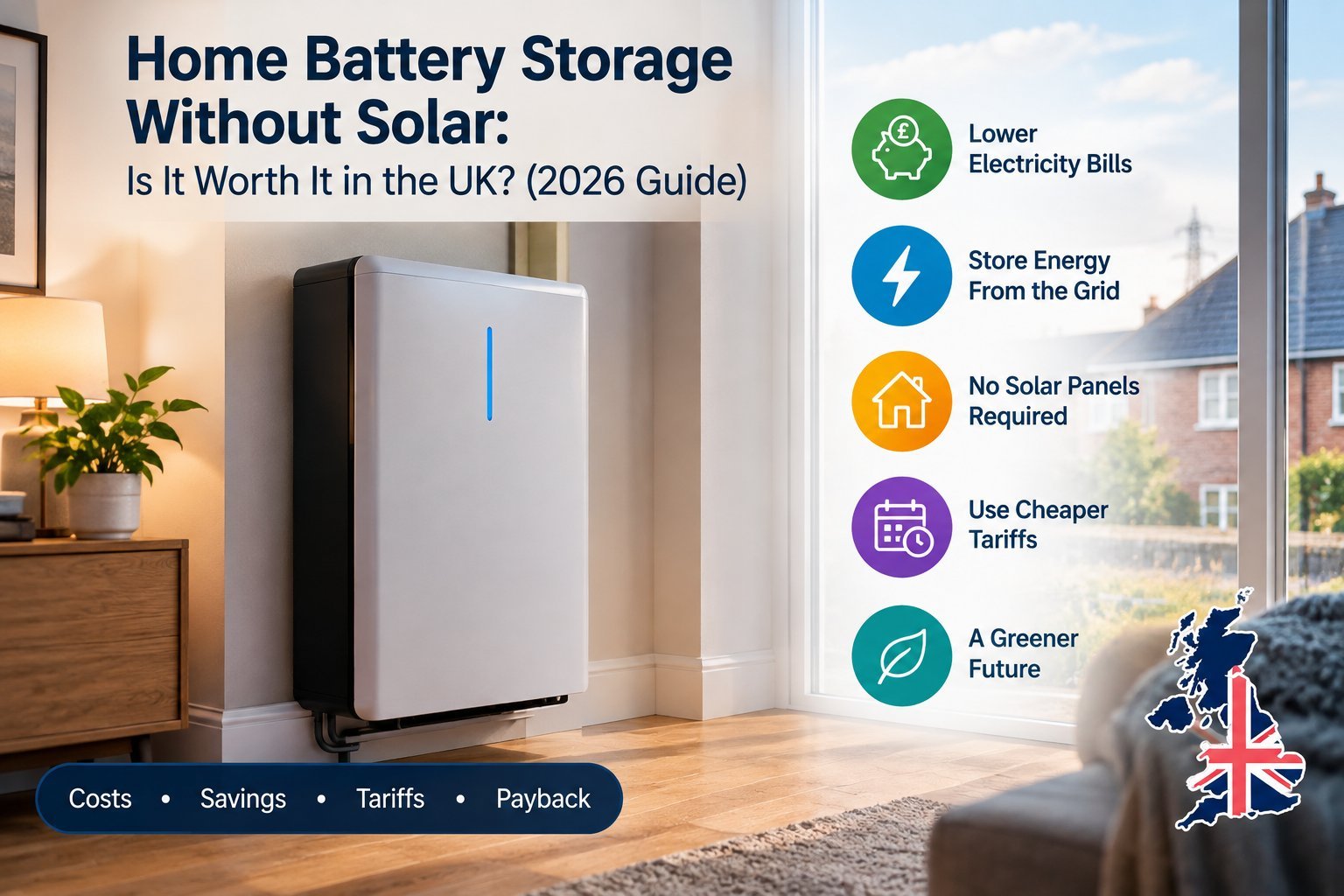
Electricity bills are a major expense for many UK households. With energy prices changing, homeowners are looking for ways to reduce their electricity costs. Solar panels are a popular solution, but they are not suitable for every property. Some homes have unsuitable roofs, limited space or restrictions that make solar panel installation difficult.
However, there is another option: home battery storage without solar.
A standalone home battery allows you to store electricity purchased from the grid and use it later. For example, you can charge your battery overnight when electricity is cheaper and use the stored energy during the day or evening when prices are higher.
This approach is known as energy tariff arbitrage. It can help you reduce your electricity bills if the difference between cheap and expensive electricity rates is large enough.
But is installing a home battery without solar panels worth the investment in the UK in 2026? How much does it cost? How much can you save? And how long will it take to recover your investment?
In this guide, we explain how standalone home batteries work, their costs, potential savings, suitable electricity tariffs, advantages and disadvantages. We will also help you understand whether a battery-only system is suitable for your home.
What Is Home Battery Storage Without Solar?
Home battery storage without solar is a system that stores electricity purchased from the national grid instead of electricity generated by solar panels.
A traditional solar battery stores excess electricity produced by solar panels during the day. However, a standalone battery works differently. It charges using electricity from your energy supplier and stores it for later use.
For example, imagine your electricity supplier offers a cheaper rate overnight. You can charge your battery during those hours and use the stored electricity when your household needs it later.
A typical standalone battery system includes:
- Battery: Stores electricity for later use.
- Inverter: Converts electricity into the form required by your home and battery.
- Battery management system: Monitors battery performance and helps protect it.
- Energy monitoring system: Allows you to track charging, discharging and electricity usage.
Some systems have a separate inverter, while others use an integrated design.
The main purpose of a standalone battery is to buy electricity when it is cheaper and use it when prices are higher. However, the financial benefits depend on your electricity tariff, battery efficiency and household consumption.
How Does a Home Battery Work Without Solar Panels?
A home battery without solar panels works by storing electricity purchased from the grid. You can then use the stored electricity instead of buying it directly from your supplier during expensive periods.
The process is simple:
- Buy electricity: Your battery takes electricity from the grid during cheaper hours.
- Store energy: The battery stores the electricity for later use.
- Use stored electricity: When electricity prices increase, your battery supplies power to your home.
- Reduce grid consumption: Your home buys less electricity during those expensive periods.
Example of Charging a Home Battery Overnight
Let’s consider a simple example. Suppose your electricity tariff offers an overnight rate of 8p per kWh and a daytime rate of 26p per kWh.
You charge your battery with 10kWh of electricity overnight. However, because of energy losses, you cannot use the entire amount later. If the battery has 90% round-trip efficiency, approximately 9kWh will be available for your home.
| Description | Amount |
|---|---|
| Electricity purchased overnight | 10kWh |
| Overnight electricity rate | 8p/kWh |
| Total charging cost | £0.80 |
| Usable electricity after losses | 9kWh |
| Daytime electricity rate | 26p/kWh |
| Cost of buying 9kWh during the day | £2.34 |
| Potential saving per cycle | £1.54 |
In this example, you could save approximately £1.54 per full battery cycle.
If you achieved the same saving every day, the theoretical annual saving would be around £562. However, this is only an illustration. Actual savings may be lower because of battery degradation, tariff changes, installation costs and days when the battery is not fully used.
The important point is that a battery does not produce free electricity. It helps you use electricity purchased at a cheaper rate.
Home Battery Storage Without Solar: UK Costs in 2026
The cost of installing a home battery without solar panels depends on several factors, including battery capacity, brand, inverter requirements and installation complexity.
A smaller battery usually costs less, while larger systems can store more electricity but require a higher initial investment.
The following table provides broad indicative installation costs for different battery sizes.
| Battery capacity | Estimated installed cost |
|---|---|
| 5kWh | £3,000–£4,500 |
| 7–10kWh | £4,000–£6,500 |
| 13.5kWh | £7,000–£10,500 |
| Larger modular systems | £8,000+ |
These are indicative price ranges, not guaranteed quotations. Actual prices depend on the equipment, property and installer.
What Affects Home Battery Installation Costs?
Several factors can influence the final installation price.
Battery capacity: Larger batteries generally cost more because they store more electricity.
Battery brand: Different manufacturers offer different features, warranties and performance specifications.
Inverter requirements: Some batteries require a separate inverter, which can increase the total cost.
Installation complexity: Electrical upgrades, cable requirements and the location of the battery may affect labour costs.
Additional features: Monitoring systems, backup power equipment and smart controls can add to the price.
When comparing installation quotes, check whether the price includes the battery, inverter, electrical work, commissioning and any additional equipment.
Is There VAT on Home Battery Storage in the UK?
Qualifying domestic battery storage installations in Great Britain currently benefit from a 0% VAT rate. This can apply to standalone batteries that store electricity from the grid, subject to the relevant conditions.
The temporary zero rate is scheduled to end on 31 March 2027. Before installation, check the latest GOV.UK VAT guidance and confirm how it applies to your project.
Can You Save Money With a Home Battery Without Solar?
Yes, a standalone battery can reduce electricity bills, but savings are not guaranteed.
The main way to save money is to charge the battery when electricity is cheap and use the stored energy when electricity is more expensive.
For example, a household with a suitable overnight tariff may charge its battery at a lower rate and use the stored electricity during the evening. This can reduce the amount of electricity purchased at the higher daytime rate.
However, the difference between the two rates must be large enough to cover battery losses and other costs.
What Affects Your Home Battery Savings?
1. Electricity price difference
The difference between your off-peak and peak electricity rates is one of the most important factors. A larger difference can create more opportunities for savings.
2. Battery efficiency
Some electricity is lost during charging and discharging. Therefore, you need to purchase more electricity than the amount you can eventually use.
3. Battery capacity
A battery that is too small may not cover enough of your household’s expensive-period electricity use. A battery that is too large may not be fully used.
4. Household electricity consumption
Your potential savings depend on how much electricity you use when prices are high. A household with substantial evening consumption may have more opportunities to benefit.
5. Battery degradation
Battery capacity gradually decreases with age and use. This can affect how much electricity the system can store and deliver over time.
Best Electricity Tariffs for Home Battery Storage Without Solar
Choosing the right electricity tariff is essential if you want to make the most of a standalone battery.
Some UK energy suppliers offer tariffs with cheaper electricity at certain times. These tariffs can allow you to charge your battery when prices are lower and use stored energy when prices increase.
However, not every tariff is suitable for every battery. You should check the current rates, eligibility rules and compatibility before switching.
Time-of-Use Electricity Tariffs
A time-of-use tariff charges different electricity rates at different times of the day.
For example, your supplier might offer a cheaper rate overnight and a higher rate during the evening. A compatible battery can charge during the cheaper period and supply your home later.
This can be useful for households that can schedule their battery charging automatically.
Economy 7 Electricity Tariff
Economy 7 is a type of electricity tariff that provides a cheaper rate for a set number of overnight hours.
A home battery may be able to charge during this period and provide electricity during the day. However, Economy 7 tariffs can also have higher daytime rates.
Before choosing one, compare the overnight rate, daytime rate and standing charge with your current tariff.
Octopus Energy Smart Tariffs
Octopus Energy offers smart electricity tariffs that may be relevant to households with batteries. Some tariffs provide cheaper electricity during specific periods, while others have prices that change according to market conditions.
Explore the supplier’s smart tariffs and check which options are currently available for your battery.
Not every smart tariff will suit every household. Always check eligibility, charging arrangements and the full electricity rates before making a decision.
Is a Smart Tariff Always Cheaper?
No. A smart tariff is not automatically cheaper for every household.
Your savings depend on when you use electricity, when your battery charges and how much you pay during expensive periods.
Before switching, compare:
- Off-peak electricity rates
- Peak electricity rates
- Cheap charging hours
- Daily standing charges
- Battery compatibility
- Smart meter requirements
A tariff that works well for one household may not be suitable for another.
How Much Can a Home Battery Save Per Year?
The annual savings from a home battery without solar depend on the tariff, battery size, electricity consumption and charging schedule.
To understand the potential, consider a simple example using a 10kWh battery.
Suppose you buy 10kWh at 8p per kWh and receive 9kWh of usable electricity after losses. If you use that electricity instead of buying it at 26p per kWh, the difference is £1.54 per cycle.
If the battery completes one full cycle every day, the theoretical annual saving would be approximately £562.
This is not a guaranteed saving or a typical result for every UK home. Actual savings can be lower if your battery is not fully used, the price difference changes or the system has additional costs.
Why Might Your Savings Be Lower?
Your battery may not be able to charge fully every day. You may also use less electricity during expensive periods than expected.
In addition, battery efficiency means some electricity is lost, and the battery’s capacity may decrease over time.
For this reason, use your own electricity consumption and actual tariff rates when estimating savings.
What Size Home Battery Do You Need Without Solar?
Choosing the right battery capacity is important. A battery that is too small may not store enough electricity for your needs, while a large battery may cost more than you can reasonably recover through savings.
Battery capacity is measured in kilowatt-hours (kWh). It represents how much energy the battery can store.
Here are some general examples of battery sizes and their possible uses.
| Battery capacity | Possible household use |
|---|---|
| 5kWh | Smaller households or limited evening usage |
| 7kWh | Homes with moderate electricity needs |
| 10kWh | Homes with higher evening consumption |
| 13.5kWh | Households with greater storage requirements |
| 15kWh+ | Larger homes with substantial electricity demand |
These examples are not fixed recommendations. The right size depends on your electricity use and the battery’s usable capacity.
How to Choose the Right Battery Capacity
Start by checking your electricity bills and smart meter data. Look at how much electricity your household uses during expensive periods.
Next, consider how much of that electricity a battery could realistically supply. You should also check the battery’s maximum charging and discharging power.
Before buying, ask your installer about:
- Usable battery capacity
- Maximum charging and discharging power
- Round-trip efficiency
- Warranty period
- Expected battery lifespan
- Compatibility with your electricity tariff
- Possibility of adding more capacity later
Choosing a battery based on actual usage can help avoid paying for storage capacity that you rarely use.
Benefits of Home Battery Storage Without Solar Panels
A standalone battery can offer several benefits, especially if your electricity supplier offers suitable off-peak rates.
1. Reduce Electricity Bills
The main advantage is the potential to reduce electricity bills by charging at cheaper times and using stored electricity when prices are higher.
However, savings depend on the tariff and how effectively you use the battery.
2. No Solar Panels Required
You do not need a suitable roof or solar panels to install a standalone battery.
This can make battery storage an option for some households that cannot install solar panels because of roof conditions, limited space or property restrictions.
3. Better Control Over Electricity Use
A battery can help you shift some of your electricity consumption away from expensive periods.
With a compatible system, charging and discharging can be automated according to your tariff.
4. Potential Backup Power
Some home batteries can provide electricity during a power cut. However, backup power is not available on every system.
Some systems require additional equipment and may only support selected circuits. Check with your installer which appliances could continue operating during an outage.
5. Possible Future Solar Installation
If you plan to install solar panels later, some standalone batteries can be integrated with a solar system.
However, compatibility depends on the battery, inverter and proposed solar installation. Ask your installer about future expansion before purchasing.
Disadvantages of Home Battery Storage Without Solar
Although standalone batteries can be useful, they also have some disadvantages that you should consider before investing.
1. High Upfront Cost
A home battery can cost several thousand pounds, including installation.
Even if it reduces your electricity bills, you need to calculate whether the savings are sufficient to recover the initial cost.
2. No Free Electricity Generation
Unlike solar panels, a standalone battery does not generate electricity.
You must purchase the electricity that you store. Your potential savings come from the difference between electricity prices rather than from generating your own energy.
3. Dependence on Electricity Tariffs
The financial benefit depends heavily on the tariff you choose.
If cheaper electricity rates increase or the difference between peak and off-peak rates becomes smaller, your savings may decrease.
4. Energy Losses
A battery does not return all the electricity used to charge it. Some energy is lost during charging and discharging.
These losses reduce the amount of money you can save.
5. Battery Degradation
Battery capacity gradually decreases over time. The rate of degradation depends on the battery model, operating conditions and usage.
Eventually, the battery may need replacing. You should consider its warranty and expected lifespan when calculating the total cost.
Home Battery Storage Without Solar vs Solar Battery Storage
A standalone battery and a solar battery can look similar, but they work differently because they have different electricity sources.
| Feature | Battery without solar | Solar battery system |
|---|---|---|
| Electricity source | Grid | Solar panels and potentially grid |
| Stores electricity | Yes | Yes |
| Generates electricity | No | Solar panels generate electricity |
| Can charge from the grid | Usually, if compatible | Often, if compatible |
| Potential bill savings | Depends on tariff differences | Depends on solar generation, usage and tariff |
| Export income | Not from grid-charged electricity alone | May be possible for eligible solar exports |
| Suitable for homes without suitable roofs | Yes | No, if panels cannot be installed |
| Initial cost | Battery and installation | Solar panels, battery and installation |
A solar battery can store electricity generated by solar panels, which may reduce the amount of electricity you need to purchase from your supplier.
A standalone battery relies on buying electricity at a lower rate and using it later.
For some households, combining solar panels and battery storage may offer more ways to reduce electricity bills. For others, a standalone battery may be easier to install. The financial benefits depend on the property’s circumstances.
Is Home Battery Storage Without Solar Worth It in 2026?
A home battery without solar may be worth considering if you have access to a suitable time-of-use tariff and regularly use electricity during expensive periods.
However, it may not be financially attractive if you have a flat-rate tariff, low electricity consumption or a high installation quote.
Before investing, calculate your likely annual savings and compare them with the total installation cost. You should also consider battery degradation and the possibility that electricity tariffs may change.
Home Battery Payback Period
The payback period is the time it takes for your savings to recover the initial investment.
For example, imagine you pay £5,000 for a battery system and save £500 per year.
| Item | Amount |
|---|---|
| Installation cost | £5,000 |
| Estimated annual savings | £500 |
| Simple payback period | 10 years |
The calculation is:
£5,000 ÷ £500 = 10 years
This is a simple example. It does not account for maintenance, battery degradation, changes in electricity prices or the time value of money.
If the same battery saves only £250 per year, the simple payback period would be 20 years. That may be longer than the battery’s useful lifespan.
For this reason, do not rely only on advertised savings. Ask for a realistic estimate based on your own electricity usage and tariff.
Who Should Consider a Home Battery Without Solar?
A standalone battery may be worth investigating if:
- You have access to a time-of-use tariff with a meaningful price difference.
- You use a substantial amount of electricity during expensive periods.
- Your home has suitable space for battery installation.
- You expect to stay in your property for several years.
- Your installer can provide a clear estimate of potential savings.
- You want to explore battery storage without installing solar panels.
It may be less suitable if you have a flat-rate tariff, very low electricity consumption or no access to cheaper charging periods.
How to Install Home Battery Storage Without Solar
Installing a home battery requires electrical work and should be completed by a qualified professional.
Here are the main steps to consider before installation.
Step 1: Check Your Electricity Tariff
Review your current electricity tariff and compare it with available time-of-use options.
Check whether your supplier supports the battery you are considering and whether any smart meter requirements apply.
Step 2: Review Your Electricity Usage
Use your electricity bills or smart meter data to understand how much electricity you use during peak and off-peak periods.
This information can help you estimate how much electricity a battery could realistically replace.
Step 3: Compare Battery Systems
Compare different battery models based on capacity, efficiency, power output, warranty and compatibility.
Do not choose a battery based on capacity alone. A system with suitable charging and discharging power may be more useful for your household.
Step 4: Get Installation Quotes
Ask experienced battery installers for detailed quotations.
Compare the equipment, installation work, warranty, commissioning and any additional costs. It is sensible to obtain more than one quote before making a decision.
Step 5: Check the Installation Location
Your installer should assess where the battery can safely be installed.
The location depends on the manufacturer’s requirements, electrical setup, access and ventilation.
Step 6: Set Up Battery Charging
After installation, configure the battery to charge during cheaper periods and discharge when electricity prices are higher, if your system supports this.
Make sure you understand how to monitor the battery and adjust its settings.
Frequently Asked Questions About Home Battery Storage Without Solar
Can I install a home battery without solar panels?
Yes. A standalone home battery can charge directly from the electricity grid. You do not need solar panels to install one.
Can a home battery without solar reduce electricity bills?
Yes. It can reduce bills if you charge the battery when electricity is cheap and use the stored energy when electricity is more expensive. The amount you save depends on your tariff, battery efficiency and household consumption.
Can I charge a home battery from the grid?
Yes. Many home battery systems can charge directly from the grid. However, you should check the product specifications and make sure it is compatible with your electricity tariff.
Can a home battery power my house during a power cut?
Some home batteries offer backup power, but not all systems do. Backup functionality may require additional equipment and may only support selected circuits.
How long does a home battery last?
A home battery’s lifespan depends on its model, usage and operating conditions. Many systems are designed to operate for around 10 years or longer. Check the manufacturer’s warranty and performance guarantees before buying.
Do I need a smart meter for a home battery?
A smart meter is often useful for accessing time-of-use tariffs and monitoring electricity use. Whether it is required depends on your supplier’s tariff and the battery system.
Can I add solar panels to my battery later?
Some standalone batteries can be integrated with solar panels later, but compatibility is not guaranteed. Ask your installer whether the system can be expanded before purchasing.
Does a battery without solar qualify for the Smart Export Guarantee?
A battery that only stores electricity purchased from the grid does not generate electricity to export. If you later add eligible solar panels, you may be able to export surplus solar electricity under a suitable tariff, subject to the supplier’s requirements.
Final Verdict: Is Home Battery Storage Without Solar Worth It?
Home battery storage without solar can be useful, but it is not automatically a money-saving investment.
Its value depends on the electricity tariff, battery efficiency, household consumption and installation cost.
If you can charge your battery at a low rate and use the stored electricity when prices are higher, you may be able to reduce your electricity bills. However, energy losses, battery degradation and the upfront cost can reduce the financial benefit.
Before buying, compare installation quotes, check your electricity tariff and calculate the payback period using realistic savings. If the numbers do not work for your household, you may prefer to wait or explore solar and battery storage together.
The most important thing is to choose a system that fits your electricity usage, property and budget rather than relying on advertised savings alone.
Further Reading
- Energy Saving Trust: Battery Storage
- GOV.UK: VAT on Energy-Saving Materials
- Ofgem: UK Energy Regulator
- Octopus Energy: Smart Tariffs
Editorial note: Prices and tariff examples are illustrative. Confirm current rates, installation costs, VAT eligibility and product compatibility before making a purchase.



Great platform for combining football betting with casino games in one place. The odds are competitive and I have never faced any issues with my transactions. The customer care team actually listens and solves problems fast. I recommend it to anyone who wants a unified sports and gaming experience. ngturkeybet